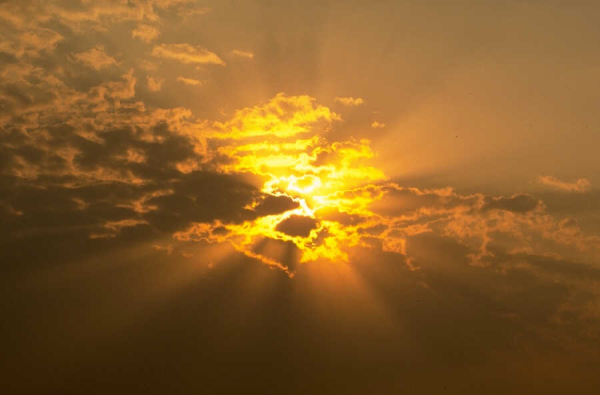
Divine Light and Cloud in the Bible
Article written by Clare Merry in June 1994, expanded in March 2025
KEY QUESTIONS
- Can you see divine light?
- What was the nature of the cloud in the Old Testament?
- When did the cloud reappear in the New Testament?
- Did the energy of the Resurrection consist of light?
1. Introduction
In 1994 I set myself the task of finding all the references to light in the Bible with the help of a concordance. I wanted to see what would emerge from looking at this theme in the Bible as a whole. I found it very enlightening and wrote up my article. I sent the first draft of my article to a priest to get advice. I was going to the parish church in the place where I lived in Chile at the time – the parish church was a Catholic church.
The priest very kindly wrote me a reply in November 1994. He told me that I had to find out what scholars have written about light in the Bible. He said that I was giving a spiritual answer to a scholarly question. Thus, I set about reading the notes at the bottom of the page in various Bibles and Bible commentaries.
I quickly found a lot of prophetless or profitless Bible scholarship. Any event in the Old Testament was deemed to have not taken place in the way described, or at all, and at any rate any foreseeing of it happening was re-dated to after the event had taken place, which maybe it hadn’t, with the author of the book reassigned to various committees of Bible authors known by acronyms! The ways of discrediting the Bible are very clever and ingenious. The rest of the faithful who read the Bible are apparently plain stupid.
I soon asked myself the question: is it worth wasting my time studying this profitless / prophetless academic tradition – illustrious as these scholars may be? What could any of them possibly have to say about light?
Today there are two types of writing about the Bible:
- Scholarly, clever discourses designed to disprove the authenticity of the Bible, ironically in the name of truth.
- Spiritual meditations on the Bible – taken as just a personal opinion. These are assumed to have a meaning quite separate from what the text really says and from what really happened.
My writing does not fit into either of the above categories.
I decided to study in order to make clear statements about what I believe and why I believe it, and quote from the Bible to support and illustrate my arguments.
My arguments are not simple opinions or poetic metaphors, they are a search for truth. This set the tone for the next 30 years of my writing; it became what I do.
Jesus did not want to put his ‘new wine in old wineskins.’ I don’t want to put my message into scholarly sclerosis. Let the dead bury the dead!
The manifestation of God both in history and in our lives is inseparable from real events. That is to say events which took place, things that were seen and experienced. The Bible is not just a metaphor; symbols of faith are often grounded in reality. Is the meaning more important than miracle? The meaning comes from miracle in the Bible.
Fundamentally, I believe that the spiritual and the phyical cannot be separated
For example, the meaning of my life cannot be separated from the events in my life.
The revelation of God cannot be separated from the historical events of the people of Israel.
I’ve returned to my article on light after 30 years as I am publishing articles on my website: merry and true.com
I have again searched all through the Bible for references to light, from the first day of creation in Genesis to the New Jerusalem of Revelation; from the pillar of cloud that led the Israelites out of Egypt to the Promised Land which came to rest in the Holy of holies of the first temple to light manifested in the life of Jesus.
- Is light in the Bible symbolic or was it visible when it appeared?
- What did the appearance of divine light signify?
- Are there references to divine light that have been over-looked?
- Was divine light created or uncreated?
- If God’s light is unapproachable, what wavelength would it have?
2. Genesis and Revelation
In the opening phrases of the Bible God created light:
“And God said, ‘Let there be light’ and there was light. God saw that the light was good, and he separated the light from darkness. God called the light ‘day’ and darkness he called ‘night’. And there was evening, and there was morning – the first day.” (Genesis 1:3-5)
This account of creation is not written like a scientific treatise, even so it is surprising to find that the Sun and the Moon were created on the fourth day.
“And God said, ‘Let there be lights in the expanse of the sky to separate the day from the night, and let them serve as signs to mark the seasons and days and years, and let them be lights in the expanse of the sky to give light on the earth.’ And it was so. God made two great lights – the greater light to govern the day and the lesser light to govern the night. He also made the stars. God set them in the expanse of the sky to give light on the earth, to govern the day and night, and to separate light from darkness. And God saw that it was good. And there was evening, and there was morning – the fourth day.” (Genesis 1:14-19)
Reading the account of creation in Genesis we see that light was created on the first day and the Sun was created on the fourth day. This discrepancy is very confusing, since you don’t need a degree in science to know that light comes from the Sun; the Sun and light must have come into existence simultaneously. How could the writer of Genesis make such an obvious mistake?
This question remained unanswered in my mind, until I happened to read the last chapter of the Bible: Revelation chapter 22. The last chapter in the Bible contains the key to understanding the first chapter – I exclaimed to myself. This is what it says:
“There will be no more night. They will not need the light of a lamp or the light of the sun, for the Lord God will give them light.” (Revelation 22:5)
Also: “The city does not need the Sun or the Moon to shine on it, for the glory of God gives it light, and the Lamb is its lamp.” (Rev. 21:23)
The prophet Isaiah foresaw the same thing. Writing of the future glory of Zion:
“The Sun will no more be your light by day, nor will the brightness of the Moon shine on you, for the Lord will be your everlasting light, and your God will be your glory. Your Sun will never set again, and your Moon will wane no more; the Lord will be your everlasting light, and your days of sorrow will end.” (Isaiah 60:19-20)
Again, Zachariah speaks about the ‘unique day’ on the Day of the Lord:
“On that day there will be no light, no cold or frost. It will be a unique day, without daytime or night time – a day known to the Lord. When evening comes, there will be light.” (Zach 14:6-7)
For the life to come, therefore, the Bible speaks of another kind of light which is not sunlight. This fired me up to search for light in the Bible to clarify the issue. Are there other references in the Bible to light which is not sunlight?
3. Light as Symbol
The use of light as a metaphor in the Bible is well-known. Light is a recurring theme throughout the entire Bible. In fact, light is spoken of symbolically more than forty three times between Genesis and Revelation. My concordance lists a total of fifty five to all references to light and forty six references to cloud. This is what my concordance has to say about light:
“The ancients held light to be holy. Hence the Bible associates it with God. He not only lives in light (Exodus 24:10; 1 Timothy 6:16) and is clothed with it (Psalm 104:2), but He is light (1 John 1:5). Hence when God becomes Incarnate, He is called ‘the light of the world’ (cf. John 1:1-18, 8:12). To walk in the light brings salvation (John 8:12, 12:36; 1 John 1:17, 2 Corinthians 4:6 etc), while a life lived without God is darkness (John 3:19, 12:46, etc).” (W. M. Clow D. D. 1977)
I had always thought that the light symbolically referred to in the Bible was a metaphor of sunlight, comparing God to the Sun. However, on closer inspection one sees that this light is nowhere compared to or associated with the Sun.
If we suppose that there could be a form of light which is not sunlight, then we could re-read Genesis and make more sense out of it. We could believe that in the beginning God created a form of divine light and later on he created the Sun, Moon and stars which give what we normally consider to be light. At least this would give the text more logical sense.
If we are to believe Revelation, we will experience this other sort of light in the life to come. But what evidence do we have on this earth of light which is not sunlight? What can we learn or say about it?
Surprisingly enough, accounts of light sent by God abound. God led the Israelites out of Egypt by a cloud, which must have been a cloud of light. This cloud remained in Israel until at least the time of Solomon and possibly until the Babylonian Exile.
The Symbolic based on the observable
When light or the cloud are spoken of symbolically in the Bible, it is clear that the symbol is based on and depends upon true past events.
This is what St Paul has to say to Jews who had become Christians living in Corinth:
“For I do not want you to be ignorant of the fact, brothers, that our forefathers were all under the cloud and that they all passed through the sea. They were all baptised into Moses in the cloud and in the sea.” (1 Corinthians 10:1-2)
In Psalm 27 King David prays that he will be delivered from his enemies:
“The Lord is my light and my salvation – whom shall I fear? The Lord is the stronghold of my life – of whom shall I be afraid? (Psalm 27:1)
In the first verse the word ‘light’ appears to be symbolic, but three verses down in Psalm 27 David makes it clear that this envisioning of light is linked to gazing upon the cloud of the presence in his tabernacle:
“One thing I ask of the Lord, this is what I seek: that I may dwell in the house of the Lord all the days of my life, to gaze upon the beauty of the Lord and to seek him in his temple.
For in the day of trouble he will keep me safe in his dwelling; he will hide me in the shelter of his tabernacle and set me high upon a rock.” (Psalm 27:4-5)
We know that the cloud rested upon the ark of God between the cherubim of the mercy seat housed in the tabernacle. Thus, to be hidden “in the shelter of his tabernacle” was to be hidden within this cloud of light. To be set “upon a rock” is prophetic of being founded on Christ who is the Rock, the firm foundation.
Thus, what could be taken as symbolic, on closer inspection, was a description based on fact.
Symbolic Language in the Gospel of John
The classic view that light symbolizes goodness and darkness symbolizes sin comes in large part from John’s gospel.
“This is the verdict: Light has come into the world, but men loved darkness instead of light because their deeds were evil. Everyone who does evil hates the light, and will not come into the light for fear that his deeds will be exposed. But whoever lives by the truth comes into the light, so that it may be seen plainly that what he has done has been done through God.” (John 3:19-21)
“When Jesus spoke again to the people, he said, ‘I am the light of the world. Whoever follows me will never walk in darkness, but will have the light of life.” (John 8:12)
“Then Jesus told them, ‘You are going to have the light just a little while longer. Walk while you have the light, before darkness overtakes you. The man who walks in the dark does not know where he is going. Put your trust in the light while you have it, so that you may become sons of light.” (John 12:35-36)
These sayings are true in the sense of what they signify in terms of truth, goodness, evil and sin. They are theologically true in their meaning.
4. The Cloud in the Old Testament
The following is a summary of the history of the cloud of God’s presence and the ark of God in the Old Testament.
The Lord leads the Israelites out of Egypt by a pillar of cloud, which appeared as a pillar of fire at night (year 1320 BC).
“Because of your great compassion you did not abandon them in the desert. By day the pillar of cloud did not cease to guide them on their path, nor the pillar of fire by night to shine on the way they were to take.” (Nehemiah 9:19)
After three months they reach Mount Sinai. God speaks with Moses out of the cloud which covers the mountain. All the Israelites see the cloud and hear God’s voice. Moses receives the Ten Commandments written by God on two tablets of stone. He spends forty days and nights in the cloud with God.
“These are the commandments the Lord proclaimed in a loud voice to your whole assembly there on the mountain from out of the fire, the cloud and deep darkness; and he added nothing more. Then he wrote them on two stone tablets and gave them to me.” (Deuteronomy 5:22).
Moses came down the mountain with the stone tablets inscribed by God, and found the Israelites worshipping the golden calf. In his rage he smashed the tablets. The tribesmen regretted their infidelity to the Lord.
Then Moses went back up the mountain again and spends another forty days and nights there with God. He gets two more tablets of stone and chisels out the Ten Commandments again, himself this time. When Moses comes down the mountain to the camp his face is so radiant that the Israelites make him wear a face covering.
“And when he came out and told the Israelites what he had been commanded, they saw that his face was radiant. Then Moses would put the veil back over his face until he went in to speak to the Lord.” (Exodus 34:34-35)
Moses put up a tent called the Tent of Meeting outside the camp where he would go to speak with God. While he spoke with God there, a pillar of cloud would appear at the entrance of the Tent.
“As Moses went into the tent, the pillar of cloud would come down and stay at the entrance, while the Lord spoke with Moses. Whenever the people saw the pillar of cloud standing at the entrance to the tent, they all stood and worshipped, each at the entrance to his tent. The Lord would speak to Moses face to face, as a man speaks with his friend.” (Exodus 33:9-11)
Moses placed the tablets with the Law in the ark, and he placed the ark with other furnishings in the Tent of Meeting inside the tabernacle (a type of moveable temple). On that day the cloud covered the tabernacle and the glory of God filled the Tent of Meeting such that even Moses could not enter.
“Whenever the cloud lifted from above the Tent, the Israelites set out; wherever the cloud settled, the Israelites encamped.” (Numbers 9:17)
The cloud continued to cover the Tent of Meeeting during all the travels of the Israelites until they entered the Promised Land. When the cloud lifted from the tabernacle they would lift camp and set out and where the cloud settled they would stop and make a new camp.
“In all the travels of the Israelites, whenever the cloud lifted from above the tabernacle, they would set out; but if the cloud did not lift, they did not set out – until the day it lifted. So the cloud of the Lord was over the tabernacle by day, and fire was in the cloud by night, in the sight of all the house of Israel during all their travels.” (Exodus 40:36-38)
The Lord instructs Moses that Aaron must only enter the Holy of Holies where the ark was kept once a year with sacrifices for atonement, otherwise he would die because God is present there in the cloud.
“The Lord said to Moses: ‘Tell your brother Aaron not to come whenever he chooses into the Most Holy Place behind the curtain in front of the atonement cover on the ark, or else he will die, because I appear in the cloud over the atonement cover.” (Leviticus 16:2)
The Israelites enter the Promised Land and set up the tabernacle at Shiloh in the year 1280 BC. Some two hundred years later the prophet Samuel hears God’s voice in the tabernacle as he sleeps near the ark. Psalm 99 affirms that God spoke to Samuel, as well as to Moses and Aaron from out of the cloud.
“Moses and Aaron were among his priests. Samuel was among those who called on his name; they called on the Lord and he answered them. He spoke to them from the pillar of cloud; they kept his statutes and the decrees he gave them.” (Psalm 99:6-7)
The Philistines invade Israel at the time of Samuel and capture the ark. Eli the priest is so sad that he falls off his seat backwards and dies. His daughter-in-law gives birth and calls her child Ichabod which means ‘no glory’ as she said, ‘The glory has departed from Israel, for the ark of God has been captured.’ (1 Samuel 4:22)
The ark causes the Philistines so much trouble that in the end they decide to send it back to Israel on a cart. It seems that the Israelites receive back the ark, but there is no longer a cloud over it at this time. (1 Samuel chapters 5 and 6)
Samuel anoints David as king and David brings the ark to David’s city: Jerusalem. People who irreverently touch the ark die. (2 Samuel chapter 6)
Solomon builds the first temple in 975 BC. The day that the ark is brought into the Holy of Holies, cloud fills the temple and the glory of God stops the priests from performing their duties.
“The priests then brought the ark of the Lord’s covenant to its place in the inner sanctuary of the temple, the Most Holy Place, and put it beneath the wings of the cherubim. …….. There was nothing in the ark except the two stone tablets that Moses had placed in it at Horeb, where the Lord made a covenant with the Israelites after they came out of Egypt.
When the priests withdrew from the Holy Place, the cloud filled the temple of the Lord. And the priests could not perform their service because of the cloud, for the glory of the Lord filled his temple.” (1 Kings 8:6-11)
The first temple is destroyed in 587 BC by the Babylonians, the Israelites are taken into exile and the ark of God is lost.
Fifty years later the tribe of Judah returns from exile and they build the second temple, but the ark of the Covenant is no longer with Israel. This temple is enlarged to a grand scale by King Herod and the Holy of Holies is duely separated by a curtain, but it was empty. There was no ark and no cloud.
Therefore, the luminous cloud led the Israelites out of Egypt, Moses received the Law of God on Mount Sinai from within the cloud, the cloud remained over the ark of God as they travelled through the desert, it filled the tabernacle, and when the first temple was built the cloud filled the Holy of Holies.
5. Nature of the Cloud
When the Bible talks about a cloud, what sort of cloud are we talking about? We know from the sky that you can get white clouds, dark clouds and dispersed, tenuous clouds.
Brightness
It seems that the clouds of heaven were bright clouds, with a luminous quality of radiance. These clouds gave light and clarity, but you could not see through these clouds as they were opaque.
While the tribes of Israel journeyed towards the Promised Land, the cloud filling the tabernacle could be so bright that even Moses was dazzled. This is the account of when Moses consacrated the tabernacle:
“Then the cloud covered the Tent of Meeting, and the glory of the Lord filled the tabernacle. Moses could not enter the Tent of Meeting because the cloud had settled upon it, and glory of the Lord filled the tabernacle. (Exodus 40:34-35)
The same cloud became intensely bright when King Solomon finally got the temple built and it was ready to be consacrated:
On the day that King Solomon consacrated the temple, it is written: “When the priests withdrew from the Holy Place, the cloud filled the temple of the Lord. And the priests could not perform their service because of the cloud, for the glory of the Lord filled his temple.” (1 Kings 8:10-11).
It seems that the cloud was so bright that it dazzled the priests and they could not see what they were doing.
The bright cloud reappears at the Transfiguration of Jesus on the mountain.
“While he was still speaking, a bright cloud enveloped them, and a voice from the cloud said, ‘This is my Son, whom I love; with him I am well pleased. Listen to him!’” (Matthew 17:5)
Light as Fire
The pillar of cloud that led the Israelites out of Egypt looked like fire after dark.
“By day the Lord went ahead of them in a pillar of cloud to guide them on their way and by night in a pillar of fire to give them light, so that they could travel by day or night.” (Exodus 13:21)
The pillar of cloud and of fire brought the Israelites to camp at the foot of Mount Sinai. Another name for Mount Sinai was Mount Horeb. It was at Mount Horeb that Moses had first witnessed a fire that does not consume. It was here that Moses saw a burning bush.
Moses was tending the flock of his father-in-law, the priest of Midian, and led the flock to Horeb, the mountain of God. He saw a bush on fire, but noticed that the bush was not consumed by the fire. The fire was not the product of combustion.
“There the angel of the Lord appeared to him in flames of fire from within a bush. Moses saw that though the bush was on fire it did not burn up. So Moses thought, ‘I will go over and see this strange sight – why the bush does not burn up.” (Exodus 3:2-3)
God speaks to Moses from within the bush, saying this is holy ground. It is here that Moses is commanded to lead the Israelites out of slavery in Egypt by going to speak to Pharaoh.
The cloud over the tabernacle continues to look like a fire that does not consume.
“So the cloud of the Lord was over the tabernacle by day, and fire was in the cloud by night.” (Exodus 40:38)
“On the day the tabernacle, the Tent of the Testimony, was set up, the cloud covered it. From evening till morning the cloud above the tabernacle looked like fire. That is how it continued to be; the cloud covered it, and at night it looked like fire.” (Numbers 9:15-16)
A different type of fire is fire that consumes burnt offerings. This also was sent from heaven:
Solomon’s dedication of the temple:
“When Solomon finished praying, fire came down from heaven and consumed the burnt offering and the sacrifices, and the glory of the Lord filled the temple.” (2 Chronicles 7:1)
Elijah sets up a sacrifice and the fire of the Lord fell down and burned it up. (1 Kings 18:38)
Darkness
If there is unnatural light, there is also unnatural darkness. Darkness can be thought of simply as the absence of light. But it would appear that God created darkness as well as light.
Exodus describes how Moses requested of Pharaoh to let the Israelites leave Egypt where they worked as slaves, and Pharaoh kept on refusing. To persuade Pharaoh to change his mind ten plagues are visited on Egypt. The ninth plague of Egypt consists of three days of darkness.
“Then the Lord said to Moses, ‘Stretch out your hand towards the sky so that darkness will spread over Egypt – darkness that can be felt. So Moses stretched out his hand towards the sky, and total darkness covered all Egypt for three days. No-one could see anyone else or leave his place for three days. Yet all the Israelites had light in the places where they lived.” (Exodus 10:21-23)
It appears that the same cloud may appear differently to different groups of people.
“Then the angel of God, who had been travelling in front of Israel’s army, withdrew and went behind them. The pillar of cloud also moved from in front and stood behind them, coming between the armies of Egypt and Israel. Throughout the night the cloud brought darkness to the one side and light to the other; so neither went near the other all night long.” (Exodus 14:19-20)
The next day Moses stretched his hand over the sea, and the Red Sea parted so the Israelites could pass through it into the Promised Land. (Exodus 14:21-22)
The cloud prevented the Eygptians from seeing the Israelites as they camped by the Red Sea that night due to darkness. Likewise, the Israelites did not see the danger of the enemy camped nearby. But on the Israelite side the cloud gave out light.
The explanation for the different experiences of the cloud would seem to indicate that spiritual people, in tune with God look upon the cloud and see light; while sinful people with evil intentions look upon the cloud and see darkness. A better explanation could be that the cloud the Egyptians saw was dense and impenetrable because they were on the outside of it. It prevented them from seeing the camp of their enemies. However, for the Israelites the cloud was full of light because they were on the inside of it. The Israelites were kept safe.
I originally wrote this article in 1994 after reading Cosmos by Carl Seagan (1981). He writes of the Orion Nebula “Seen from the outside, such clouds seem dark and gloomy. But inside, they are brilliantly illuminated by the hot newborn stars.” Page 250. This passage inspired me to see the pillar of cloud in a new way.
Unnatural darkness also shows the displeasure of God. In the hours leading up to Jesus’ death on the cross, darkness fell on the whole land. The Sun’s light was not seen during this time.
As Jesus hung on the cross the Roman soldiers mocked him, those who passed by hurled insults, the chief priests, teachers of the Law and elders taunted and accused him and the robbers crucified with him heaped insults on him.
“From the sixth hour until the ninth hour darkness came over all the land. About the ninth hour Jesus cried out in a loud voice, ‘Eloi, Eloi, lama sabach-thani?’ – which means, ‘My God, my God, why have you forsaken me?’” (Matthew 27:45-46) After this Jesus gave up his spirit and died. Mark 15:33-34 says the same thing.
“It was now about the sixth hour, and darkness came over the whole land until the ninth hour, for the sun stopped shining. And the curtain of the temple was torn in two. Jesus called out with a loud voice, ‘Father, into your hands I commit my spirit.’ When he had said this, he breathed his last.” (Luke 23:44-46)
There is also a darkness that can reside in the soul and be seen in the face. It is the darkness of refusing to acknowledge God; it is the sin of rebellion. Although darkness in the soul can draw a person back to life and light.
It is the common lot of humans to experience darkness at some points in life. Sometimes the spirit must operate in darkness and the terrible unknowing that racks us all.
“I am the Lord, and there is no other. I form the light and create darkness, I bring prosperity and create disaster; I, the Lord, do all these things.” (Isaiah 45:6-7)
Opacity
The nature of the cloud was that you could not see through the cloud, or see into it, but the cloud had light coming out of it. The light inside the cloud was intense, but shrouded because the cloud was opaque.
“The Lord said to Moses, ‘I am going to come to you in a dense cloud, so that people will hear me speaking with you and will always put their trust in you.’” (Exodus 19:9)
“Then Solomon said, ‘The Lord has said that he would dwell in a dark cloud.” (1 Kings 8:12)
Why should it always be described as cloud and not as light?
It seems that God’s presence took the form of a very bright light which had to be shrouded in cloud. It had to be partially hidden otherwise it would have been too much for us human beings to stand. If the light had not been shrouded in cloud, people could not have looked upon it without being blinded (we will soon see that this is, in fact, what happened to Paul on the road to Damascus).
Therefore, the cloud was no ordinary cloud, it was luminous and gave out light. This light was brighter than sunlight, but you could not see through it or into it.
God’s presence is associated with blinding light unbearable to human beings, so God also created a veil for himself which is the cloud or the darkness. It may be that the opacity of the cloud and the darkness were the same thing.
Radiance Reflected
When Moses came down the mountain with the tablets inscribed with the ten commandments, the people told him to wear a face covering because his face was too bright to look at. Moses had spent forty days and nights in the Lord’s presence and after this his face reflected God’s light rather like the Moon reflects the light of the Sun.
“When Moses came down from Mount Sinai with the two tablets of the Testimony in his hands, he was not aware that his face was radiant because he had spoken with the Lord. When Aaron and all the Israelites saw Moses, his face was radiant, and they were afraid to come near him. ……. When Moses finished speaking to them, he put a veil over his face. But whenever he entered the Lord’s presence to speak with him, he removed the veil until he came out.” (Exodus 34:29-34)
When Jesus was transfigured on the mountain top and the cloud appeared, not only his face, but his entire body reflected God’s light:
“His face shone like the Sun, and his clothes became as white as the light.” (Matthew 17:2)
“His clothes became dazzling white, whiter than anyone in the world could bleach them.” (Mark 9:3)
“As he was praying, the appearance of his face changed, and his clothes became as bright as a flash of lightning.” (Luke 9:29)
God makes his light shine on those with whom he is pleased. Isaiah anticipated the future glory of Zion and the restoration of Israel as a nation:
“Arise, shine for your light has come, and the glory of the Lord rises upon you.” (Isaiah 60:1)
The psalmist hoped for the light of God to shine on his people:
“Let the light of your face shine upon us, O Lord.” (Psalm 4:6)
Glory
“When Moses went up on the mountain, the cloud covered it, and the glory of the Lord settled on Mount Sinai. For six days the cloud covered the mountain, and on the seventh day the Lord called to Moses from within the cloud. To the Israelites the glory of the Lord looked like a consuming fire on top of the mountain. And he stayed on the mountain forty days and forty nights.” (Exodus 24:15-18)
Today we associate glory with triumph. A glorious thing is a great, good and triumphant thing. To glorify someone is to celebrate their victory and success.
The Bible associates glory with splendour, radiance and light. It is used not only as an adjective in a symbolic way, but also as a noun, naming a phenomenon. The Bible uses the words ‘cloud’ and ‘glory’ interchangeably.
Phrases in the Bible which I previously thought were positive symbolic utterances, I now realize refer to a visible thing:
“men who saw my glory and miraculous signs ….” (Numbers 14:22)
Isaiah refers to the temple as the ‘house of my glory.’ (Isaiah 60:7)
“the glory is departed from Israel” (1 Samuel 4:21)
The pillar of cloud moving through the desert, and then the same cloud above the ark, housed in the tabernacle, and later the same tabernacle brought into the temple was a visible manifestation of God’s presence to the Israelites. So it seems that ‘glory’ is not just a spiritual thing, but also a luminous sort of thing.
At the Second Coming when “Jesus comes in glory” it doesn’t only mean that Jesus will come in triumph, but that he will come surrounded by light, returning divine light to this world.
“They will see the Son of Man coming on the clouds of the sky, with power and great glory.” (Matthew 24:30)
“The son is the radiance of God’s glory ….” (Hebrews 1:3)
Shekinah glory
The term ‘shekinah glory’ is used frequently in Jewish circles. ‘Shekinah’ in Hebrew means ‘one who dwells’. Jewish rabbis use it to mean ‘one who dwells in the divine presence of God’.
It turns out, however, that ‘Shekinah glory’ is not a word that appears in the Hebrew or Christian Bible.
6. The Cloud in the New Testament: Annunciation, Transfiguration and Ascension
You will bless the land of Zebulun and Naphtali and honour Galilee of the Gentiles:
“The people walking in darkness have seen a great light; on those living in the land of the shadow of death a light has dawned.” (Isaiah 9:2)
This is the prophecy that the Messiah will be brought up in Galilee. Jesus came from Nazareth in Galilee; the territory of the tribe of Naphtali.
Moses, Aaron and all the Israelites had lived with the cloud of God; the prophet Samuel and King David saw the cloud above the ark in the tabernacle at Shiloh (Shiloh was an ancient city 31 km north of Jerusalem where the central sanctuary was located at the time of the Judges); King Solomon had the first temple built and witnessed the cloud at its consacration; but with the Babylonian exile in 586 BC the nation ceased its existence, the temple was destroyed, the fire of the temple was taken to Persia, the ark was stored away in a cave by the prophet Jeremiah never to be found again, and the cloud departed.
The tribe of Judah returned to Judea with the priest Ezra after about 120 years (465 BC or later), they rebuilt Jerusalem and built the second temple. However, the second temple had no ark within the tabernacle and the veil that hid the Holy of Holies hid nothing – the holy place was empty!
The cloud had not had a mention for hundreds of years, and the Jewish nation grappled with being taken over politically by the Roman Empire when an angel was sent to a virgin.
The Annunciation
I did not at first realize the significance of the ‘overshadowing’ of Mary, but I do now.
Mary was pledged to be married to Joseph, but before the marriage is consummated she receives the visit of the angel Gabriel. The angel Gabriel greets Mary calling her “highly favoured”, Mary is alarmed, but the angel continues: “You will be with child and give birth to a son, and you are to give him the name Jesus.” (Luke 1:31). Mary, ever practical and a bit wary replies, “How will this be, …… since I am a virgin?” The angel explains: “The Holy Spirit will come upon you, and the power of the Most High will overshadow you. So the holy one to be born will be called the Son of God.” (Luke 1:34-35)
It is easy to miss the cloud aspect to this text. Other Bibles apart from the NIV also use the term ‘overshadow’, however, I once heard reference to the word ‘cloud’. This is what I heard at Mass in Chile one Sunday in the 1990s:
“El Espiritu Santo vendra sobre ti, y el poder del Dios altisimo descansara sobre ti como una nube.” (Lucas 1:35) Biblia Dios Habla Hoy (DHH)
Translated this means: The Holy Spirit will come upon you, and the power of God most high will rest upon you like a cloud. I have checked the reference and found that the word ‘cloud’ is now omitted from the DHH Bible. But I am convinced that Mary knew the actual presence of God and experienced the cloud of God.
The descent of the cloud upon Mary would mean that at the moment that the Son of God was conceived in her womb, she was enveloped in divine light, wrapped in the intimate presence of God. Mary is filled with grace through entering the cloud, and this grace stays with her her entire life.
Mary is venerated by Catholics as the ‘Ark of the New Covenant.’ Just as the luminous cloud rested upon the Ark of the Old Covenant – the chest containing the tablets of the Law of Moses, the luminous cloud enveloped the Virgin Mary who is symbolically the Ark of the New Covenant since she bore Jesus Christ who brought the New Covenant in his blood.
The cloud ‘shadowed’, but a better word is enveloped the Virgin Mary when Jesus was conceived in her womb.
Mary and Joseph took the baby to be circumcised in the temple on the 8th day after birth. At the temple Simeon who had been waiting for the Messiah to appear, took the baby Jesus into his arms and praised God saying:
“Sovereign Lord, as you have promised, you now dismiss your servant in peace. For my eyes have seen your salvation, which you have prepared in the sight of all people, a light for revelation to the Gentiles and for glory to your people Israel.” (Luke 2:29-32)
The Transfiguration
It was at the Transfiguration, when Jesus was preparing about his impending death, that his true identity was revealed to the apostles Peter, John and James. Jesus took the three disciples with him up a mountain to pray. Traditionally the mountain was thought to be Mount Tabor, but today it is argued that it is more likely to have been Mount Hermon which is a higher mountain. When they reach the top of the mountain, the cloud appears and the disciples see Jesus transformed in glory.
The gospels of Matthew, Mark and Luke give similar accounts of the Transfiguration. This is the account given in the gospel of Luke:
“About eight days after Jesus said this, he took Peter, John and James with him and went up onto a mountain to pray. As he was praying, the appearance of his face changed, and his clothes became as bright as a flash of lightning. Two men, Moses and Elijah, appeared in glorious splendour, talking with Jesus. They spoke about his departure, which he was about to bring to fulfilment at Jerusalem. Peter and his companions were very sleepy, but when they became fully awake, they saw his glory and the two men standing with him. As the men were leaving Jesus, Peter said to him, ‘Master, it is good for us to be here. Let us put up three shelters – one for you, one for Moses and one for Elijah.’ (He did not know what he was saying.)
While he was speaking, a cloud appeared and envelopped them, and they were afraid as they entered the cloud. A voice came from the cloud, saying ‘This is my Son, who I have chosen: listen to him.’ When the voice had spoken, they found that Jesus was alone. The disciples kept this to themselves, and told no-one at that time what they had seen.” (Luke 9:28-36)
Notice the similarities with Mount Sinai and the giving of the Ten Commandments:
They go up a mountain.
The cloud causes the disciples to feel fear, just as the Israelites at Mount Sinai felt fear.
They hear God’s audible voice from out of the cloud.
Jesus’ appearance becomes radiant like Moses’ face after he had spoken with God.
Moses appears as the representative of the giver of the law of God, and Elijah appears as the representative of the prophets who have foretold the coming of the Messiah.
The appearance of Moses and Elijah is authenticated by the fact that Peter makes such a silly suggestion as to put up three shelters – people make silly suggestions when they find themselves in surprising situations. If they had made the story up after, they would have found something more coherent for Peter to say.
The cloud spoken about in the Transfiguration is the same as the cloud of the Old Testament.
The Ascension
The final mountain experience in the life of Jesus takes place on the Mount of Olives outside Jerusalem. Jesus departs into the cloud of the presence of God.
“After he said this, he was taken up before their very eyes, and a cloud hid him from their sight.” (Acts 1:9)
The apostles stood looking up intently into the sky when they are addressed by two angels who tell them that this same Jesus will return in the same way one day.
Again the cloud referred to would be a cloud of divine light, not a cumulo-nimbus cloud. Jesus ascends to the presence of God, not to the outer stratoshere of earth’s atmosphere.
7. Early Church and early belief in the Second Coming
The church in Jerusalem was born after the departure of Jesus at the Ascension and with the gift of the Holy Spirit coming down upon the apostles, Mary and other followers of Jesus on the day of Pentecost. (Pentecost will be mentioned in a later section).
The twelve apostles began preaching fearlessly in the name of Jesus, and other followers of The Way also were witnesses to Jesus Christ and many miracles took place.
Martyrdom of Stephen
Stephen was a fearless follower of Jesus. He was a man full of God’s grace and power. The miracles he performed, however, brought him opposition. Outraged Jews of Cyrene and Alexandria seized Stephen and brought him before the Sanhedrin where he was falsely accused.
The High Priest calls upon Stephen to defend himself against the charges brought. Stephen delivers a great discourse on the history of Israel leading up to the coming of the Righteous One who they had murdered.
After this accusation the Jews enfuriated, went to rush at him. “But Stephen, full of the Holy Spirit, looked up to heaven and saw the glory of God, and Jesus standing at the right hand of God. ‘Look,’ he said, ‘ I see heaven open and the Son of Man standing at the right hand of God.’” (Acts 7:55-56)
Stephen was dragged outside and stoned to death. The people stoning Stephen laid their cloaks at the feet of a young man who looked after their outer garments for them. His name was Saul; his presence there gave approval for the martyrdom of Stephen.
When he looked up, what Stephen saw were the clouds of heaven described as glory. This again is a reference to the cloud of divine light. While he was being judged Stephen’s face reflected both grace and divine light as it says:
“All who were sitting in the Sanhedrin looked intently at Stephen, and they saw that his face was like the face of an angel.” (Acts 6:15)
Saint Paul Struck by a Ray of Light
Saul, pleased with the way the persecution was going in the name of Judaism and the God of the Old Testament, booked up another engagement to persecute Christians in Damascus, now the capital of Syria. He was on his way there, on the road to Damascus when a ray of light struck him down.
“As he neared Damascus on his journey, suddenly a light from heaven flashed around him. He fell to the ground and heard a voice say to him, ‘Saul, Saul, why do you persecute me?’ ‘Who are you, Lord?’ Saul asked. ‘I am Jesus, whom you are persecuting,’ he replied. ‘Now get up and go into the city, and you will be told what you must do.’
The men travelling with Saul stood there speechless; they heard the sound but did not see anyone. Saul got up from the ground, but when he opened his eyes he could see nothing. So they led him by the hand into Damascus. For three days he was blind, and did not eat or drink anything.” (Acts 9:3-9)
Saul, instead of coming upon the Christians with strength, was now blind and totally gutted, unable to eat. Jesus, who had appeared to him required that he receive healing from a reluctant Christian named Ananias in Damascus. The prayer caused scales to drop from Saul’s eyes, so he could see again. He was baptized in the name of Jesus taking the new name of Paul. The new apostle Paul began preaching that Jesus is the Son of God after all, in synagogues in Damascus. The Jews there were baffled saying was he not the one who caused havoc among the Jewish Christians in Jerusalem?
When dealing with Saul, the proud persecutor of Christians, God did not shroud his light in cloud, but let him have it at full force. The corneas of Saul’s eyes were burned into opaque scabs causing Saul to become blind. He stumbled into Damascus with healing from Jesus as his only way out.
Later, in his letter to Timothy, Paul describes God as living in “unapproachable light” (1 Timothy 6:16). When he says this, Paul is talking from experience!
Discourses of Stephen and Paul
Stephen, before he died gave a great discourse about the Israelites and Moses leading up to Jesus coming as the Messiah. He mentioned the burning bush:
“After forty years had passed, an angel appeared to Moses in the flames of a burning bush in the desert near Mount Sinai.” (Acts 7:30)
Paul also was given to great discourses tying in Biblical history with faith in Jesus. In this discourse to the Corinthians Paul connects the light of Genesis with the symbolic light of Christ.
“The god of this age has blinded the minds of unbelievers, so that they cannot see the light of the gospel of the glory of Christ, who is the image of God. For we do not preach ourselves, but Jesus Christ as Lord, and ourselves as your servants for Jesus’ sake. For God, who said, ‘Let light shine out of darkness,’ (a) made his light shine in our hearts to give us the light of the knowledge of the glory of God in the face of Christ.” (2 Corinthians 4:4-6)
Genesis 1:3
The testimony of St Paul makes clear again that the light sent forth on the first day of creation was not sunlight, but light whose existence is associated with the presence of God.
The Second Coming
The revealing of what the cloud actually was in the Old Testament sheds new light on texts about the Second Coming of Jesus Christ:
“At that time they will see the Son of Man coming in a cloud with power and great glory.” (Luke 21:27)
Mark records the same event only replacing ‘cloud’ with ‘clouds’. “At that time men will see the Son of Man coming in clouds with great power and glory.” (Mark 13:26)
Belief in the Second Coming ties in with the Old Testament belief in the restoration of Israel as a nation. The Jews never ceased to believe that they would return, and they did. But the fulfilment of the promises in completeness is still to come.
“and I saw the glory of the God of Israel coming from the east. His voice was like the roar of rushing waters, and the land was radiant with his glory.” (Ezekiel 43:2)]
The return of Jesus on the clouds does not mean that Jesus will come back on a day with billowing white clouds against a blue sky, but that he will return on no ordinary cloud – the “clouds of heaven” (Mark 14:62). Jesus will come arrayed in the light of God and his glory will be seen by all. To ‘come in glory’ really means to come in light, and to be glorified means to be filled with light. Jesus is the “Lord of glory.” (James 2:1)
When Jesus returns, the cloud of divine light will not be confined in the Holy of Holies of a temple, hidden behind a curtain. Jesus returns in glory for all to see. No one will make any mistake about his identity when he comes.
“So if anyone tells you, ‘There he is, out in the desert’; do not go out; or ‘Here he is, in the inner room,’ do not believe it. For as the lightning comes from the east and flashes to the west, so will be the coming of the Son of Man.” (Matthew 24:26-27)
In the early church, followers of Jesus expected the return of Jesus in glory to happen very soon. Certainly Stephen, Paul and the other apostles would not have expected him to tarry long. It was fortunate that God did not reveal his plans to anyone. The task set before the apostles was imperative, but it would not run out of time.
8. God: Person, not force
God is a Person, not a force
God’s existence holds everything in existence.
If God did not exist, matter itself would not exist. There would be nothing.
God is everywhere; he is omnipresent.
God knows every detail of his creation and he knows us; he is omniscient.
God is able to do what he wills; he is all-powerful, omnipotent.
God is eternal. God the Son was begotten of the Father before time began. The Holy Spirit came from the relationship of love between the Father and the Son from the beginning. All things were created by the Father, through the Son. The Holy Spirit has been present in creation from the beginning.
The presence of God’s Spirit does not necessarily involve light. The Holy Spirit may also act in darkness. A feature of God is that he can bring what is good out of what is not good. Sin can be turned to redemption, and good brought out of it. All things return ultimately to God. Even darkness, even evil, even sin cannot thwart or throw down God’s overall plan of salvation anticipated from the beginning.
(I summarize this affirmation on the authority of Thomas Aquinas in Summa Theologica Volume 1).
The Cloud: Favour and Sign
The presence of the cloud was not automatic. At one point in history the cloud appears over the ark and at another point it is absent. The cloud appears when God is pleased. For example, he is especially pleased when Moses consacrates the tabernacle and when Solomon consacrates the first temple some 345 years later. He is especially pleased with Jesus Christ his son who does his will. At the Transfiguration, the cloud descends and a voice is heard which says, “This is my Son, whom I love; with him I am well pleased. Listen to him!” (Matthew 17:5)
God is not a faceless force. God is a person (in the true sense of person) who chooses when he wishes to appear.
The appearance of the cloud of light announced God’s presence and denoted his favour. God is everywhere, but the radiance of his glory is only seen in specific places at particular times when God’s presence is experienced by chosen people. God’s existence holds everything in being everywhere all the time, but God’s appearance is accompanied by light that becomes visible for a while and then disappears again.
The manifestation of divine light appearing and disappearing is used as a sign. A sign that has not yet happened is at the return of Jesus:
“For as lightning that comes from the east is visible even in the west, so will be the coming of the Son of Man.” (Matthew 24:27)
“At that time the sign of the Son of Man will appear in the sky, and all the nations of the earth will mourn. They will see the Son of Man coming on the clouds of the sky, with power and great glory. And he will send his angels with a loud trumpet call, and they will gather his elect from the four winds, from one end of the heavens to the other.” (Matthew 24:30-31)
Angels
Angels are ministering spirits that have a will and knowledge, but do not have a body. (Summa Theologica Volume 1, section on angels).
When angels appear, they are often surrounded by light. Angels are associated with light because they live in the presence of God, and reflect God’s light.
The night that Jesus was born there were shepherds watching their flocks on the hills above Bethlehem. An angel appeared to them in light amidst the darkness to announce the birth of the saviour.
“An angel of the Lord appeared to them, and the glory of the Lord shone around them, and they were terrified.” (Luke 2:9)
The shepherds were invited to go down to the town and find the Saviour. The sign that he was the Saviour would be that they would find him lying in a sheep’s fodder container in a barn. Even if the shepherds didn’t find him, the sheep would soon wonder what was in their feeding trough.
Angels have put in an appearance from time to time as messengers of God. There is no doubt that at the end of time the ‘company of heaven’ will bring in the kingdom.
“For whoever wants to save his life will lose it, but whoever loses his life for me will save it. What good is it for a man to gain the whole world, and yet lose or forfeit his very self? If anyone is ashamed of me and my words, the Son of Man will be ashamed of him when he comes in his glory and in the glory of the Father and of the holy angels.” (Luke 9:24-26)
Pentecost
A prefiguring of the Christian Pentecost occurred in the Old Testament with Moses and the seventy elders. It was at a time when Moses was struggling with the Israelites who were complaining about not having enough to eat and becoming fractious.
“So Moses went out and told the people what the Lord had said. He brought together seventy of their elders and made them stand round the Tent. Then the Lord came down in the cloud and spoke with him, and he took of the Spirit that was on him and put the Spirit on the seventy elders. When the Spirit rested on them, they prophesied, but they did not do so again.” (Numbers 11:24-25)
This is a Pentecost of the Israelites, but it is reserved for the elders only. They receive a portion of the Spirit Moses had, passed on in the presence of the cloud.
The Feast of Pentecost is called Shavuot in Hebrew. It is when the Jews celebrate the giving of the law on tablets of stone to Moses on Mount Sinai and the writing by Moses of the Torah – the first five books of the Bible.
The apostles, Mary and other followers of Jesus were gathered in a room in Jerusalem for this festival as they were practicing Jews. It was 9am in the morning.
Jesus had left them, but had promised a gift that they would receive in Jerusalem, before being sent out. Jesus had been crucified at Passover and died; he had risen from the dead at the Resurrection three days later; and he had ascended to the Father at the Ascension 40 days after this. These events had happened 10 days ago. The Sending of the Holy Spirit happened like this:
“Suddenly a sound like the blowing of a violent wind came from heaven and filled the whole house where they were sitting. They saw what seemed to be tongues of fire that separated and came to rest on each of them. All of them were filled with the Holy Spirit and began to speak in other tongues as the Spirit enabled them.” (Acts 2:2-4)
There were Jews from all over the Roman Empire in Jerusalem for the festival. They heard the followers of Jesus speaking boldly about him in their own languages with exhuberance which was difficult to explain at nine in the morning.
The Spirit of God is not necessarily associated with light, but on the first occasion of the gift of the Holy Spirit to believers at Pentecost, the Spirit came accompanied by visible tongues of fire.
Jesus’ Ascension meant his glorification. This means that symbolically he sits at the right hand of God the Father. In practice it means that he is able to send his Spirit to all those who become his followers.
Even God cannot contradict the principles of God. Jesus had to be glorified and receive authority before he could send the Holy Spirit. This is alluded to in the gospel of John: “because Jesus was not yet glorified” (John 7:39) and “that the Son of God might be glorified” (John 11:4).
I have included Pentecost and the baptism in the Holy Spirit in this section as it is a section about who God is. Through baptism in the Holy Spirit God’s people are joined to Jesus, and transformed into his likeness. The third person of the Holy Trinity is the part of God who lives in us.
At Pentecost and at the Baptism in the Spirit of the believer, the Holy Spirit who is God is given to the person who abides in him.
9. Divine Light: Created or Uncreated?
Light and holy fire figure to a large degree in Persian mysticism. Zoroastrians who originated in Persia believe that God called Ahura Mazda is the source of light.
Manicheism
The Iranian mystic Mani (216-274/277 AD) devised a religion based on the dualism of warring kingdoms of light and darkness and good and evil. Mani combined the beliefs of various different religions with Christian Gnosticism. The followers of his teachings were called Manicheans; there were many of them between 250 and 350 AD living in Persia. After his execution many Manicheans escaped to India and China. St Augustine (354-430) from Hippo in Roman North Africa (now Algeria) was a follower of Mani until he converted to Christianity in 386 AD. In his young years Augustine saw God as an immense body of light.
With this Religion of Light, Mani proposed that there was a Father of Light who would conquer the demons of darkness. He would remake the earth through shards of light found in human souls. One of the ‘beings of light’ was ‘Jesus the Luminous’ alongside Buddha and the deities of other religions. Beings from diverse religions were integrated into a complex spiritual hierarchy of roles and functions.
Manicheism was denounced by Christian Fathers of the Church as a heresy. It was suppressed in the west by the 5th century.
Tabor Light
Equating God with Light is not a Christian belief. In Christian theology the divine presence may be perceived as light in a vision. In Christian iconography halos of light abound above the heads of saints, it is true. Divine illumination is very much associated with light, but that is not to say that God is light.
However, in the Greek Orthodox Church there is a belief in ‘Tabor Light’. According to Eastern Orthodox theology the light revealed on Mount Tabor at the Transfiguration of Jesus was uncreated light. The same light appeared to St Paul at his conversion. This doctrine was proposed by Gregory Palamas, a monk living on Mount Athos in the 14th century. He promoted this belief with the mystical practices of Hesychasm.
Hesychasm comes from the Greek word hesychia meaning stillness. Hesychasm is a Greek Orthodox practice of contemplative prayer involving repeating the Jesus Prayer many times. The aim is union with God at a level beyond images, concepts and language. The desire is for inner silence and contemplative union.
Practioners of Hesychasm believe that through the repetition of prayers they will finally perceive the ‘uncreated light of God’ or ‘Tabor Light’, a hypostasis of the divine essence. Many others have called this heresy. I myself do not think it is ultimately a good idea.
Belief in uncreated light or Palamism has been the official doctrine of Eastern Orthodoxy since 1347. Catholic theologians rejected the belief as heresy or they neither affirmed nor denied it. However, since the end of the 20th century Palamism has had a more favourable reception. In 1996 Pope John Paul II declared himself favourable to Hesychast spirituality. In 2002 Pope John Paul II named the Transfiguration as the 4th Luminous Mystery of the Rosary.
The Luminous Mysteries or Mysteries of Light were added to the Rosary for Thursdays in 2002. The five new mysteries join the five Joyful, five Sorrowful and five Glorious Mysteries already in place in Rosary practice. Each mystery quotes the relevant texts in the Bible, although the new luminous ones are not at all connected to light, except for the Transfiguration one.
Theological Reflection
Divine light that appears with God’s presence is a theological question. What is it? If divine light is uncreated, then it is God. If divine light is normal light consisting of photons and radiation, then it is created. Science could have something to say about created light potentially, but not about uncreated light.
If you discard the type of theology that says that divine light is only perceived in visions (taking place in the mind), or incorporated into ‘theophanies’ as part of the story, or that light is represented in written biblical accounts only as allegory or metaphors for God’s presence – and I do reject this theology – as I know God’s light to be real and visible on exceptional occasions – we then engage with theology that talks of real and true things which exist, as opposed to things only ‘meaningful’ in a symbolic way. But it still does not inform the mind as to how these things exist?
I knew that this question concerning divine light is one of those questions whose answer can only be revealed, and which cannot be derived by a logic I am capable of arriving at by my own efforts. Therefore, I asked the source of light what the answer is. I walked along the street in darkness as I prayed this prayer.
Question: God clothes himself in light. Is this light created or uncreated?
This was the answer: In Genesis 1:2 earth was in darkness but the Spirit of God was hovering and present. This shows that God was present before light came into the world. God is present in darkness.
In Genesis 1:3 God said ‘Let there be light’. On this, the first day of creation, light was created.
Therefore, if divine light was uncreated, it would be God who is eternal and uncreated. If this were so, light would have figured in Genesis 1:1-2. It does not. Therefore, light is created.
God is omnipresent which means he is everywhere throughout all time. This does not necessarily involve any light. On the other hand, God’s glory may be revealed as light shining in one place denoting God’s special presence in this particular place at this particular time as a revelation to these particular people. But the light seen is some form of natural light.
10. Resurrection Energy
The cloud of God’s presence known in the Old Testament appeared again in New Testament times at the following events:
- The Annunciation: the overshadowing of Mary at the moment of the Incarnation of the Son of God in her womb.
- The Transfiguration of Jesus on the mountain top witnessed by Peter, James and John with the appearance of Moses and Elijah.
- The Resurrection
- The Ascension of Jesus into the cloud of heaven from the Mount of Olives.
- Pentecost tongues of fire when the Holy Spirit comes down on the gathered apostles, Virgin Mary and other followers in Jerusalem.
- The martyrdom of Stephen in Jerusalem when he sees heaven open and Jesus in glory.
- To Saul on the road to Damascus. The blinded Saul undergoes healing and conversion; he becomes the Apostle Paul sent to the gentiles.
- The Second Coming when it is foreseen that Jesus will return on the clouds of heaven in full sight of everyone on earth.
Of all these references to the cloud in connection to Jesus, one of the most important is the Resurrection.
The Resurrection
Jesus was crucified on the Friday during the Passover Festival of 33 AD and was dead before the Sabbath started at sundown.
Jesus’ body was taken down from the cross and wrapped in linen cloth by Joseph of Arimathea and Nicodemus. They laid Jesus dead body in the newly hewn-out tomb commissioned by Joseph for himself in a garden located within Jerusalem city. The burial was hurried due to the Sabbath day of rest starting that evening. A large stone was placed at the tomb entrance.
Jesus claimed that he would be in the tomb for three days, though no one understood what he was referring to. On the first day of the week, Sunday, the women including Mary Magdalene came to the tomb to see where he was laid, bringing spices to anoint the body. They found the tomb open. An angel whose appearance was like lightning and clothes as white as snow (Matthew 28:1-10) rolled back the stone from the tomb, then sat on it. He said to the women “He has risen!”
The women saw the empty tomb, then they hurried away to inform the apostles. Peter and John came running, but John ran faster and got there first as he was a young lad and Peter was older. At the tomb Peter went in and saw the strips of linen lying there and the burial cloth placed separately, and John also went in. Mary Magdalene stayed at the tomb after the others went home. Two angels asked her why she was crying (John 20:10-18), then Jesus is there speaking to her. Mary Magdalene was the first person Jesus spoke to after his resurrection.
Shroud of Turin
The early history of the Shroud of Turin is vague. It seems that it was conserved by Byzantine Orthodox Christian emperors in Constantinople until invasion caused it to be salvaged by taking it to Europe. In 1453 the relic came into the hands of the House of Savoy, an Italian royal house that ruled in the Alps. The Savoy family took the shroud from Chambery in the French Alps to their capital city of Turin. The shroud survived a fire. The cathedral of Turin has housed the relic from 1578 to today. It became the property of the Catholic Church in 1983.
I attended a Zoom presentation by Christian Heritage Centre, Stonyhurst (CHC), a Catholic organisation, on an ‘Exhibition of the Shroud of Turin’ by Pam Moon in March 2021. New analysis of the Shroud of Turin was revealing it to be genuine after all.
The Holy Shroud was venerated for centuries before aspersions were cast upon it. It shows the body of a man who had been crucified with the wounds outlined in the gospels. The man was tall, about 6 foot, with broad shoulders, a muscular body, a large face with long nose and well-kept long hair.
In 1898 a photo was taken of the shroud. Photographic images of the shroud reveal the details much more clearly than the faint yellow impression on the linen cloth. The Catholic Church authorized the veneration of the Holy Face of Jesus revealed by these late 19th century Turin Shroud photo negatives. (I have a picture of this photo made from wire revealing the face of Jesus on my wall).
In 1976 a scientist attributed the imprint of the body to yellow discolouration of the linen fibres from a dehydrative oxidation process. The idea was to show that the impression of the body was caused by a natural process. But many still believed that the imprint of the body is miraculous (and just its conservation by any means is miraculous in any case!)
Analysis of the Turin Shroud using C14 testing in the 1980s dated it to between 1260 to 1390. It was discarded as a medieval hoax. However, it has now been shown that the part of the linen tested was taken from a patched part of the shroud. The recorded history tells how a saint patched the shroud in 1690, adding in new threads.
A new study was done in 2022 by the Italian scientist Liberato de Caro and his team. They have dated the shroud to New Testament times, 2000 years old. The technique Liberato de Caro used was wide-angle X-ray scattering. The shroud thus appears to be as old as originally believed.
The new assessment of 2022 attributes the undistorted, X-ray-like impression of the crucified body to the image having been created by ultraviolet radiation burning the fibres of the cloth. A scientist has disputed this conclusion by saying that it “runs counter to the laws of physics.” Yes, that, in fact, is what a miracle is! A miracle is an event that cannot be explained by the natural ongoing laws of physics, but which none-the-less often occurs through natural means, in this case, powerful radiation.
There has recently been a tour of a Turin Shroud replica round different churches. The accompanying exhibition gives all the updated details of analysis and dating of the shroud. I went to this exhibition at the Anglican Cathedral in Derby.
The replica shows that the shroud was a single piece of linen covering the entire body and head front and back. So the folded cloth was underneath and on top of the body. The image of a crucified man on the shroud is not distorted. The image shows the bone of the ankle with a nail through it. The body has a pierced side. The hands are folded, covering the private parts.
The blood-soaked cloth found separately in the tomb was a cloth used to wipe blood from Jesus’ face while he was on the cross. Blood on the shroud and the cloth is AB blood group and comes from the heart of a person undergoing extreme trauma.
The image of the dead body was burnt into the linen cloth by very strong ultraviolet light. This is the actual light, the high intensity radiation energy which resurrected Jesus from the dead! Jesus was resurrected out of the shroud without disturbing it. When the flash of light came, he must have lain perfectly still, and then got up.
11. The Physics of Light
Can a theological question be addressed without any knowledge of science?
St Augustine in the 4th century and other Church Fathers did not think so. Keeping it all separate is, in fact, a modern phenomenon – the Non-Overlapping Magisteria (NOMA) of Stephen Jay Gould set this in motion. The palaeontologist Stephen Jay Gould wrote an essay in 1997 in which he suggested that religion and science have totally separate areas of inquiry: religion being about meaning, while science being about facts. I wish to dispute this.
At Synergy All Things New Conference entitled ‘Jesus is Lord’ I recently went to at Reach Derby in February 2025, one of the speakers, Oliver Russell said “Jesus is Lord of everything. He is Lord without distinction. This means he is Lord of theolgy and science. It means he is Lord of both miracle and law.”
If it is now established in this article that divine light is not ‘uncreated light’, but a form of natural light that may be commanded by the Creator, then science as well as theology can have something to say about this light.
First of all, let’s find out what light is. Another name for light is radiation, or photons and these photons may be placed on a scale called the electromagnetic spectrum.
Light in Human Experience
This is a description of the electromagnetic spectrum of light from human experience.
Gamma rays
When we look up at the sky and see stars, the ‘stars’ beyond our galaxy, the Milky Way, are actually galaxies containing millions of stars. When light first set out from distant galaxies these galaxies were young and active. The light they emitted was super-strength gamma radiation with very short wavelength.
While ubiquitous in the early universe, gamma rays are not experienced much on earth. If they were, it would be very damaging to life. There is the exception of terrestrial gamma ray flashes (TGF) that occur during thunder storms. Radioactive isotopes of some elements also emit gamma rays.
Scientists have found a use for radioactivity. Gamma rays from radioactive elements are used to irradiate food to sterilize it. Also, PET scans involving radioactive tracers work through the detection of gamma rays. Positron emission tomography (PET) is used to show metabolic activity in organs such as the brain or heart and any dysfunction of these organs.
X-rays
Other objects in the sky seen by telescopes are old, dead stars called neutron stars. They emit X-rays. Sometimes they spin and are called pulsars due to the flashes of light they pulse out. Black holes occur through the collapse of matter and they also emit X-rays.
X-rays have been extensively used in medicine to produce images of internal organs of the body. Radiography employs X-rays to produce images because this wavelength of light penetrates matter,; it thus sees inside the body. Airport security also uses X-rays to examine luggage.
UV
Ultraviolet light spans the wavelength between X-rays and visible light. Humans do not see ultraviolet light, but insects do see it. Insects see markings in nectar-producing flowers guiding them in towards the nectar and pollen for pollination. We cannot see these markings.
Plants use ultraviolet light to drive chemical synthesis reactions known as photosynthesis. Through photosynthesis plants make sugars, and grow. This provides us and other animals with food.
Humans make vitamin D by ultraviolet light interacting with enzymes in their skin. Though there is a balance as to how much ultraviolet light humans can tolerate without getting DNA damage to skin cells. There is a healthy tan, and sunburn.
Lasers are often beams of ultraviolet light or infrared light. 3D printing employs a thread of plastic directed to fill a computer-generated 3D image. The plastic is cured by ultraviolet light lasers.
Visible light
Human beings see visible light – hence the name. White light is composed of all the colours of the rainbow. These colours are seen separately when visible light passes through a prism or some medium that refracts light. The human eye retina has receptors for the colours of visible light.
Wavelength of Visible Light:
Rainbow Nanometers
Violet 380-450
Blue 450-485
Cyan 485-500
Green 500-565
Yellow 565-590
Orange 590-625
Red 625-750
Violet light has more photon energy than red light.
Infrared Heat
On the electromagnetic scale below visible light, there are infrared waves we feel as heat. We may see iron glowing red hot or only feel its heat. In warfare, infrared cameras see at night by detecting body heat.
Microwaves
Nowadays most of us reheat our food in microwave ovens rather than gas or electric ovens. In the space of three or four minutes the microwaves have caused the molecules in our food to jiggle so much that the food has become hot. The jiggled-up food is then ready to eat.
Radio waves
When we put on our radios at lunchtime, we are listening to the longest wavelengths of light to bring us the news. Radio waves of analogue radio sets are thousands of miles (or km) in length. Radio waves have the lowest photon energy. Until recently we have had long wave radio, medium wave and short wave radio.
Therfore, this is the spectrum of light. Illustrations of it abound on the internet. It starts with very short wavelength and high energy, and moves down to long wavelengths and gentle energy. Photons have energy measured in quantum energy levels. Light consists of quantum packages of energy travelling as waves.
Origin of Each Type of Light
The above-mentioned types of light with different wavelengths are produced in different ways by atoms. This is a short summary:
Gamma rays have the shortest wavelength and are emitted by atomic nuclei. This is extremely energetic light. Their wavelength is less than the diameter of a proton or neutron forming the nucleus of an atom.
Gamma rays are emitted by radioactive elements because their nuclei are unstable. As they decay, they emit gamma photons.
X-rays are a powerful form of light emitted by matter as it collapses down in neutron stars and black holes. An X-ray is emitted when an atom has an electron knocked out of an inner electron shell close to the nucleus. An electron from another shell jumps in to fill the vacancy and this leads to the emission of powerful X-rays.
X-rays occur when atoms lose electrons from the electron shells surrounding the nuclei of the atoms.
Ultraviolet light photons are emitted when the outer electron shells of atoms lose electrons, as opposed to loss of electrons from an inner electron shell. The expulsion of an electron causes the atom to become ionized.
Lower spectrum ultraviolet light comes from an electron transition from a higher to a lower energy level without the electron leaving the atom. Gentler UV light does not ionize atoms.
Gamma, X-rays and powerful ultraviolet light cause chemical reactions to take place.
Visible light is emitted by excited atoms. The photons are released as the excited atoms drop back to their ground state.
Visible light is produced when an excited atom drops to a lower energy state and emits quantized energy as a photon. In this case, electrons orbiting the nucleus in an expanded electron shell just continue orbiting the same atom in the same shell, but the shell becomes smaller. The distance of orbital shells from the nucleus determine the colours of light emitted as this causes the wavelength to vary.
Infrared photons come from the vibration of nuclei within atoms and heat comes from molecules knocking together. The collisions cause the substance to become hot. In hot gases there are many collisions.
Microwaves come from vibrations of atoms within molecules relative to each other.
Radiowaves may be produced when molecules start to spin or the nuclei within atoms start to spin. There are different lengths of radiowaves.
Radio waves also come from oscillating electrical currents within metals that are good conductors. Iron has atoms that share electrons. If the charged particles are accelerated, then the electrons can be pushed back and forth between atoms of the metal which then emit photons which are radio waves.
Effects of clouds
In this article there has been frequent mention of clouds. Clouds are a means of diffusing light, making the light less intense.
In astronomy the study of interstellar dust clouds shows that although light entering the molecular clouds comes in as gamma, X and UV rays of light, it exits as visible light of various colours.
Interstellar Dust Clouds are vast conglomerations of silicate dust, water as ice and organic molecules that are found in interstellar space in between stars within our galaxy. High energy light entering these dust clouds is downgraded and reduced to lower energy levels by bouncing the photons from one molecule to another within the cloud. The bounced around light is diffused and softened.
This section has been about natural light – how natural light is experienced and used for various purposes, the origin in the atom of different intensities of light, and the effects of naturally occurring clouds.
12. The Light of Creation
After looking at the physics of light, let us look again at the cloud of divine light spoken of in the Old and New Testaments.
Divine light
Moses led the Israelites out of Egypt guided by a pillar of cloud. Moses ascended Mount Sinai alone and after 40 days fasting was taken into the cloud and given the Ten Commandments. Moses placed the tablets of the law in the ark, kept in the Tent of Meeting and spoke with God in the Tent with the cloud hovering above the ark.
The cloud had a tendancy to become so bright that it dazzled the onlookers. Moses apparently had less trouble from its radiance than the others, but he could not see within the cloud. Having been closer to God than any other person in history, Moses requested that he be allowed to see God. But the Lord replied,
“You cannot see my face, for no one may see me and live.” (Exodus 33:20)
This text has been interpreted as meaning that a sinful person – and all of us have sinned – cannot see God who is perfect. What Moses had requested was to see God beyond the veil of the cloud that kept him hidden.
Another supplementary interpretation of this text could be that the powerfulness of the light surrounding God is such that, if it were not veiled in a cloud, it would do you damage due to its intensity. When Saul was struck by a ray of light from heaven, the corneas of his eyes burned up turning into scales that fell out, causing him to become blind. Three days later the healed and converted Paul would go on to describe God as living in “unapproachable light” (1 Timothy 6:16).
The message of the Bible is that all that is not God himself, is created. Light is created. Thus, all forms of light are natural in that they can be measured in wavelength and in energy intensity measured in quanta. Divine light is commanded by God to appear according to his will, sometimes it is given as a sign, but it is none-the-less natural light with a wavelength.
I outlined earlier the wavelengths of light familiar to humans and the uses of light to humans. We know ‘what wavelength we are on.’ But what wavelength does God function on?
Creation of Matter
CERN in Switzerland conducts experiments with the Large Hadron Collider aimed at creating new subatomic particles. Scientists crash accelerated protons into other atoms at very high speed. The collisions produce new subatomic particles which exist for tiny split seconds and simultaneously release photons as gamma rays of light.
Artificially-made subatomic particles are extremely unstable. The universe, on the other hand, is made of subatomic particles – protons and electrons – which are incredibly stable. No one has ever seen a proton decay. Even if smashed, protons just reform. Basic atomic matter in the universe has the appearance of having been created to last forever.
Matter in the universe came into existence at and shortly after 13.7 billion years ago when the temperature of the incipient universe dropped to 4000 degrees centigrade and atoms formed. Each atom of hydrogen formed from the recombination of one proton with one electron released one photon of gamma radiation.
At the moment of creation, when atomic hydrogen was formed, the early universe was flooded with light. Gamma rays were the light of the creation of matter. Do you know that we can still see this light?
The photons of gamma radiation released at the formation of matter – atomic hydrogen – began travelling in all directions throughout the universe, filling the universe. Light travels at the speed of light forever – it does not slow down or decay. However, the expansion of the universe has caused the light waves to become lengthened. The original gamma rays are now at microwave wavelength. Microwave light is observed across the whole sky. It is everywhere. This microwave fossil of creation is called the Cosmic Background Radiation (CBR).
Creation of life
At the Resurrection, Jesus’ body was recreated and made alive. The image seared into the fibres of the Turin Shroud occurred through a burst of extremely intense radiation. The energy level would probably be at the upper end of ultraviolet light wavelength, nearly at X-ray strength as this is the wavelength of chemical reaction.
New life was set in place at the Resurrection. This would presumably involve setting in place organic molecules of which the body is composed including DNA. The energy that enabled the setting in place apparently was UV radiation.
We can conclude that God, in his capacity to create, functioned and continues to function at the top of the scale of light. Matter is created in conjunction with gamma rays and life is set in place in conjunction with ultraviolet light rays.
Gamma rays, X-rays and UV rays that have the capacity to transform atomic matter and molecular matter through chemical reactions, radioactivity and other effects outlined in physics are the active ingredients to creation. God employs his creation, what he has creaed, in creating.
Why the Cloud?
God protects humans from the high intensity of divine light by keeping it always hidden in cloud.
Natural clouds can clearly diffuse light, downgrading its intensity by bouncing photons from one molecule to another. It may be that the opaque cloud noted in Biblical texts surrounding divine light was doing exactly the same thing. It may have consisted of water vapour and ended up as dew when the cloud dispersed.
God has on rare occasions communicated directly with human beings. More often he sends an angel who appears shining with radiant visible light who delivers a message. But generally God communicates as an inner voice, and any light experienced is metaphorical. God communicates both through light and through darkness in the path life takes.
I have now reached the conclusion that divine light is the light of creation. To be useful in creating things, it had to be very powerful light. Even attempts by humans in physics experiments to create matter have involved gamma rays.
The power of the Creator to create is literally very powerful, and many orders of magnitude beyond human power.
13. God’s Voice and Thunder
God has also manifested his presence as sound waves said to resemble thunder. It is interesting that thunder is associated with brief flashes of gamma rays.
The audible voice of God has been likened to the sound of thunder. The oldest book in the Bible, the book of Job, presents God as speaking to Job from thunder clouds.
“Then the Lord answered Job out of the storm. He said: ‘Who is this that darkens my counsel with words without knowledge?” (Job 38:1-2)
In the gospel of John the voice of God is again described as sounding like thunder. Jesus entered Jerusalem to great acclaim knowing that he would die there very shortly. He said: “The hour has come for the Son of Man to be glorified.” (John 12:23) “Now my heart is troubled, and what shall I say? ‘Father, save me from this hour’? no, it was for this very reason I came to this hour. Father, glorify your name!’
Then a voice came from heaven, ‘I have glorified it, and will glorify it again.’ The crowd that was there and heard it said it had thundered; others said an angel had spoken to him.
Jesus said, ‘This voice was for your benefit, not mine. Now is the time for judgment on this world; now the prince of this world will be driven out.” (John 12:27-31)
As outlined above, gamma radiation is rare on earth as power of this intensity is associated mainly with the early extremely active universe and objects the size of galaxies. But I was fascinated to learn that thunderstorms on earth produce brief pulses of gamma radiation called a terrestrial gamma-ray flash (TGF). It happens when high intensity electric fields accelerate electrons. When these electrons collide with atoms in the atmosphere, they produce gamma rays.
Thus, electricity can accelerate particles so much so that their collision causes brief gamma ray flashes. These gamma rays pass straight through the human body. If, however, a ray hits DNA it can cause damage leading to cancer and tumours. For this reason it is not healthy to be out in thunder storms.
We established that gamma rays are associated with the creation of matter. When atoms were created in the beginning, the light released was gamma radiation that still travels through the universe now.
God’s light or divine light is unapproachable, extremely powerful and dazzling. Even God’s voice is on the gamma wavelength it would seem.
Natural Storms
Most storms are just natural phenomena produced by atmospheric conditions. Thunder and lightning are the same phenomenon: lightning is the visible flash of light, while thunder is the audible sound wave which travels slower than the wave of light.
When it is said in the Bible that God’s voice sounded like thunder, this is a resemblance. But there is also the category of storm sent by God for some specific purpose. In this case the storm is natural, but the timing of the coming of the storm is not. This example is sent to persuade Pharaoh to let the enslaved Israelite tribes go.
“When Moses stretched out his staff towards the sky, the Lord sent thunder and hail, and lightning flashed down to the ground. So the Lord rained hail on the land of Egypt; hail fell and lightning flashed back and forth. It was the worst storm in all the land of Egypt since it had become a nation.” (Exodus 9:23-24)
Most of the time starry skies and atmospheric storms belong entirely to the order of the natural world, of which God is the Creator behind it all, but not the immediate cause.
“Praise the Lord, O my soul. O Lord my God, you are very great; you are clothed with splendour and majesty. He wraps himself in light as with a garment; he stretches out the heavens like a tent and lays the beams of his upper chambers on their waters. He makes the clouds his chariot and rides on the wings of the wind. He makes winds his messengers, flames of fire his servants.” (Psalm 104:1-4)
This refers to the Lord’s enjoyment of what he has created. Here the light is of the starry heavens and atmospheric clouds. This is a song about creation and natural light.
Rainbows
Rainbows often follow storms. They occur when the Sun comes out again, but rain is still falling. Sunlight is split by each raindrop acting as a tiny prism.
Genesis 9:8-17 tells how a rainbow appeared in the sky at the end of The Flood. The rainbow would serve as a sign of a covenant between God and Noah that the earth would never again be destroyed by a huge flood.
“Whenever the rainbow appears in the clouds, I will see it and remember the everlasting covenant between God and all living creatures of every kind on the earth.” (Genesis 9:16)
Some angels have also been associated with rainbows such as one in the vision of the apostle John regarding the end times.
“Then I saw another mighty angel coming down from heaven. He was robed in a cloud, with a rainbow above his head; his face was like the sun, and his legs were like fiery pillars.” (Revelation 10:1)
Creation took place at a wavelength of light far beyond human capacity to withstand it, however, angels are sent to converse with human beings, so they appear surrounded by light that humans can see and whose significance they can appreciate.
14. Mystics and Saints
Divine light reappeared at key points in the life of Jesus. But what about the past 2000 years? Has divine light been known to the followers of Jesus who would come after him; to the faithful in the church?
The answer is clearly yes. I guess there are countless accounts of light being seen by Christians throughout the ages. I have chosen two examples because they stand out beyond the others for me.
The death of the Apostle John
John the writer of the gospel of John, letters of John and book of Revelation departed from Jerusalem and went to live at Ephesus, in what is now Turkey. The Basilica of St. John was constructed in the 6th century over the burial site of John the Apostle. It is located in what is now Selcuk about 3.5 km from Ephesus and 7 km from the ‘Doorway to the Virgin’ house on Mount Koressos.
John was the youngest disciple of Jesus, he was the beloved disciple of Jesus. John lived a very long life, dying at a great age in Ephesus, having never married. In the pagan town of Ephesus John was known as ‘the virgin’. He was probably the occupant of the house at Mount Koressos called ‘Doorway to the Virgin’.
From Basilica of St. John Wikipedia:
Legend has it that John knew a week before that he was going to die and told his disciples that he had been called home. On the following Sunday he went to preach at the small church that existed at that time at Selcuk. After preaching he entered the cave below the church. An intense light filled the cave so that none of John’s disciples could go in. When the light dissipated John had also gone.
Thus, if this legend were true, this cave marked the spot where the apostle John died, was resurrected and his body was at once assumed into heaven. Intense light marked the event.
When this cave tomb was opened during the time of Constantine I in the 4th century no body or relics were found in it. This advanced the legend that St. John was assumed into heaven straight after he died. There are no relics of St John. John is the only saint apart from the Virgin Mary whose body has not been claimed by anyone anywhere.
A great pilgrimage grew up first to the small church and later to the large basilica of St John at Selcuk where pilgrims went to see the empty cave tomb. Every year on the 8th May the dust around the tomb would stir. The pilgrims called it manna and for a thousand years collected it into flasks to take home.
The Stigmata of St Francis
The favour of God has also been palpably shown to saints and mystics of the Church. One of the greatest and most loved saints was St Francis of Assissi. The night that St Francis received the stigmata was a night when the forest he was praying in was seen by other people to be on fire. This is how it is described in the book written by St Francis disciples.
The Little Flowers of St. Francis pages 114-115
St Francis went up onto the Mount of La Verna to pray and contemplate the Passion of Christ. He was visited by a six-winged seraph and received the stigmata of the crucifixion imprinted on his hands and feet. At that same moment the “spiritual fire” happened,
“Then the whole mount of La Verna seemed to flame forth with dazzling splendour, that shone and illumined all the mountains and the valleys round about, as were the sun shining on the earth. Wherefore when the shepherds that were watching in that country saw the mountain aflame and so much brightness round about, they were sore afraid, according as they afterwards told the friars, and affirmed that that flame had endured over the mount of La Verna for the space of an hour and more. Likewise, certain muleteers that were going to Romagna, arose up at the brightness of this light which shone through the windows of the inns of that country, and thinking the sun had risen, saddled and loaded their beasts. And as they went on their way, they saw the said light wane and the real sun rise.”
After having the vision of Christ crucified, St Francis experienced in his heart “a burning flame of divine love, exceeding great” and the marks of the nails started to appear on his body (Page 115).
St Francis had fasted for 40 days on Mount La Verna before receiving the stigmata. His hands, feet and side started bleeding and continued to bleed. He had to be brought down from the mountain by Friar Leo and a peasant with an ass he could ride on as he could no longer walk. The people heard what had happened from the shepherds, and came out to venerate the wounds in St Francis’ hands which he had bound up and tried to keep hidden. However, the people knew that a great miracle had taken place (Page 117).
Other mystics also experienced manifestations of divine light. The light would come and go depending on the intensity of prayer, and what is called mystical union.
Religious iconography depicts the reflected glory of God in his saints by small discs of gold above their heads called halos.
15. Conclusion
I had always thought that the light symbolically referred to in the Bible was a metaphor of sunlight, comparing God to the Sun. I decided to go through the whole Bible finding references to light to see what would emerge. I quickly discovered that divine light is a separate category of light to sunlight. ‘Divine light’ is not a metaphor for sunlight. This was the first discovery I made in 1994.
My initial article took me all through the Old Testament with the references to the pillar of cloud leading the Israelites through the Red Sea; Mount Sinai aflame as the law was being given to Moses; the Tent of Meeting upon which the cloud rested and Moses’ radiant face after talking with God; the ark with the tablets of the law above which the cloud abided within the mobile tabernacle; the first temple where the ark and tabernacle were placed within the Holy of Holies and how the divine light became dazzling on the day of its consacration.
I carefully noted the nature of the cloud: its brightness, appearance of fire at night, and that it was opaque while being radiant. I noted that darkness was also created, and was not a simple absence of light.
A second personal discovery I made was that glory is not only a symbolically glorious thing, but also a luminous thing. The Bible uses the word ‘glory’ to refer to light.
Now in 2025 some 30 years later I have taken up my article again with new insights. All Christians know that the cloud of God reappeared at the Transfiguration of Jesus on the mountain top, but it is not generally known that the Virgin Mary was enveloped in the cloud of God’s presence at the Annunciation as it is referred to as ‘shadow’. The Incarnation of Jesus Christ in Mary’s womb took place as the cloud covered her as it had formerly covered the ark of the Old Covenant.
The New Testament looks to the time of the second coming of Jesus in glory. It means that he returns in light and brings light. Jesus ascended into heaven and was hidden by a cloud. Not a cumulo-nimbus cloud, but by the clouds of heaven.
The church is born with the fire of the Spirit at Pentecost. The tongues of fire were a form of light that came to rest upon the apostles, Mary and other followers gathered in the upper room. This baptism of the Holy Spirit has been transmitted ever since to new believers.
Stephen at his martyrdom saw heaven open and Jesus in his glorified state. Saul is struck down by a ray of divine light and converts to become the apostle Paul. Angels appear from time to time as messengers of God clothed in light.
A theological question has arisen: Is divine light created or uncreated?
Eastern Orthodox Christians have held the belief since 1347 that divine light they call ‘Tabor Light’ from the Transfiguration on Mount Tabor, is uncreated light. This belief was formerly rejected by Catholic theologians, but is now gaining acceptance.
If divine light is uncreated, then it is God. The clarification I received when I addressed the question to the Lord is that divine light is not uncreated, it is created. “Let there be light” on the first day of creation signifies the creation of light. This is to say the creation of the first light to flood the universe, prior to which there was darkness.
As someone faithful to the Catholic Church for 40 years I believe in the authenticity of the Shroud of Turin and have a replica of the face of Christ made of wire by a Chilean craftsman on my wall.
New, recent analysis of fibres from the Shroud of Turin show it to be 2000 years old and the image to have been burnt into the linen fibres by a burst of strong ultraviolet light. This is a relic of the Resurrection of Jesus from the dead.
This raises a scientific question about divine light: If divine light can be detected in the same way as natural light, what wavelength does it have?
In the section on the physics of light a quick look at the activities of CERN and at the science of astronomy indicates that matter is created both with the interaction and emission of gamma radiation.
When atomic matter came into existence in the universe some 13.7 billion years ago, light flooded the early universe. This light was emitted as gamma rays, the most energetic form of light. This amount of power is unknown to the more recent universe, and only seen on planet earth in a very limited way as gamma flashes. The fossil of creation is the cosmic background radiation (CBR) detected everywhere as microwave light across the sky.
The answer to the scientific question about divine light is that it is the light of creation. The light of creation consists of gamma rays, X-rays and ultraviolet light rays. These three wavelengths of light are involved in chemical reactions and can ionize atoms. It means that these three powerful forms of light can move and transform matter.
Divine light is always surrounded by an opaque cloud, unless it consists of a single ray. The reason for this is that divine light is so intense and “unapproachable” that it is only bearable for humans if it is downgraded to less energetic visible light wavelengths by being bounced around within a cloud of, for example, water vapour. The diffuse light of the cloud can then be looked upon.
Thus, God makes known his presence with divine light, but also veils the light. The rare appearance of divine light usually comes as a sign to specific people pointing to an event.
Did divine light only appear in Old Testament and reappear in New Testament times or has it been seen since then?
The answer is that divine light has occasionally been experienced during the life of the church after Biblical times. Firstly, I picked out the intense light seen at the death of St John the apostle at Ephesus. Secondly, I chose the amazing story of the life of St Francis. The mountain La Verna was seen to be on fire when St Francis received the stigmata after 40 days fasting on that mountain.
In conclusion, the light created on the first day of creation in Genesis 1:3 was the light emitted at the creation of matter. Divine light is the light of creation. Sun and Moon were created on the 4th day of creation. Thus, sunlight is emitted by one star, the Sun and is different to the original light emitted when the universe came into existence.
The first day of the week is Sunday, but the light created on this day did not come from the Sun. Jesus rose from the dead on the first day of the week: Sunday. The Resurrection involved light and the day, Sunday, has theological significance.
God is not light, but God may be manifested by light at his own discretion. Divine light was witnessed through the history of Israel and in the life of Jesus Christ. It is profitable to take note that the Incarnation took place within the cloud, as this is another witness as to the identity of Jesus Christ. This has been overlooked by Christians.
In the Bible, light is a powerful symbol, but beyond the symbolic is the real. The symbolic meaning is based on reality and tangible manifestations of light.
Clare Merry
Guayacan, Coquimbo, Chile
June 1994 4624 words
England, February and March 2025
17 658 words
Bibliography
Cosmos: The Story of Cosmic Evolution, Science and Civilisation
Carl Sagan 1981 Futura Publications
Catechism of the Catholic Church Libreria Editrice Vaticana Paulist Press 1994 (New Catechism)
St Francis 1182 – 1226
The Little Flowers & Life of St Francis published by J.M. Dent & Sons Ltd 1910
The Little Flowers was compiled in 1322 by Franciscan friars and the Life of St Francis was written by St Bonaventura in 1260.
William Neil’s One Volume Bible Commentary 1962 Hodder & Stoughton
New Bible Commentary Eds. Carson D.A.; France R.T.; Motyer J.A. & Wenham G.J.
1953, 1994 Inter-Varsity Press
Biblia Latinoamericana notes
New Jerusalem Bible notes
Standard Revised Bible notes
New International Version (NIV) Bible notes and quotes
The Bible Reader’s Encyclopaedia & Concordance
Ed Rev. W. M. Clow D. D. based on The Bible Reader’s Manual by Rev. C H Wright, D. D.
1977
Thomas Aquinas (1270s) The Summa Theologica Volume 1
Catholic Way Publishing, Translated by fathers of the English Dominican Province 1947
Wikipedia: Augustine of Hippo; Divine Light; Mani (prophet); Manichaeism; Shroud of Turin; Visible spectrum; X-ray
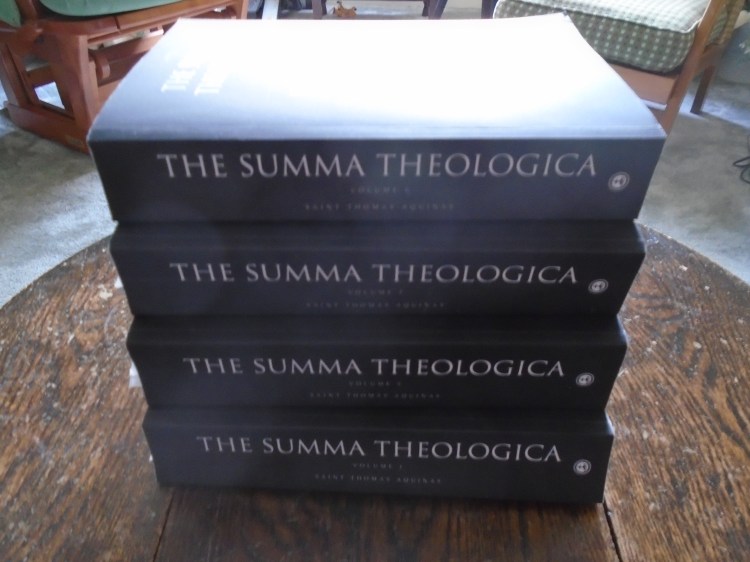
Thomas Aquinas on the Trinity and Creation
Article written by Clare Merry in February 2022
1. Introduction
Thomas Aquinas (1225-1274) summarized human knowledge and philosophy up to 1270. His tour de force was Summa Theologica – Summary of the theology of Western Christianity. The Blackfriars edition of 1964 presents Summa in 61 volumes. Other editions have a lesser number of volumes, but more hefty tomes.
Thomas Aquinas reflected upon the nature of the human person as having an individual soul; the nature of God as Trinity; the creation of the world by the Creator acting by analogy as a craftsman; the sustaining of all creatures in being by Being. He also reflected upon the basis of laws and how to be happy, and other secular topics.
The theology of Thomas Aquinas, in particular, his Doctrine of Creation, became the theology of the Catholic Church up to recent times. All priests were instructed according to the teachings of Thomas Aquinas up to Vatican II.
The thought of Thomas Aquinas, for which he fought many battles with his contemporary scholars of the Latin Church, became the basis to concepts behind Western Civilization. I say this because it was he who recognized human persons both male and female as individuals possessing free will and the right to make choices in life.
Thomas Aquinas worked on rational thought, defining what things actually are. His personal faith, however, was completely given to the love of God, to the Person of Jesus Christ and the sanctifying influence of the Holy Spirit. The object of his writing was to glorify God as well as to promote the common good of society.
2. Life of Thomas Aquinas
Thomas Aquinas was born in 1225 in Aquino, Italy and died aged 49 in France in 1274.
Thomas Aquinas’ father was Count Landulf of Aquino, near Naples. Landulf and his brother Ronald seized the castle of Roccasecca and became the overlords of that area. Thomas’ mother was Theodora; she may have been sister to the Holy Roman Emperor.
Aged five Thomas was taken to the abbey of Monte Cassino to be educated by monks. Thomas’ family wanted to place him in the best position to obtain power and wealth. However, aged 18 Thomas refused the path that would lead to him becoming abbot of the abbey, and instead joined the poor Order of Preachers founded by Saint Dominic.
Thomas’ outraged family abducted him and incarcerated him in Roccasecca castle. This was to prevent Thomas from joining the Dominicans who they deemed to be too evanglical. Dominicans were going around preaching the gospel to the poor. Other saints of the new evangelical movement in the church in the 13th century were Saint Francis of Assisi and Saint Anthony of Padua.
Thomas escaped and as a Dominican friar went to study at Naples University under the new Aristotlian teachers of the 1240s. However, the Dominican brothers removed Thomas from there because of the problems he had with his nearby family. They took him to the University of Paris to study under Albert the Great in 1245. The other scholars in Paris mocked Thomas for being a bit slow and stupid, but Albert saw that Aquinas was destined for great things.
Thomas was made a priest in Cologne where he had a post teaching Bible studies to Dominican brothers. He taught Biblical studies and theology at various papal universities receiving his qualification as a teacher in 1256.
In 1267 Thomas Aquinas met William Moerbeke who was busy translating Aristotle directly from the Greek. Up to this point Latin scholars had only known Aristotle from translations of Arabic into Latin. The translations from Arabic presented Aristotle’s thoughts coloured by Islamic philosophy to Latin scholars obscuring the meaning.
From this point on, Thomas Aquinas based all of his own writings on the translations of Moerbeke of the original Greek texts. In this way he was able to lead Latin theology in a totally new direction: one that would become the basis to Western thought and Western Civilization.
The crucial point here is that whereas the teaching from the Islamic world was that men participated in one collective soul that they either followed or refused to follow, Thomas Aquinas taught that each man was an individual who had his own soul and free-will. As a consequence, each man has his own mind and is able to decide on his own actions whichever social class that man belonged to. Aquinas argued that it is because of this that slavery is wrong as it deprives a man of choice in his actions. (In Western Europe in the 13th century there was the system of feudal landlords and serfs, while in other parts of the world there were systems based on slavery).
Thomas Aquinas applied himself to Natural Theology which is to seek knowledge of God and of things through reason. It was Aquinas who defined in detail what could be taken as true and what should be regarded as false in the many areas of theology. In the numerous volumes of Summa Theologica Aquinas lays out his arguments for the correct understanding of God, the Trinity, angels, human souls, the human condition and creation.
Aquinas is most quoted on his five ways to prove the existence of God, although this is a very small section of Summa. Aquinas’ most perceptive insight was the recognition that God created things from nothing: in Latin creatio ex nihilo. This became the Doctrine of Creation of the Catholic church.
Aquinas debated with Siger of Brabant who was a Latin Averroist disagreeing with him on many points. Brabant proposed that church theology is true and philosophy is true even though they contradict each other – you just keep them separate. Aquinas proclaimed one truth although this one truth could be approached by the two paths. Aquinas stood firm, he would not be moved, and he would not accept contradiction or the double truth.
Aquinas tirelessly fought against heretics. There is an anecdote of Aquinas having been invited to a dinner with King Louis IX of France and his courtiers. He reluctantly went, however, he found the flirtaceous courtiers boring so he remained in his own thoughts, not listening to the trivial chit chat. Suddenly he banged his fist on the table and exclaimed “And that will settle the Manichees.” The king quickly summoned a scribe to write down on a tablet the inspiration that Aquinas had just had to prove a point before he forgot it.
Aquinas was quite motivated by hot debates, and had many of them with the medieval philosophers and theologians of his day. Aquinas was outspoken and would not back down. This won him both admiration and enemies.
At the end of his life Aquinas was summoned by the Pope to attend the Council of Lyons. It is unclear whether this was to get a good telling off or to be commended for putting down some heretics and enemies of the church. Thomas did not want to go, but started out. The journey to Lyon was to prove his final voyage, as Thomas Aquinas managed to die en route.
In 1273 Thomas had a vision of Christ (it was witnessed by a brother as he prayed in the chapel). After the vision Aquinas wrote no more and did not finish his great work Summa. By the time he died a year later, Aquinas’ spirit was already residing elsewhere, and his body fairly quickly followed.
Thomas Aquinas was made a saint, a Doctor of the Church and a Father of the Catholic Church. Aquinas’ writing on the Doctrine of Creation was adopted by the Catholic Church as it’s own teaching. His writings on theology were taught to men training to be priests until Vatican II in the 1960s.
3. What Aquinas Achieved
Ancient Greek philosophers initiated a dialogue about science and the nature of reality from about 600 BC. The texts written by Greek philosophers were copied and conserved by Orthodox Christians in libraries belonging to the Byzantine Empire prior to the fall of Alexandria in 642 AD, surviving in a reduced way up to the fall of Constantinople in 1453.
Philosophical dialogue was taken up by Catholic Europeans when universities were first founded in Europe during the 13th century. At first the Latin scholars were Averroeist and Avicenna followers. But Europe was to take its own direction different to that of the Arabic philosophers. The pivot point of this new direction was the work of Thomas Aquinas himself.
Thomas Aquinas accomplished the feat of summarizing all the relevant knowledge known up to his day (1250s – 1270s). He got to grips with the writings of ancient Greek philosophers especially Aristotle, Islamic philosophers such as Avicenna and Averroes, Church Fathers especially Saint Augustine (354-430 AD) as well as with his contemporary Scholastic scholars. He commented on every part of the Bible which he knew in its entirety. What he bequeathed to future generations was encyclopedic knowledge from the Ancient Greeks through to the Medieval Scholasticism of his day.
Thomas Aquinas dealt in the analysis of what things are – the subject matter of science and philosophy. Aquinas’ quest was for the reasons for things. In the Christian tradition even the mysteries of faith are not irrational in themselves, but often beyond human grasp unless the meaning is revealed by God to his chosen.
In philosophy Thomas Aquinas sided with Aristotle most of the time, but greatly expanded his ideas, joining them with the ideas of Saint Augustine. The Greek philosophers were firm believers in God, but Thomas Aquinas took this further and Christianized the ideas.
Aquinas established that creatures, including human beings, have agency and are separate to God. The purposes of creation, however, are drawn towards their conclusion by God’s providence and governance of creatures.
Aquinas proclaimed the God of an ordered universe in which each thing has its place. He likewise ordered his writings such that they could be read – which was unusual in his day. Many ancient books read like a hotchpotch of bits and pieces.
On the question of origins, however, Thomas Aquinas was bound by the science of his historical time period – the High Middle Ages. He could not know what was not available to know. He could not know what we know now with the benefit of modern science. I think that he knew that he couldn’t know because in discussing origins and addressing certain questions, he does not say categorically that it was like this or like that. In these cases Aquinas quotes all the sources and opinions of the erudite of his day without declaring which one should be followed or taken as the definitive true path.
While displaying an openess of approach on questions he could not answer, he was very firm on the truth he could establish. His arguments are built up step by step paying attention to detail. He details the way in which the Bible was written and the particular words used, the intention behind the text, and makes observations relating to the human condition.
There have been many centuries of exegesis of the Bible by theologians; among all exegets, I believe that Thomas Aquinas is among the greatest.
Aquinas read the Bible in the most literal way that logic would allow, and far more literally than Saint Augustine’s reading of it.
In Summa Theologica volumes 1 and 2 Aquinas discusses why certain phrases were employed by Moses in writing Genesis and what they actually signify. I, personally have derived great benefit from his insights as a basis to further reflection. However, this further reflection must be done in the light of modern science, not according to the science of the Middle Ages.
Thomas Aquinas believed that none of the Biblical authors erred in composing the Scriptures; if we have the wisdom to understand it, the truth becomes evident. The whole of his theology is based on the Bible and the actual words used. The works of Aquinas read as evangelical as any Protestant Evangelical writings, but he was writing nearly 300 years before the Reformation.
4. The Trinity
Who is God?
This is the most fundamental question for any believer who feels God’s presence but does not comprehend the Being who is felt, the One who calls.
The vision of Thomas Aquinas is truly sublime. It is he who consolidated the Christian concept of God as Trinity.
This is what Thomas Aquinas writes in Summa Theologica Volume 1: Treatise on the Most Holy Trinity (I will not quote page numbers too much as they will be different in different editions).
God is one essence and three persons. The divine persons are distinguished as each subsists distinctly from the others in the divine nature. There is only one essence though and one Godhead.
God the Father is existence itself, the principle without principle. The Father is the principle of the whole deity. It is the property of the Father to beget the Son. God is the Father of the Son from eternity.
Jesus, the Son is begotten of God the Father receiving the whole Godhead from God.
Jesus is the principle from a principle. He is wisdom.
Jesus is the image of the invisible God.
The Holy Spirit is the spirit of Jesus.
The Holy Ghost proceeds from Father and Son. He is not made, nor created, nor begotten, but proceeding. There is unity between Father and Son by the Holy Spirit.
The Father, Son and Holy Spirit have the essence of God which is existence; which is perfection; which is the goal of all things.
Power belongs to the Father who is the principle of the whole Godhead. Wisdom belongs to the Son as the Word. Goodness whose object is love has the likeness of the Holy Spirit.
The Father and Son are in everything one and are one principle of the Holy Spirit. The Father in begetting the Son communicated his whole nature to him. “The Son was not begotten from nothing, but from the Father’s substance.”
Creatures were originally created from nothing. The principle of each ‘genus’ or type of creature made, came from the over-arching principle of God. It’s form was originally established by God it’s maker.
Humans are different from all other creatures in that God, the Holy Spirit may be given to us through grace and reside in our souls. We can begin to know the One who made us.
5. Creation and Act
The creative power of God is common to the whole Trinity and belongs to the essence of God.
God is the Father of the Son from eternity; while He is the Father of the creature in time.
Reference: Summa Theologica Volume 1: Treatise on the creation: The mode of emanation of things from the first principle: Whether to create is proper to any person?
To the Father is appropriated power which is chiefly shown in creation, and therefore it is attributed to him to be the Creator. To the Son is appropriated wisdom, through which the intellectual agent acts; and therefore it is said “Through Whom all things were made.” And to the Holy Ghost is appropriated goodness, to which belong both government bringing things to their proper end, and the giving of life – for life consists in a certain interior movement.
“God is the cause of things by His intellect and will, just as the craftsman is cause of the things made by his craft. Now the craftsman works through the word conceived in his mind, and through the love of his will regarding some object. Hence also God the Father made the creature through His Word, which is His Son; and through His Love, which is the Holy Ghost.” [Page 510]
To create belongs to God according to his being, that is his essence and this is common to the three persons. Hence to create is proper to the whole Trinity, and not only to one of the Persons.
Reference: Summa Theologica Volume 1: Treatise on the Most Holy Trinity: Of the person of the Son:
Word implies relation to creatures. For God by knowing himself, knows every creature.
The knowledge of God is cognitive and operative of creatures “He spake, and they were made.” Because in the Word is implied the operative idea of what God makes.
A Beginning to Creation
Thomas Aquinas, along with all the other Church Fathers of the Catholic and Orthodox churches, believed that creation had a beginning. The beginning brought time into being.
Thomas Aquinas also shared the Evangelical Creationist belief that God created many forms of life and the substrate upon which they depend directly; he brought creatures into existence that had not previously existed.
While God’s sustaining of creatures is continuous, their creation refers to their origin in the beginning.
Aquinas’ explanation of creation is that it is to make things by combining form with matter. God created forms according to ideas in his mind, ideas which are perfect exemplars of forms; each idea is a concept and each concept is a word.
The specification of the form is from mind and from nothing; creatures are made out of matter, but matter does not dictate their original form. (Just as writing is in ink, but the ink does not determine what is written on the page).
Thomas Aquinas states that to create something from nothing shows infinite power.
What is Act?
Some theologians have said that Aquinas’ argument is not dependent on a past, but only on a present cause of being. It is true that ‘act’ is a continuous present. God is the continuous present of creation. What is made is maintained in actuality by God’s own existence.
Aquinas writes that creatures exist and live through their participation in God. This is one truth, but it does not discount the truth that God conferred existence upon them in the first acts of creation that brought their forms into existence.
6. To be or not to be? That is the question
When William Shakespeare put this in his play Hamlet he was, of course, quoting Thomas Aquinas Summa Theologica Volume 2. Hamlet asks the skull of a man who has ceased to be whether it is better to live or die?
In the original reference Aquinas states that every contingent thing has in it something necessary. Contingency arises from matter. Things made of matter have in them the potentiality to be or not to be. [Page 219]
Shakespeare was quoting the following reference: Summa Theologica Volume 2: Treatise on man: What our intellect knows in material things: Whether our intellect can know contingent things?
Realism
The principle of identity – in the order of being (ontology) Aquinas states that everything is identical with itself. This signifies the unity of things. Ontologically something must either be or not be; it cannot both be and not be at the same time and in the same sense.
Most people find ontology difficult to follow, but they get the bit with the dialogue with the skull. They get that life is a difficult and painful business.
What is knowledge?
Thomas Aquinas’ thoughts culminate in the analysis of what thought is in itself. He reflects upon human thought and then upon God’s thoughts.
Human understanding is based on what can be perceived by the senses and captured in the imagination. The proper object of the human intellect is the ‘whatness’ or quiddity of the material thing. Aquinas is down-to-earth in being concerned about thoughts based on things that can be perceived.
The judgment of things is, however, based on innate first principles – principles infused into the human soul by God. We judge things through uncreated truth.
God is the efficient cause of all things. God is really related to creatures as their Creator, and their relationship with God is one of dependence. God knows his own essence and every creature as participating in his essence. Every creature has its own proper form in which it is like God. God knows the form or idea of every creature. In this way God both made the creature and knows the creature.
As human beings, we only know ourselves and are ourselves through God.
God thinks on a totally different level to us
God knows all things eternally at once. God knows things other than himself through himself. He knows them simultaneously and intuitively. God is omniscient.
7. Summary and Conclusion
Thomas Aquinas established in Summa Theologica:
- That each human person has an individual soul. This includes both men and women. The possession of a soul confers rights on individuals and means that they should not be made into slaves. This is one of the bases to Western civilization.
- Thomas Aquinas established a Natural Theology about things. He endeavoured to define what things are in themselves and how they relate to God.
- He read the Bible literally, seeking the meaning of each word used in Scripture. He knew Scripture in its entirety.
- Thomas Aquinas went deep into the nature of God: he described the Trinity in a way never preceded nor superseded:
- The Father is existence itself: the principle without principle.
- The Son is begotten of the Father: the principle from a principle.
- The Holy Spirit is the unity of Father and Son, proceeding from the love between them.
The creative power of God is common to the whole Trinity: to the Father is appropriated power – He is the Creator; to the Son is appropriated wisdom – He is the Word; and to the Holy Spirit is appropriated goodness and the giving of life.
Creation had a beginning when the Creator combined form (concept or idea) with matter. Creatio ex nihilo – each creature in its origin was created from nothing.
Acts of creation brought creatures into existence in the beginning. Act is also a participation in God’s existence; God’s Being maintains creatures in being.
Creatures are made of matter. This makes them contingent. It means that they can also cease to be, or cease their existence. The can die.
God knows all that he has created simultaneously and intuitively as he knows his own essence.
If the thought and writings of any one person changed the course of history, it was the thought of Thomas Aquinas. The foundations of Western civilization and Western thought are planted in the writings of this 13th century saint and doctor of the church.
3723 words
Bibliography
Aquinas, Thomas (1270s) The Summa Theologica Volume 1
Catholic Way Publishing Translated by fathers of the English Dominican Province 1947
Aquinas, Thomas (1270s) The Summa Theologica Volume 2
Catholic Way Publishing Translated by fathers of the English Dominican Province 1947
Geisler, Norman (1991) Thomas Aquinas: An Evangelical Appraisal
The Collected Works of G.K. Chesterton, Volume 2: St Thomas Aquinas
G. K. Chesterton (1874-1936) Reprint by Amazon.
Oliver, Simon (2017) Creation: A Guide for the Perplexed T&T Clark Bloomsbury

Jesus the Passover Lamb
Article written by Clare Merry October 2025
KEY QUESTIONS
- When was Jesus born?
- Is there any significance to the timing of His birth?
- What gave rise to the title ‘Lamb of God’?
1. The 25th December
We celebrate the birth of Jesus Christ on the 25th December. It is, however, generally agreed that Jesus was not actually born on this day.
The first record of celebrating the birth of Christ is found in the Roman calendar of 354 AD. The new Christian festival replaced the old pagan feast of Sol Invictus – the Invincible Sun. The pagan festival was supposed to be celebrated on the shortest day of the year. The winter solstice occurs on the 21st December, but it was mistakenly celebrated on the 25th December.
Europe was Christianized not by removing pagan festivals from local communities, but by replacing the significance of the festivals with events in the life of Christ. Patron saints were also swapped in with similar names to replace gods and goddesses at places such as springs. For example, the warm thermal spring in Buxton was dedicated to the Romano-British goddess Arnemetia. Her name meant ‘beside the sacred grove’. Catholics later changed the dedication of the well with curative waters to St Ann’s Well. St Anne was the mother of the Virgin Mary. The name Anne sounds like an abbreviation of the name Arnemetia, but this is the only association.
My investigation with this article is to ascertain when Jesus was actually born. The significance of this will become apparent to Jewish believers and to those who see Christianity as firmly founded in Judaism and the Jewish awaiting of the appearance of a Messiah.
2. Bright Comet of 5 BC
In order to establish when Jesus was born in terms of month of the year, we first must know in which year he was born. The obvious answer is at the beginning of 1 AD, but this is not the correct answer.
Two lines of evidence establish that Jesus was born several years before 1 AD. One line of evidence involves identifying the star of Bethlehem in scientific terms. The other line of evidence is that of recorded, secular history.
I had long wondered what the star of Bethlehem could have been, and how any wise men would be able to follow such a star. I found the answers to my questions in an article written by Colin Humphreys entitled The Star of Bethlehem published in Science & Christian Belief in 1995.
The star was, in fact, an exceptionally bright comet that appeared in 5 BC, according to records kept by Chinese astronomers. No bright comet appeared in 1 AD.
The Chinese catalogue of comets is called the Ho Peng-Yoke. The Ho Peng-Yoke record relies on the Han shu record which was the official history of the Han dynasty. They labelled tailed comets ‘sui-hsing’ or ‘suibsing’ meaning broom. These careful records record a bright comet for 5 BC under the catalogue number 63.
The comet of 5 BC is described thus, “Second year of the Chien-p’ing reign period, second month (5 BC, March 9-April 6), a suibsing appeared at Ch’ien-niu for over 70 days.”
Ch’ien-nui is a part of the sky that would have been visible to the east in the early morning. Thus, a comet arose in the east. It appeared between the 9th March and 6th April 5 BC. It was visible for 70 days which implies that it must have been exceptionally bright for some of that time as 70 days of visibility is very unusual. It was labelled “sui” which means tailed comet.
3. Herod the Great’s Reign 37-4 BC
Maybe you doubt that a comet recorded by the Han Dynasty in China for 5 BC was the sign of the Star of Bethlehem followed by the wise men from Persia to Bethlehem. Lets pursue another line of inquiry involving the Bible and Jewish history.
Jesus was born in Bethlehem during the reign of Herod the Great. The ‘three kings’ first went to Herod’s palace in Jerusalem, the obvious place, to seek the new king whose birth was announced by the appearance of a star. (At that time the appearance of comets signified the birth of a great king, a positive meaning. Later in history, after Halley’s Comet of 1066 the appearance of comets took on an ominous negative meaning, at least for the Saxon English).
The wise men found no new king in Jerusalem. The teachers of the Law said that the Messiah would be born in Bethlehem six miles south of Jerusalem. Eventually King Herod sent the Magi on their way saying ‘Go find this new king and come back to let me know, that I may worship him too’. (Gospel of Matthew 2:8)
The wise men did find the new-born child in Bethlehem, they did rejoice and worship, but they were warned in a dream not to return to Herod’s palace in Jerusalem. They went back to Persia by a different route.
After the Magi left, Joseph had a dream in which an angel told him to take Mary the mother and Jesus the child and flee to Egypt. (Matt 2:13-20) Joseph and Mary get up and flee from Bethlehem in the night. Meanwhile Herod realized that the wise men had not returned. To ensure that no baby king would challenge him for the throne, Herod decided to have all the baby boys born in Bethlehem of two years or younger killed.
Herod the Great came to the throne in 37 BC and died in 4 BC. Joseph and Mary return to Israel sometime after his death. These known dates mean that Jesus must have been born while Herod was still alive, maybe a year before he died. This implies that Jesus could have been born in 5 BC. Then the family returned from two years sanctuary in Egypt to live in Nazareth in 3 BC after the death of Herod.
4. Passover 10 and 14 Nisan
We have now established that Jesus was born in March or April of 5 BC on the evidence of the appearance of a bright comet in 5 BC and the death of King Herod in 4 BC. Jesus was born in spring time of that year just before Passover. This was one of the points made in the article by Colin Humphreys.
I am now going to take a closer look at the dates for Passover in 5 BC and make my own suggestions as to the significance of the date when Jesus may have been born and the mission he came to complete.
First of all this is a summary of the institution of the Passover Feast in Exodus chapter 12
These are the instructions from the Lord to Moses and Aaron while they were still in Egypt:
This month is to be the first month of your year. On the 10th day each household will select a lamb.
The lambs will be year-old males without defect; they can be sheep or goats.
On the 14th day of this month the chosen lambs will be slaughtered at twilight.
Some of the blood is to be put on the sides and tops of door-frames of the houses where they eat the lambs.
The meat is to be roasted over a fire and totally consumed. It is to be eaten with bitter herbs and unleavened bread.
You are to eat it with your cloak tucked into your belt, your sandals on and your staff in your hand. Eat it in haste; it is the Lord’s Passover.
On that same night the Lord will pass through Egypt and strike down every firstborn – both men and animals – and I will bring judgment on the gods of Egypt.
The households that have blood on the door posts will be passed over – no plague will strike down these households.
Passover is to be conmemorated as a festival as a lasting ordinance.
For seven days eat only bread without yeast. The Feast of Unleavened Bread commences on the evening of the 14th and goes on until the evening of the 21st day of this month. If anyone eats leavened bread during this time, he is to be cut off from the community of Israel.
Moses summons the elders and instructs them to go at once and select the animals for their families and slaughter the Passover lamb.
The first month of the Jewish calendar is called Nisan. In 5 BC 10 Nisan was Sunday 14th to Monday 15th April. On this day the Passover lambs were chosen – lambs without spot or blemish.
On 14 Nisan the lambs were slaughtered at sundown. The blood was put on doorposts and the meat roasted and consumed as the Passover meal. The sacrificing of the lambs would have taken place on Friday 19th April 5 BC. The Passover Sabbath would have been on the 20th April in 5 BC.
We saw that the latest date for the appearance of the comet in 5 BC was the 6th April. If Jesus was born on this day, when the comet appeared, then he would have been circumcized eight days later on the 14th April.
The passage that refers to Jesus’ circumcision is Luke 2:21. If Jesus was circumcised on the 14th April or 10 Nisan then this coincided with the day that the sacrificial lambs were chosen. The 6th April or 2 Nisan when he was born was the Sabbath day.
Colin Humphreys does not say this, but in my estimation, if the latest date for the appearance of the star which was the 6th April is taken as the date of Jesus’ birth, then his circumcision eight days later would have been on the 14th April. If this were so, Jesus would have received the symbol of being chosen on the day that the sacrificial lambs were chosen.
5. Passover and Census
Central to the recounting and depiction of the Christmas story is that Jesus was born in a stable and laid in a manger. There was no other accommodation available in Bethlehem when Joseph and Mary arrived. This has been attributed to there being a census, but more importantly, I believe, it was because it was Passover.
People arrived for Passover a week before so they could do purification rites, and the feast itself lasted a week. Thus, it would have been very busy in Jerusalem between the 13th and 27th April in 5 BC. Many Jewish families came up to Jerusalem before the festival to prepare for it.
Are the Biblical accounts of a census taking place correct?
“In those days Caesar Augustus issued a decree that a census should be taken of the entire Roman world. (This was the first census that took place while Quirinius was governor of Syria.) And everyone went to his own town to register. So Joseph also went up from the town of Nazareth in Galilee to Judea, to Bethlehem the town of David, because he belonged to the house and line of David. He went there to register with Mary, who was pledged to be married to him and was expecting a child.” (Luke 2:1-5)
There was no census for taxation purposes in the Roman province of Judea in 5 BC, although there had been one in 8 BC. However, censuses were not conducted on a particular day in the Roman Empire, but over a period of time. Maybe the period of time was several years, and so the census that started in 8 BC still continued in 5 BC.
The historian Josephus (Ant. XVII. ii, 4) recorded that the Pharisees refused to swear allegiance to the Romans and this occurred about a year before Herod died in 4 BC. The rebellion of Jews refusing to register occurred in 5 BC so this may have extended the duration of the census. Maybe Joseph had not wanted to register with the invading Roman power in 8 BC but finally acquiesced in 5 BC combining the trip with Passover celebrations in Jerusalem?
Joseph complied with Roman Empire law by going to the town of his ancestor King David to be counted in the census. Mary was also descended from King David so the child she carried was of this royal line.
All adult Jewish males were required to celebrate Passover at the Temple each year. A good time to do a census was therefore at Passover. This way they would only have to make one journey both for the religious festival and the census at the same time.
“There was no room at the inn.” This may have referred to the guest room of Joseph’s family house in Bethlehem. Passover and the census together may have been the reason why there was no room in the house, and they had to stay in the stable with animals.
6. Flocks in Fields at Night
The shepherds mentioned in Luke chapter 2 are watching their flocks at night when angels appear to them on the hills to say that a Saviour has been born. The angels encourage the shepherds to go and find the new born baby; as a sign they will find him lying in a manger.
At this time, sheep were only pastured out on the hills all night in the warmer months of the year between March and November. Between December and February it was too cold for the sheep to be outside at night, so they were kept inside after dark in barns.
“And there were shepherds living out in the fields near by, keeping watch over their flocks at night. An angel of the Lord appeared to them, and the glory of the Lord shone around them, and they were terrified.” (Luke 2:8-9)
That the Christmas story includes shepherds watching their sheep out on the hills at night shows that the time of year could have been March or April, but not December. Thus, shepherds tending sheep out on the hills favours the Passover time of year for Jesus’ birth.
The shepherds descended to Bethlehem from the hills above the town, with sheep and lambs and found the baby hidden in the feeding receptacle beneath the hay. It was probably the sheep that found him there when they went to feed on the hay. Mary would have hidden the baby there in fear of the unknown visitors, I think, as no one used cradles for new-born babies back in those days.
7. The Lamb of God
The Jews expected the Messiah to be born in Nisan, the first month of the year in the Jewish calendar. He was indeed born at this time. This month marks the season of the Exodus from Egypt and the Passover celebration of it.
Lamb of God is the title given to Jesus by John the Baptist.
John the Baptist’s mother was Elizabeth, a relative of Mary who was a generation older than her. Elizabeth was probably Mary’s mother’s sister and so Mary’s aunt. This means that Jesus and John the Baptist were first cousins once removed.
In the gospel of the Apostle John, John the Baptist twice says “Look, the Lamb of God” as Jesus came near (John 1:29; 1:36). This is strange phraseology, unless John the Baptist, being his cousin, knew that Jesus was born at Passover. This point is noted by Colin Humphreys. I believe that Jesus’ circumcision eight days after birth corresponded to the day that the sacrificial Passover lambs were chosen.
“The next day John was there again with two of his disciples. When he saw Jesus passing by, he said, ‘Look the Lamb of God!’ When the two disciples heard him say this, they followed Jesus.” (John 1:35-37)
The two disciples of John the Baptist were Andrew and John the Apostle himself. They both become disciples of Jesus. Andrew brings his brother Simon who becomes the Apostle Peter.
‘The Lamb’ is a title used by the Apostle John in the book of Revelation. It is The Lamb who opens the seven seals of the scroll that reveals the destiny of the world.
When John the Baptist called Jesus the ‘Lamb of God’, he did not know that Jesus would die at Passover. John the Baptist died before his time at the hands of Herod Antipas (also known as Herod the Tetrarch, son of Herod the Great) in 28-29 AD. This was before Jesus died in 33 AD.
Therefore, the title Lamb of God comes from Jesus’ birth at Passover in 5 BC, but the mission of Jesus was accomplished in his death at Passover in 33 AD. Colin Humphreys and I believe this. In addition to this I believe that Jesus received the mark of being chosen on the day that the Passover lambs were being prepared.
It means that both Jesus’ birth and death were linked to his identity of being the Messiah who would appear in Nisan, the first month of the year.
8. Long Delay in Jerusalem for Wise Men
The wise men appear to have packed up and gone to Jerusalem in haste, but there is a long delay until they reach Bethlehem.
Philo of Alexandria, a 1st century AD Jewish scholar stated that the scholar of astronomy perceives “timely signs of coming events” since “the stars were made for signs” (De Opificio Mundi, 22).
The time of appearance of a comet was deemed in the ancient world to mark the day that a great king was born. This is why Herod was anxious to learn from the Magi when exactly they had first observed the star.
“Then Herod called the Magi secretly and found out from them the exact time the star had appeared.” (Matthew 2:7).
Herod’s inquiry implies that the Messiah – Jesus was born on the day the star appeared in the sky.
Magi, a Persian word, denoted that the wise men were priests among the Medes. This priesthood had existed in Persia since the exile of the Jews to Babylon in 586 BC. These priests had a habit of visiting kings, maybe to offer advice and share their wisdom. The Jewish historian Josephus records that Magi had already visited Herod in 10 BC. Thus, the journey made by the ‘three wise men’ was not unusual.
The comet of 5 BC, catalogue no. 63 was noted as being visible for 70 days. This would give ample time for the wise men to saddle up their camels and travel from Media in Persia to Jerusalem in Judea.
Lawrence of Arabia in The Seven Pillars of Wisdom states that a fully loaded camel can cover up to 100 miles if hard pressed or 50 miles a day comfortably.
The Magi would have travelled between 750-800 miles to reach Jerusalem from where they lived in Persia. This would have taken them about 15-16 days. If the star had been visible for just over two weeks, they would have got there. However, it was visible for well over two months. They may have travelled in haste to reach Jerusalem in time for Passover and so taken only 12-13 days to get there.
Thus the Magi probably got way-laid at Herod’s palace in Jerusalem for a very long time. Herod was taking his time making inquiries as to the advent of a competing claim to the throne before letting the Magi go on their way. When the Magi finally leave the palace they are surprised and overjoyed to see that the star is still visible in the sky.
“After they had heard the king, they went on their way, and the star they had seen in the east went ahead of them until it stopped over the place where the child was. When they saw the star, they were overjoyed.” (Matthew 2:9-10)
Most comets would have disappeared over the course of two weeks, but this comet continued to be visible for long enough for the Magi to complete their journey with a long delay, and still arrive at Bethlehem a long time later with their gifts of gold, incense and myrrh.
9. Comets Point Down and Recede Away
The ability of comets to stop and point down to a town or city is explained in my article Was the Star of Bethlehem a Comet? (Article and blog posts posted on my website http://www.merryandtrue.com).
Comets with tails have the tail streaming vertically upwards with the body of the comet pointing down to the earth just before they recede away from the earth and become invisible.
By the time the Magi reach Bethlehem, Joseph, Mary and Jesus are staying in a house, not a stable (see Matt 2:11). They have also been to the Temple in Jerusalem 40 days after the birth and the time of purification for Mary.
Jesus, as a first born son, is dedicated to the Lord in the Temple on the 40th day after birth. Mary and Joseph are offering a sacrifice of two doves when Simeon and then Anna come up and prophesy over the child (Luke 2:21-38).
The wise men reach Bethlehem when the comet is in its pointing down phase. Comets do this just before disappearing. If the comet was visible for 70 days then the wise men arrive in Bethlehem to find the child when he is already nearly two and a half months old.
10. Escape to Egypt When Nile Not in Flood
The delay in reaching Bethlehem could have been caused by the wise men being held up by Herod in Jerusalem, but was the delay beneficial in some way and therefore serving the purposes of God?
The Magi were warned in a dream not to return to Jerusalem and report to Herod (Matt 2:12).. The Magi depart for Persia via a different route. But they would also have warned Joseph and Mary to be careful. Joseph also received a dream warning him about Herod and telling him to flee with the family to Egypt.
“When they had gone, an angel of the Lord appeared to Joseph in a dream. ‘Get up,’ he said, ‘take the child and his mother and escape to Egypt. Stay there until I tell you, for Herod is going to search for the child to kill him.’ So he got up, took the child and his mother during the night and left for Egypt, where he stayed until the death of Herod. And so was fulfilled what the Lord had said through the prophet: ‘Out of Egypt I called my son.” (Matt. 2:13-15)
As soon as the Magi left, Joseph and Mary depart for Egypt. The gifts of gold, incense and myrrh probably came in handy to finance the trip.
As it happened the time was now mid-June. This was exactly the right time to flee as the River Nile which used to flood every year in about the same period, was at its lowest in the month of June. It may be that the family could not have crossed the River Nile and reached Egypt when the river was in flood. Thus, the two month delay was to their benefit.
11. Slaughter of the Innocents
Herod sent the Magi to Bethlehem and instructed them:
“Go and make a careful search for the child. As soon as you find him, report to me, so that I too may go and worship him.” (Matt. 2:8)
This was trickery. His intentions are revealed in the verse Matthew 2:16:
“When Herod realised that he had been outwitted by the Magi, he was furious, and he gave orders to kill all the boys in Bethlehem and its vicinity who were two years old and under, in accordance with the time he had learned from the Magi.” (Matt. 2:16)
The reason for the killing of boys up to two years old was because there had been signs in the planets in 7 BC and 6 BC.
In 7 BC the planets Saturn and Jupiter came together in the constellation of Pisces. Pisces was associated with Israel. A Babylonian clay tablet with the star almanac of Sippar records this conjunction dated to 7 BC. In 6 BC Mars joined Saturn and Jupiter in Pisces. The Magi being astronomers would have known this and discussed it with Herod.
The terrible event of the killing of all the baby boys in Bethlehem fulfilled what was foretold by the prophet Jeremiah:
“A voice is heard in Ramah, mourning and great weeping, Rachel weeping for her children and refusing to be comforted, because her children are no more.” (Jeremiah 31:15)
With the flight to Egypt Joseph and Mary rescue Jesus from the jealous wrath of Herod. They remained in Egypt until an angel spoke to Joseph in another dream. The angel told Joseph that Herod is dead so it is safe to return to Israel with the mother and child. Joseph and Mary return but avoid living in Jerusalem and go to the quiet place of Nazareth in Galilee instead.
12. Chronology and Conclusion
This is the chronology:
- Birth of Jesus in Bethlehem on the 6th April 5 BC / the comet appears and the Magi set off from Persia.
- Visit of the shepherds to the stable in Bethlehem that night.
- Circumcision of Jesus eight days after birth on the 14th April – the day the sacrificial Passover lambs were chosen.
- Passover on the 19th and 20th April /the wise men arrive in Jerusalem for Passover and go to Herod’s palace / Jesus is two weeks old.
- 26 days after Passover Joseph and Mary take Jesus to the Temple for his dedication 40 days after birth and return to a house in Bethlehem. Meanwhile the wise men are held up at Herod’s palace for nearly two months.
- 30 days later the wise men leave Jerusalem and travel the six miles to Bethlehem where they find the new-born king. Jesus is ten weeks old.
- The comet disappears; the wise men depart to Persia via a different route; and Joseph and Mary flee to Egypt.
- Herod orders the massacre of all the baby boys in Bethlehem aged two years or less but Jesus had been rescued by his parents.
- King Herod died in 4 BC.
- Joseph and Mary with Jesus return to Israel but go to live in Nazareth in Galilee, not in their home town in Judea in 3 BC.
Jesus lived a quiet life in Nazareth working as a carpenter with Joseph. Jesus was in his 30s when he started his three year ministry. He moves to Capernaum on the shores of Lake Galilee. Jesus went to Jerusalem each year for Passover, first with his family and later with his disciples. On his final visit to Jerusalem in 33 AD he celebrated Passover with his disciples and taking the bread and the cup instituted the Lord’s Supper. He and the disciples went out and that same night he was arrested and put on trial immediately. The following day, on the eve of the Sabbath he was condemned to death, led away carrying his cross and crucified.
If Jesus was born in 5 BC it means that he started his mission aged 34 and was aged 37 when he died. (Note that in calculations of Jesus’ age there was no zero AD or zero BC so 1 AD = 1BC).
Not only in his death, but also in his birth Jesus is identified as the Passover Lamb who is sacrificed at Passover for both Jew and Gentile alike.
Thus, the month in which the comet of 5 BC appeared shows that Jesus must have been born just before Passover on the 20th April 5 BC. He was born and circumcised as the lambs were being chosen and prepared for the Passover sacrifice. This symbolically reveals Jesus Christ’s identity as the Lamb of God who takes away the sin of the world.
4587 words
Bibliography:
Humphreys, Colin 1995 The Star of Bethlehem in Science and Christian Belief Vol. 5, pages 83-101.
New International Version (NIV) Bible notes and quotes
NIV Bible Gateway
The Bible Reader’s Encyclopaedia & Concordance
Ed Rev. W. M. Clow D. D. based on The Bible Reader’s Manual by Rev. C H Wright, D. D.
1977
Wikipedia: Arnemetia; Chronology of Jesus; Herod Antipas; Herod the Great; St Ann’s Well (Buxton)
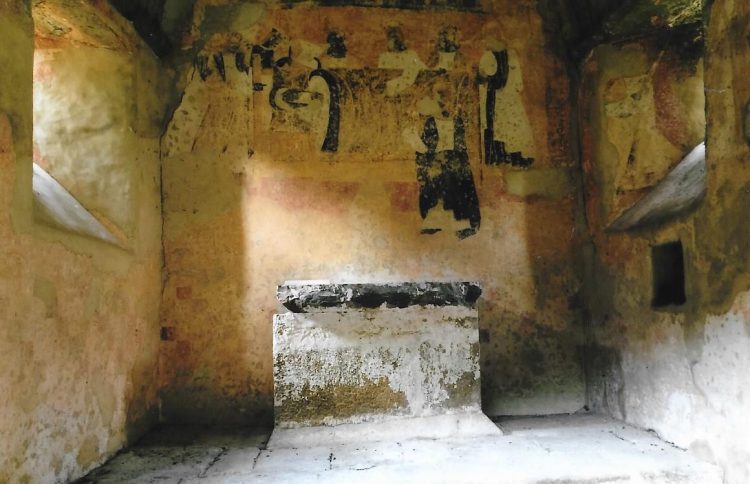
The History of Christianity in Britain
Article written by Clare Merry in July 2025
KEY IDEAS
- England was evangelized by Aristobulus sent out by Jesus and Joseph of Arimathea, Jesus’ uncle. This led to the Brittonic-speaking church being founded at Glastonbury in the 1st century AD among the Ancient Britons.
- The Celtic Church which was mainly Gaelic-speaking in Celtic lands was an Orthodox church. The Saxon church in England was also an Orthodox church.
- The Normans brought the Roman Catholic Church to Britain with Latin as a religious language.
- Popular Catholicism of the Middle Ages was swept away by The Reformation. The Bible was translated into English and services with singing adopted new liturgy in English.
- Protestantism was maintained in Britain by the import of Protestant royalty.
- Puritan factions within the Anglican Communion gave rise to new Evangelical churches with several great revivals of Christianity in Britain.
1. Introduction
The British Isles was one of the earliest places to be evangelized. The Ancient Britons, who were the original inhabitants historically of Britain, were first evangelized by missionaries from Judea in the 1st century AD.
Britain has a 2000 year history of Christianity incorporating the Brittonic-speaking church, the Celtic Church and the Saxon church which were Orthodox churches; the Roman Catholic Church of the Normans and the Middle Ages; and Protestant churches of The Reformation which were the Anglican Church of England and various Evangelical churches.
In this article I seek to understand and describe the different churches of the British Isles that grew up between the 1st and the 19th century.
The Gospel of Jesus Christ was brought by missionaries to:
- Ancient Briton pagans who were the constructors of megalithic stone circles in Britain and Brittany. These were stone calendars calibrated to the summer and winter solstice. Rituals may have been centred on a sun god.
- Gaelic-speaking Gaels of Celtic lands whose religion was centred on druids and the veneration of oak trees. They worshipped in sacred groves of trees. They also believed that sprites inhabited springs and wells.
- Saxons and Angles were pagans when they invaded England, but were converted to Christianity.
- Vikings were pagans who invaded Christian Saxon England from Denmark and Norway. They believed in the god Thor, god of thunder and storms.
Conversion to Christianity took place through missionary monks celebrating the Lord’s Supper or Communion in open air gatherings in each small place where they arrived on their travels. Many stories of miracles and healings have been told of these itinerant preacher priests known for their asceticism. In this way the people were evangelized, but evangelization also came through the conversion of kings and royal households of the many kingdoms of England, Wales, Scotland and Ireland.
All of the peoples of Britain had been Christianized by the 9th century or sometime prior to the Norman takeover of the 11th century.
The Norman invasion of 1066 brought the Roman Catholic Church to England, whose centre of power and authority was Rome and the Pope. Catholicism has various facets which had a huge influence on life in Britain during the Middle Ages, not only in terms of religion, but also in running the economy.
Reformation in Britain was a sweeping away of most of what had come before. It was the return to the Gospel of Jesus Christ that had become overlain with many layers of ritual and dogma. Difficult choices were debated on what to retain and what to remove of the old religion. These debates and disputes took place between Anglican mainstream ministers and the purist Puritans. There emerged liberal and evangelical factions belonging to the new Church of England in Tudor times.
Reformation brought huge Christian revivals in England, Scotland and Wales with Evangelical preachers going on missions to the common people, speaking to them in their own languages whether dialects of English or in Welsh or Gaelic. The religious language Latin was banned by the head of the Church of England, Queen Elizabeth I. Latin was only used by Catholics whose priests were in hiding, celebrating Latin masses in secret at the houses of ‘Recusants’.
The King James Bible of the Anglican Church helped shape modern English. High literacy in England came from Protestant families reading the Bible. It shaped culture and helped bring in the modern era we now inhabit.
Christian revivals shaped the British nations where they took place and probably prevented all-out secular revolution from taking place in Britain as it had done in France.
The 19th century saw the development of the Anglican Church into a wider communion as the British Empire took it to other continents and countries. There was Roman Catholic emancipation in the mid-19th century that brought Catholic churches and very successful Catholic schools back to England.
Evangelical churches sprang up of various sorts such as Baptists, Methodists, United Reformed often conserving fundamentals of Christian belief in an increasingly secular world through the 20th century.
Most inhabitants of Britain would describe themselves as Christian and a very high proportion were regular church-goers up to the First World War. It becomes more complicated after this, but my article ends here.
2. One of the 70 Came to Britain
The mission of Jesus Christ lasted three years. One of the first things that Jesus did was call twelve disciples to live and travel with him. The gospels of Matthew chapter 10 and Luke chapter 9 describe the sending out of the twelve disciples to towns in Judea. In addition to this, later on, Jesus chose seventy (or seventy two) other disciples and sent them out in pairs to announce the coming of the Messiah. The seventy two appear in Luke 10:1-20.
Bishop Aristobulus
Church fathers affirm that one of the 70 disciples sent out by Jesus was Aristobulus and he brought Christianity to Britain. Aristobulus became the first bishop in Roman Britain. The 70 went out to the Roman Province of Palestine which included Judea and returned to Jesus to recount their experiences. It was probably after the crucifixion and resurrection of Jesus that these disciples travelled further afield on mission to bring the good news, and that Aristobulus arrived in England.
Joseph of Arimathea
Joseph of Arimathea, the uncle of Jesus Christ on his mother’s side is said to have gone to Cornwall as he was a tin trader. He was a member of the Sanhedrin – the Jewish religious authorities in Jerusalem and a secret follower of Jesus. Joseph of Arimathea appears in the gospels as he supplied a newly-cut tomb in a garden where Jesus was buried before he was resurrected from the dead. Joseph of Arimathea with the help of Nicodemus buried Jesus: Matt. 27:57-61; Mark 15:42-47; Luke 23:50-56; and John 19:38-42. The two men rolled a large stone over the entrance to the cave tomb so that no one could get in very easily.
One legend is that Joseph of Arimathea brought the child Jesus, his nephew, with him to visit England on a business trip buying tin. This legend was kept alive by monks at Glastonbury Abbey in the Middle Ages. Much later William Blake (1757-1827) referred to this legend in the poem And did those feet in ancient time (1804) with the line: “And did those feet in ancient time walk upon England’s pastures green?”
Joseph of Arimathea is described as a rich man. It was tin trading that made him rich. Even before the Roman Empire came to Britain in 43 AD, Phoenician ships were carrying tin from Cornwall to the Levant or Near East. The Romans came to England to exploit the rich mineral resources of tin in Cornwall and other metals especially in Wales.
After the death and resurrection of Jesus, Joseph of Arimathea returned to England with a group of disciples to evangelize the Ancient Britons. He arrived from Judea at Glastonbury in Somerset feeling weary. There is a curious on-going miracle tree at Glastonbury: the Glastonbury Thorn or Holy Thorn. It is a hawthorn that flowers twice a year at Christmas time and in May instead of the usual once a year in the month of May. According to legend this hawthorn tree sprouted from the staff of Joseph of Arimathea which he thrust into the ground upon arriving at Wearyall Hill near Glastonbury.
Joseph’s son Josephus was also a missionary in England. Thus, the disciple of Jesus, Aristobulus and the relative of Jesus Joseph of Arimathea and his son are named as the first witnesses to bring faith in Jesus to the Ancient Britons of Britain.
The Brittonic-Speaking Church
Welsh is the modern name for the Brittonic language spoken by the Ancient Britons in Wales. Ancient Britons also lived in England: Cornwall and Cumbria, as well as Ireland and Scotland in the 1st century AD when the first church was formed in Britain.
In Wales the Ancient Britons had constructed a church at Llandoff by 162 AD. This is the oldest known site of a Christian church in Wales. Christianity grew up in Gwent in the 3rd century. The Kingdom of Gwent which became the County of Monmouthshire is in south east Wales.
Saint Ninian
In Scotland Saint Ninian established a Christian mission at Whithorn near Wigtown, Dumfries & Galloway in 397 AD. Saint Ninian was known as the Apostle of the Southern Picts. The Picts whose original tribal name was the Caledonians spoke Brittonic.
Saint David
Between 500 and 589 AD Dewiapsanctus became bishop of Mynyw. The place is now called St David’s in Pembrokeshire. Dewi became Saint David patron saint of Wales. In 1123 Saint David was canonized by the Holy See of Rome.
Thus, the Ancient Britons living on the west side of England in Cornwall and Wales became Christians. The legendary King Arthur of the 6th century is reputed as being one of these.
Saint Columba (521-597), a Gael from Ireland who evangelized Scotland and led the Celtic Church from the abbey he founded on the island of Iona, was instructed in his early years by priests of the Brittonic church. When Columba was young he was instructed by Saint Ninian, the Apostle of the Southern Picts. He entered the monastery of Clonard, in County Meath, Ireland which was governed by Saint Finnian. Finnian had been instructed in the school of David, Bishop of Mynyw who became Saint David, the patron saint of Wales.
Saint Petroc
Saint Petroc introduced Christianity to Cornwall in 520. He was the son of a Welsh chieftain from south east Wales and a Brython, in the Brittonic dialect of Cornwall. He based himself in a place that became known as Petroc’s Stow and later Padstow.
Roman Empire Christians
Gaelic-speaking Gaels started arriving in Britain after Caesar’s Gallic Wars in 58-50 BC, or maybe even during the 500 years before this time. One Gaelic tribe was called the Celtae. The Romans themselves arrived in 43 AD and were met with hostility by the Ancient Britons and Gaelic Druids. Ancient Britons inhabited most of England at this time so the Romans had to live in fortified towns with walls to keep the local tribesmen out. The Gaels were pushed westwards, and from the last stronghold of the Druids in Anglesey, migrated to Ireland and took up residence there.
Roman Christian converts started arriving in Britain from Rome, although they were not welcomed by their fellow Roman citizens. Christians were persecuted and martyred in the Roman Empire prior to the conversion of the Emperor Constantine to Christianity and the Edict of Milan in 313 which proclaimed tolerance for Christians.
Christians enraged the Roman authorities by refusing to observe the rituals considered due to Roman gods and goddesses. The disobedience was serious as a lot of commerce in towns was based on the sale of merchandise to devotees at pagan temples. Craftsmen made figurines of the local god or goddess for sale and various amulets to ward off evil, so any opposition to the cult had the tradesmen up in arms as it would damage their business and the local economy.
St Alban
Alban was a pagan Roman citizen living near Londinium who got caught up in the Roman authorities’ pursuit of a Christian priest. The Roman town was called Verulanium and the year was about 300 AD.
Verulamium had a temple with a triangular floor plan dedicated to the goddess Cybele and her consort Attis. Alban, as a pagan, would have been a worshipper in this temple.
Alban helped out a Christian priest who was being pursued by the Roman authorities by hiding him in his house. The priest sheltered by Alban was called Amphibalus. Venerable Bede relates that he stayed several days at Alban’s house before the authorities located him. During this time Alban became a Christian.
When Roman soldiers came to the house, Alban dressed as the priest and was caught while the Christian priest escaped. Alban offered to die in the place of the priest. Since he had become a Christian, he was put on trial by the Roman authorities. Alban was sentenced and martyred by beheading. His head is said to have rolled down Holywell Hill outside Verulanium. It is written that a miraculous spring with healing waters sprang up at the bottom of the hill. The church canonized Alban and his name was later given to the town. So Verulanium became Saint Albans.
When persecution of Christians ended at the time of the Emperor Constantine, a shrine was built where Alban died. Five hundred years later in the 8th century King Offa of Mercia had Alban’s bones dug up after being told in a dream where to find them. Offa founded an abbey on the site and this became the current cathedral.
When the Romans left Britain, Verulamium fell into ruin, but later the town of St Albans grew up around the pilgrimage to the shrine of St Alban set in place by the Saxon king.
The shrine at St Alban’s cathedral today dates from the 14th century and is made of marble. At the Reformation it was smashed into 2000 pieces. But in 1872 the remains were found and pieced together to rebuild the shrine. The relics of St Alban had been lost, but in 2002 a shoulder blade of St Alban was given to the cathedral by St Pantaleon Roman Catholic church in Cologne.
The name Alban came from the root Alba or Albion. Albion was the name of the whole of Britain at one time, and the Kingdom of Alba was the name for Scotland at one time. Thus, he had a very British name.
The martyrdom of St Alban caused Christianity to spread among Roman citizens. Some Roman churches have been found in excavation.
St Patrick
Patrick’s father was a ‘decurion’ which was a Roman senator and tax collector living in a Roman city in England. He was also a deacon in the church. Patrick’s grandfather called Potitus was a Christian priest living in Bonaven Tabernia. This may have been a fortified Roman town in Northamptonshire on Watling Street.
It is not known where in England Patrick was brought up, except that he lived in a villa with his family. In his autobiography Confessio, he calls himself Patricius and wrote in Latin. He was a Roman Christian at the time of the breakup of the Roman Empire in Britain. Patrick did not believe in the Christian faith when at age 16 he was captured by Irish pirates and taken to Ireland.
The Irish raiders came from the Gaelic kingdom of Dal Riata that ruled over the western isles of Scotland and north east Ireland. He was made to serve four houses of Druids. Patrick spent six years as a slave guarding swine. During the lonely time in the fields with the pigs he found faith in God. He then hatched a plan to escape. Managing to board a ship to England, he returned home to his family villa.
Aged 22 when he was free again, Patrick decided to train as a priest in France. In 431 Palladius was sent by Rome to become the first bishop of Ireland. Patrick decided to return to the country of his enslavement to evangelize the people. According to the Irish Annals Patrick returned to Ireland as a priest in 432. This was 22 years after the retreat of Roman citizens from Britain, so his family may have left by this time too.
Patrick evangelized the north and west of Ireland, and in later life was made a bishop. He became the Apostle of Ireland. After he died he was made patron saint of Ireland by popular demand, but was never formally canonized. Saint Patrick took the shamrock (triple lobed clover leaf) to illustrate belief in the Trinity: three persons, one God.
Thus, the symbol of Irish culture was not Ancient Briton, nor Celtic, nor Gaelic, but a Roman citizen who wrote in Latin, but no doubt spoke fluent Gaelic.
3. Celtic Church
The patron saints of Ireland are Saint Patrick, Saint Brigid and Saint Columba. The life of St Patrick appeared in the last section as he was a Roman citizen. Saint Brigid will be discussed later under the heading: Cult of Saints. It was Saint Columba, a Gaelic Christian who really set up the Celtic Church in Ireland and in Scotland.
From Iona, the abbey founded by Columba in the Scottish Western Isles, Celtic monks went to found an abbey on the island of Lindesfarne in Northumbria under the direction of Saint Aidan. St Aidan and St Cuthbert evangelized the Angle Kingdom of Northumbria which took in the north of England and southern Scotland.
Ireland was governed by Druids when Patrick returned there in 432 AD. The last evidence of paganism in Ireland dates to 830 AD so evangelization took some 400 years to complete. The setting up of monastic schools played a large part in Christianization. Saint Columba and Saint Brendan set up monastic schools in Iona in Scotland; Clonfert, County Galway in Ireland; and also in East Anglia and Gaul. Saint Aidan set up a monastic school on the island of Lindesfarne, Northumbria.
The Celtic Church also existed in Wales with the school of St David in the place now called St Davids. Nennius, a Welsh monk wrote Historia Brittonum, a history of Celtic Britons in 828 AD.
The Celtic Church was an early Orthodox Church. The Celtic Church in Britain existed at the time when Christianity as a whole was led by five church patriarchs in Jerusalem, Constantinople, Antioch, Alexandria and Rome. This is before there was a Pope in Rome and the Roman Catholic Church came into existence.
The Celtic Church was organized around monasteries, and not around cathedrals. Priests were married, while monks were celibate, and hermits often chose very ascetic lives. The later Anglican Church was a return to the view of priesthood held by the Celtic Church.
The Celtic Church was a missionary church. The itinerant preachers, who were monks, set off in coracles to cross seas to the remote islands of Scotland and to the coasts of Cornwall and Wales, and then on to Brittany and Britonia (now called Galicia in Spain). Later they evangelized Northumbria from Lindesfarne Island.
Monks who were priests celebrated open air masses with an alter cloth to lay upon a rock. They retold the stories of the Gospels and the Old Testament to the people in Gaelic.
The Celtic Church flourished between the 6th to 8th centuries. It was essentially a Gaelic-speaking church, although its missionaries to Cornwall spoke Cornish, a Brittonic language and its missionaries to Northumbria learnt to speak Anglo-Saxon English.
Cornwall and other regions have many place names from dedication to Cornish saints who lived in the 6th century. In Cornwall there are many high cross monuments of granite. These are large sculpted crosses that date from the time of Celtic Christianity. They resemble a Christianized form of the standing stones of the Ancient Britons. They would have been set in place by the Christian descendants of Ancient Britons.
Later on the Roman Catholic Church became the church of Celtic lands. In 1123 Saint David was canonized by the Holy See of Rome and in 1131 the Cistercian monastery of Tintern Abbey was founded in Monmouthshire, Wales.
Saint Columba (521-597)
Columba means ‘dove’. He was an Irish abbot and missionary. The Irish call him Saint Colmcille. When he was young he was instructed by Saint Ninian, the Apostle of the Southern Picts. He was also instructed by other Brittonic-speaking priests and monks at Clonard monastery in Ireland.
Columba was a Gaelic man of noble birth, great stature and powerful voice which stood him in good stead as a public speaker and evangelist. He founded four monasteries in Ireland and a church. In 563 Columba went by boat – a wicker and leather Currach with twelve companions to Scotland. One of Columba’s kinsmen, the King of Dal Riata gave him the island of Iona. Columba founded the Abbey of Iona on the island and from here evangelized the northern Picts.
Saint Columba became known as the Apostle of the Picts. He was much loved by both the Picts and Gaels. When he died his relics were divided between Picts in Scotland and Gaels in Ireland. In Scotland Saint Columba’s relics were placed in the Monymusk Reliquary. When Scottish armies went into battle they took St Columba’s relics with them. St Columba’s bones were at the Battle of Bannockburn in 1314 when the Scots led by Robert the Bruce won victory over the English despite being vastly outnumbered.
The Life of Columba was written in Latin by Adomnan or Eunan of Iona, an abbot of the 7th century.
Saint Aidan
Aidan, of Irish descent, was a monk at Iona. In 635 he went to the north of England and founded Lindesfarne Priory on the island of Lindesfarne and served as its first bishop. It was here that he learnt to speak English as he decided to make it his mission to convert the Anglo Saxons of Northumbria to Christianity. His native language must have been Gaelic. He obtained an invitation from the King of Northumbria for this missionary work. Aidan became the Apostle of Northumbria.
Aidan travelled ceaselessly spreading the gospel among Anglo Saxon nobility. He also looked after orphans from poor families and collected money to pay for the setting free of slaves (taken by the Angles and Saxons). Aidan practiced strict asceticism and was made a saint after he died in 651.
Saint Cuthbert (634-687)
Cuthbert of Lindesfarne became the Patron Saint of Northumbria. As a child Cuthbert was brought up near Melrose Abbey in the Scottish Borders. There are indications that he was of noble birth. He became a monk and went on evangelization missions from Berwick in Northumbria to Galloway in southern Scotland. He was called ‘Wonder Worker of Britain’ for all the miracles he performed.
Cuthbert joined Melrose monastery and was made prior. After this he was made prior of Lindesfarne, but he wanted to be a hermit. To this end, Cuthbert departed to St Cuthbert’s Island near Lindesfarne, but he received many visitors there. One of his visitors was Elfleda, royal virgin and holy abbess who succeeded St Hilda as abbess of Whitby in 680.
In 684 Cuthbert was brought back from his small island and was made Bishop of Lindesfarne, but he insisted on returning to his ascetic life and went to an even more remote island, Inner Farne Island. His asceticism led him to praying waist deep amidst the waves of the cold North Sea. It was on this island that he died.
The monks of Lindesfarne came under attack from Vikings in 793 and were forced to depart. They took Cuthbert’s sarcophagus with them. The stone tomb was loaded onto an ox cart. After much journeying, the cart got stuck in deep mud at Durham and would go no further. So St Cuthbert came to rest at Durham Cathedral where his shrine became the destination of a popular pilgrimage. Located in the Kingdom of York, the cult of St Cuthbert appealed to Danes who converted to Christianity and was later adopted by Normans too. St Cuthbert was the most popular saint in Britain from 687 to 1170 when Thomas Becket was martyred.
The alter cloth of St Cuthbert that he had used to lay on his mobile alter to say mass when on mission, was taken into battle by the English against the Scots on many occasions prior to the Reformation. There were no relics of bones of St Cuthbert as when they opened his tomb eleven years after his death, his body was found to be incorrupt so it was sealed up again.
In 1104 a new cathedral was constructed in Durham with a shrine for St Cuthbert. His tomb was opened again and this time his bones were taken out and put in the new shrine. Cuthbert’s bones survived the Reformation which is unusual. Today they are interred in the floor of the cathedral of Durham. When the tomb was opened in 1104 the ‘Saint Cuthbert Gospel of John’ was found well conserved. It is the oldest surviving Western book with original binding in leather. It is now kept in the British Library. The tomb also contained a square Saxon cross of gold with inlaid garnets. This cross became the heraldic emblem of St Cuthbert.
Venerable Bede
Bede (672-735) is a well-known historian of Britain and a theologian of the Celtic Church. He was a monk from Northumbria, though there are indications that he had a wife. (Celtic priests had wives so maybe he was a priest rather than a monk). He travelled throughout the British Isles and wrote and received many letters informing him on the historical events of these kingdoms.
History had been dated by the dates of reign of successive kings, of which there were many as there were many kingdoms. To get a chronological sequence these all had to be tallied together which was extremely difficult. A Byzantine monk called Dionysius Exiguus invented dating from the birth of Jesus Christ. Bede, in writing his histories, spread the usage of this new system of recording dates: in Latin Anno Domini = AD or ‘year of our Lord’. We can thank the Venerable Bede for this simplification in dating events in Britain.
One of the places visited by Bede was Lindisfarne or Holy Island on the northeast coast of present-day Northumberland. It was a big monastic centre of Celtic Christianity founded by Saint Aiden and Saint Cuthbert. Bede made known these two missionary saints by describing the miracles connected to them.
Lindesfarne Gospels
The Lindesfarne Gospels are the oldest translation of the life of Christ from Greek into English. The illuminated manuscript dates to 715-720 AD and was produced at the monastery on the island probably by Eadfrith, a monk who became bishop of Lindesfarne. The artwork has Saxon, Mediterranean and Celtic influences.
I have seen the beautifully hand illustrated Lindesfarne Gospels at an exhibition at the British Library in London.
4. Church of the Saxons
The Saxons from Saxony in Germany invaded Essex, Kent, Sussex and Wessex in 446 AD. They took the south coast of England and started to push the Ancient Britons and Celts westwards into Cornwall and Wales. As this happened, the Saxons founded the Kingdom of Mercia in the Midlands.
The Angles, a Germanic tribe akin to the Saxons invaded East Anglia and the north of England taking Northumbria. This pushed the Picts who were Ancient Britons northwards into Scotland and Cumbria.
The Saxons and Angles were pagans when they arrived in Britain, while the Ancient Britons and Celtic peoples had already been evangelized.
Saint Augustine of Canterbury
In 597 AD Pope Gregory the Great decided to send missionaries to evangelize the Saxons of England. The Gregorian Mission was headed by Saint Augustine of Canterbury. Augustine from Rome evangelized the Saxons of Kent and was the first Archbishop of Canterbury.
Paulinus of York
In 601 Pope Gregory sent Paulinus to York. He established a Christian centre there to evangelize the north of England.
The Angles and the Saxons combined to form the Anglo-Saxons. The Anglo-Saxons officially converted to Christianity in 630 AD.
Hilda of Whitby (614-680)
Paulinus who had been sent from Rome to be bishop of York conducted his mission through the conversion of Angle and Saxon royalty to Christianity. Saint Hilda was one of his converts.
Hilda was born into the royal household of Deira and Bernicia in 614. The northern kingdoms of Bernicia and Deira had been united to become the Kingdom of Northumbria by the pagan king Ethelfrith in 604.
The second king of Northumbria, King Edwin was converted to Christianity through the mission of Paulinus of York. Edwin ruled Northumbria from 616 t0 633 when he died in battle. In 634 Oswald became King of Northumbria. He was the son of Ethelfrith the former pagan king. However, the conversion of Oswald to Christianity was so profound that he was venerated as a saint. King Oswald invited Saint Aidan to conduct the evangelization of Northumbria.
Hilda was the daughter of the nephew of King Edwin who was converted by Paulinus. Hilda was brought up at the court of King Edwin. Hilda became abbess of the monastery of Whitby. At the monastery of Whitby Hilda advised kings on what they should do according to the will of God. She was made a saint.
The Synod of Whitby was convened to negotiate a rapprochement between the traditions and practices of the Saxon Rome-based church and the independent Celtic Church. The synod took place in 664 while Hilda was abbess of Whitby monastery.
Hilda lived at the same time as St Cuthbert. She may have influenced his views. Cuthbert belonged to the Celtic Church at Lindesfarne, but after the Synod of Whitby Cuthbert made concessions to traditions of the Rome-led Saxon church to establish peace between the two churches. Some Celtic Christians did not except the changes and returned to Ireland where the Celtic Church continued as it was.
Saxon Church Expansion and Viking Attacks
In 717 the Celtic clergy at Iona abbey were replaced by Rome-based clergy. This probably changed the language used from Gaelic to Latin for services and English in between times.
The first Viking raids on the western isles of Scotland and the islands off the coast of Ireland started in 795. In 802 the monastery at Iona was burned down by Vikings, and four years later they returned to kill 68 monks still there. Lindesfarne was attacked by Viking raiders in 793.
Vikings established a strong hold in Essex and overtook East Anglia during the 9th century. There is evidence from the Staffordshire Hoard that the Kingdom of Mercia was under attack from Vikings as early as the 7th century or at the beginning of the 8th century.
Staffordshire Hoard and St Guthlac
The Staffordshire Hoard provides a window into the Anglo-Saxon world of around 650 AD. It is an extraordinary find consisting of five kilos of gold, silver and garnet cloisonné objects with exquisite artwork. All the objects belonged to a male warrior – items such as swords and a helmet, as well as two crosses.
A small gold strip which could have been part of a sword or shield bears an inscription from the book of Numbers 10:35: “Rise up, Lord, and let thine enemies be scattered, and let them that hate thee flee before thee.”
The Life of Saint Guthlac, a Christian hermit living in the Kingdom of Mercia who died in 714 quotes the same passage. (The historian Bede (672-735) wrote the Life of Saint Guthlac).
It seems that Mercia was being attacked by Viking raiders even at this early date. At first Vikings looted churches and abbeys, and returned home to Scandinavia; it was only later that they started to settle in England.
The engraving of this passage of the Old Testament on a sword or shield, and the life of St Guthlac suggests a connection between the Saxon warrior and the saint. St Guthlac may have met Ethelbald King of Mercia and quoted this passage of the Bible to him, telling him to fight against the invaders. The Saxon warrior could have been the king himself.
The hoard had been hidden deliberately. It was discovered in a recently ploughed field in 2009 by a man with a metal detector. As the find was classified as ‘treasure’ it meant it belonged to the nation, and not to the finder. It was valued at £3.2 million. Two museums bought it: Birmingham Museum and Art Gallery, and Potteries Museum and Art Gallery in Stoke-on-Trent. The collection has toured various other museums since then.
Saint Edmund the Martyr
Edmund was king of the East Angles, a kingdom consisting of North Folk and South Folk east of The Fens, Devil’s Dyke and the River Stour. The Kingdom of East Anglia had seven Christian monasteries in the 9th century.
The all-out invasion of the Kingdom of East Anglia by the Great Heathen Army was led by a coalition of Scandinavian leaders in 865 AD. The Angle King Edmund went into battle against the Vikings and was killed in battle by beheading in 869.
Edmund’s relics were taken to a place that became known as Bury Saint Edmunds. A popular cult quickly grew up to honour Edmund the martyr. St Edmund, the martyr, became one of two patron saints of England before the days of St George.
Saint Edward the Confessor
King Edward, king of England did not spend all his time in the confessional box, but he confessed the Christian Faith and died childless. King Edward was the husband of Edith of Wessex, Queen of England. Edith came from the Saxon royal family of the former Kingdom of Wessex. She promoted the cause of her husband’s sainthood after he died early in 1066.
The situation was difficult as King Canute, another unwelcome Danish Viking had become King of England a bit before this time. The Saxon royals had called upon the Normans to help them keep the Vikings out once and for all. The Normans obliged and took over.
King Edward was the son of the Saxon king Ethelred the Unready and Emma of Normandy, thus he was half Saxon and half Norman. A Norman-sympathizing Saxon saint was what was needed in 1066 to quell unrest among the English.
Thus, to make St Edmund the Martyr and St Edward the Confessor joint patron saints of England was a bit of Saxon PR and promotion in the face of Norman takeover. The Normans let the people have their home-bred patron saints. Thus, the two patron saints of England were Saxon promotion in a Norman world.
Walsingham pilgrimage
The pilgrimage to Our Lady of Walsingham in East Anglia was set in place only five years prior to the Norman conquest.
In 1061 a Saxon noble woman, Richeldis de Faverches, had a vision of the Virgin who requested that she have a replica house built of the house in Nazareth of the Holy Family. The little house shrine was constructed over a spring of healing waters at Walsingham. The shrine has a statue of the enthroned Virgin Mary and child Jesus. It quickly became a place of pilgrimage for the English.
King Harold II of England, who confronted William the Conqueror at the battle of Hastings came from Walsingham manor house.
Orthodoxy
It should be noted that the English Saxon Church headed by Archbishop Augustine in Canterbury under the jurisdiction of the bishop of Rome was, at this stage, still an Orthodox church. The Orthodox Church was led by the five patriarchs, of which the bishop of Rome was only one until 1054. This was noted for the Celtic Church which was also an Orthodox church, but one which had much less direct contact with Rome.
Up to the 11th century the bishop of Rome or Latin patriarch held the keys to the tomb of St Peter located underneath St Peter’s basilica in Vatican City – as the Apostle Peter had come from Jerusalem to be crucified in Rome. However, at this stage these were only physical keys. When disputes broke out between the bishop of Rome and other heads of the church, the keys were used to lock out pilgrims visiting the shrine from Constantinople, Ephesus, Antioch and Alexandria. They were denied access and rupture occurred.
After the rupture between east and west in 1054, the Roman Catholic Church took its own path. It was from then on governed solely by the Pope who claimed succession from the Apostle Peter, head of the early church. The Apostle Peter was given authority to bind and unbind on earth – this authority became the authority of the Pope. He could excommunicate if he saw fit, and define what was and wasn’t heresy. The keys to the tomb of St Peter became the symbolic keys of power, and the authority to lock out and lock in.
The Saxon church under the See of Rome did not come under this type of authority, but the Norman church that came with conquest did.
For the first thousand years of Christianity the five heads who governed the churches of the known world met regularly at ecumenical councils. One such council was the Council of Nicaea when the Nicene Creed was set out as a declaration of what Christians believe. The five patriarchs were: the bishop of Jerusalem (Jewish Church of Judea); the bishop of Antioch (Syriac Church); the bishop of Alexandria (Coptic Church of Egypt); the bishop of Constantinople (Greek Church); and the bishop of Rome (Latin Church of Europe).
After the East-West Schism of 1054, there were no further ecumenical councils. Doctrine or dogma was determined in the West by Vatican councils overseen by the Pope. This brought in new church practices such as celibacy for priests and new doctrines imposed upon Catholic Christians, but not on Orthodox Christians.
Therefore, the Saxon Church, although receiving its instructions from Rome and using Latin for its training in theology and for mass, was in fact an Orthodox church rather than a Roman Catholic church. The Roman Catholic Church came into existence in the 11th century and was brought to England by the Normans. The Normans were the castle and cathedral builders of the 12th century.
One long-forgotten benefit of the Norman conquest is that the Normans put a stop to Viking raiding parties on monasteries and settlements in Britain, so finally the diverse populations of Britain could settle down and coexist in peace., while monasteries at last had relief from constant attack.
5. Roman Catholic Church of the Normans
Alongside building castles and keeps for security, the Normans built stone cathedrals, churches and abbeys. Many date from the 12th century. The Normans brought the Roman Catholic Church with clergy from Normandy to England.
Saints were venerated on many alters around cathedrals and there were shrines with relics in crypts. Stained glass windows told the stories of Biblical figures, saints and prelates. The soaring spirituality of these impressively high religious buildings was balanced out by hideous gargoyles spouting rainwater off cathedral roof gutters outside.
The Roman Catholic Church was formed after the rift between east and west of 1054 and the Norman conquest of England took place 12 years later. The power of this church, headed by the Pope in Rome, rivalled or surpassed the power of kings.
Abbeys and Priories
Abbeys and priories fitted into the feudal system of the Normans as land-owners. In marginal areas monks toiled in the fields to turn unploughed land into fertile fields. It was always possible to escape dire poverty by becoming a monk and being sent out to toil on the land. Abbeys then became rich by farming the newly created agricultural land. Abbots and priors also negotiated the buying of land and administered donations of land to their foundations by benefactors. The dues of serfs to specific pieces of land were all laid out in legal documents now held by the National Archives. It seems that acquired land came with its dues.
Abbeys and priories ran much of the economy of Europe in the early Middle Ages. Religious establishments dominated the economy of the north of England.
The Crusades
Islamic Moors took over most of Spain from 711 AD and there were Muslim raids along the coast of Italy. By the time of the new millennium the Pope commanded armies and there were Norman knights dressed in armour, trained, armed and supplied with horses ready for battle looking for a cause to fight for. A call to arms in defence of Christendom was raised by the Pope. The rallying cry was that Christians could no longer access pilgrimage sites in the Holy Land. This led to the Crusades.
The First Crusade was in 1095. It was directed against Muslims, and Orthodox Christians too. A split had occurred between the Latin Catholic Church and the Greek-speaking Orthodox churches in 1054 with mutual excommunication.
Richard I of England set off on the Third Crusade which took place between 1189 and 1192 to fight Saladin the Sultan of Egypt and Syria.
Saladin was a Kurd from Tikrit in Iraq. A pious Muslim and devotee of jihad he vowed he would put an end to the Crusader city states of the Levant. Saladin captured almost every Crusader city, he took control of the coast from Lebanon to Egypt and he laid siege to Jerusalem in 1187. Sultan Saladin with his heraldic Eagle of Saladin symbol still represents, in the Arab world, a hero in the struggle against the West.
Richard I became Richard the Lion Heart by rising to the challenge. He took Jaffa and Acre re-establishing Crusader control of the coast. He finally succeeded in taking back Jerusalem in 1192. The peace treaty established the right for pilgrims to go from Europe to Jerusalem unarmed.
After six major crusades, crusading stopped in 1291. By the end of this time all the Catholic outposts fell to the Muslims again. But the Moors were finally ejected from Spain in 1492 by Catholic King Ferdinand and Queen Isabel. The result was stale mate – Europe remained Christian while the Near East and Middle East remained Muslim.
The Crusades drew together Catholics from different groups to fight together against an external enemy. New patron saints were called up in the battles fought by Crusaders.
Crusaders adopted soldier saints as patrons and invoked them to fight alongside them in battle. Richard the Lion Heart adopted Saint George as his patron. (I will describe St George in an article on English legends). The strongest helper of all was deemed to be Saint Michael the Archangel. Angels were thought to determine the outcome of warfare as they represent principalities and powers. Saint Michael the Archangel is always depicted ready for battle in churches and cathedrals.
Relics of Saints
People who were not literate required tangible objects as the focus of their devotions. There was a large commerce in the bones of saints who were celebrated on the day of their death. To set up a shrine and found a new pilgrimage required relics. Without relics it wasn’t going to happen. The pilgrimage of Santiago of Compostela was set up with the relics of the body of James the Great Apostle (brother of the Apostle John). James was beheaded in Jerusalem in 44 AD. His body minus the head was taken to Spain to the shrine at Compostela cathedral. It attracted the biggest pilgrimage in Europe by four or five different routes that still goes on today.
Obviously there were no relics of Jesus, as he was resurrected from the dead and ascended into heaven. But the shroud his body was wrapped in was carefully conserved by the Byzantine emperors in Constantinople and finally found its way to Turin where it is known as the Shroud of Turin. There was also a lot of Vera Cruz, the wood of the True Cross.
Obviously there were no relics of the Virgin Mary since, although she died and was buried in a tomb in Gethsemani, she underwent an Assumption into heaven from the tomb in Jerusalem. (This was the Orthodox belief, but more recently the Catholic Church has relocated the Assumption to Ephesus). Relics of Mary consisted of a large number of flasks containing milk.
St Andrew is the patron saint of Scotland and this is entirely due to the conservation of the Apostle’s relics there at St Andrews, on the Fife of Scotland on the east coast.
St Andrew’s bones arrived in Scotland in 747 AD. This is the story of how they got there:
The relics of Saint Andrew resided at Patras in Greece until invasion meant they had to be removed for safe-keeping. A monk called Regulus took it upon himself to preserve the relics of St Andrew. He set sail for Scotland and was shipwrecked on the coast of Fife in 747. This was a sign to build a shrine and keep the relics there.
Oengus II King of the Picts saw a X in the sky like the cross of St Andrew before going into battle in 832. He vowed that if he won the battle, he would make St Andrew patron saint of Scotland. The battle was won for the Picts and Scotland got its flag of a white saltaire on a celestial blue background. Today the relics of St Andrew are housed in St Mary’s Cathedral, Edinburgh.
The relics of the Apostle Andrew were brought to Scotland long before the arrival of the Normans when the church in Britain was still an Orthodox church.
Thomas Becket Norman Martyr (1119-1170)
The Saxon Canterbury cathedral was built on the site of a Roman church so this had been a religious site from the very beginning. The Saxon cathedral was damaged by fire in 1067 and was rebuilt under the supervision of the first Norman bishop Lanfranc sent from Normandy. The new, expanded cathedral was completed in 1077, although modification works continued after this.
It became a place of pilgrimage as pilgrims flocked to the tomb of the Norman martyr Thomas Becket in the 12th century.
Young Thomas was a clerk in the household of Theobald of Bec, Archbishop of Canterbury. His parents were Gilbert and Matilda, Normans. In 1154 Theobald named Thomas Becket Archdeacon of Canterbury as he worked efficiently and well. In 1155 he was made Lord Chancellor and then in 1162 he was made a priest and became Archbishop of Canterbury when Theobald died.
Thomas Becket took on an ascetic life when he was made priest and archbishop (unlike some). Thomas Becket as Archbishop, had the son of King Henry II living in his household to school him.
The event that marked national history and showed Thomas to be a hero took place in 1170. The Pope was involved in political decisions in England and an issue arose. Archbishop Thomas Becket, despite being the guardian of King Henry II’s son, stood up against the power of the king and sided with the Pope on an issue.
King Henry II was heard to say one day “Who will rid me of this turbulent priest?” Shortly after, when Thomas Becket was saying Vespers in the evening in the cathedral, armed men came from the king. The monks tried to keep the men out. Thomas continued to say Vespers. The armed men came in and cut him down in front of the alter leaving blood everywhere.
The story of the courageous and saintly priest standing up against the power of the king and being murdered, made Thomas into a martyr in the eyes of the people. They flocked to his tomb in Canterbury Cathedral to venerate him as a saint. Really it was the Pope V King, and the Church won. The Pope canonized him not long after.
Canterbury is said to have got its name from pilgrims on horseback cantering to reach the city gates before they closed at sundown. Pilgrims purchased a pilgrim badge made of lead stamped with an image of Thomas Becket. Income from pilgrims paying for accommodation and buying merchandise paid for the rebuilding of the cathedral.
The ground plan of the Saxon cathedral shows buildings with one high alter at the front where mass would be celebrated. The ground plan of the Norman cathedral shows a more complex building with various chapels surrounding the high alter at the front of the building. Each chapel had its own alter and dedication to a saint. Relics were housed beneath these alters in medieval churches. Masses could be celebrated in these side chapels. This shows the development of the cult of saints at this time.
Third Orders within the Catholic Church
Early on, abbeys were governed by the rule of St Benedict. The Order of Saint Benedict was founded in 529 AD. This was the oldest order of the Latin Church. Benedictine abbeys were based on the communal life. First orders are monks and second orders are nuns, while third orders are lay people. The members of all orders gathered to follow the spirituality of their founder. New orders with rules of life were added in the High Middle Ages.
The High Middle Ages (1000 – 1300) saw the founding of universities in European countries where theology was taught and debated. Oxford University was founded in maybe 1096 and certainly in 1167, and Cambridge University was founded in 1209.
Ancient Greek philosophy became known through the translation into Latin of texts in Arabic, and later by direct translations from the Greek.
Saint Thomas Aquinas (died 1274) foremost doctor of the Catholic Church combined the teachings of Aristotle and Saint Augustine of Hippo with his own insights to reach conclusions that became the basis to Western Civilisation. The crucial insights of Thomas Aquinas were about the personhood of individuals even if they were women or slaves; slavery was deemed to be morally wrong therefore. The feudal system had serfs and servants, but not slaves; and each person was believed to have their own individual soul, rather than a participation in a collective soul.
Thomas Aquinas would have been too highbrow for most of the faithful, but Saint Francis of Assissi (died in 1226) and Saint Anthony of Padua (1195-1231) had founded the Franciscan Order. Saint Clare founded the Poor Clares for nuns. The Third Order of Franciscans had a large, popular following among lay people.
The Rosary
At the same time as the Franciscan Order was founded by St Francis in the 13th century, Saint Dominique (1170-1221) founded the Dominicans whose devotion was to the Virgin Mary using the Rosary as a way of praying. The Dominican Order popularized the Rosary as a form of prayer. In Rosary Groups devotees still recount the miracle stories of their founders who were canonized as saints.
Devotion to the Virgin Mary became devotion to a particular invocation of Mary and a recognizable statue. For example, Our Lady of Walsingham from the 11th century, and in the 19th and 20th centuries Our Lady of Lourdes.
6. Popular Catholicism of the Middle Ages
Between about 1350 and 1450 people in England ceased to think of themselves as being Norman or Saxon, and became English. Up until the Hundred Years War which ended in 1453 the ruling class were speaking Norman French, but when the French became the enemy, they started speaking Middle English.
Joan of Arc had been called to put on armour and fight with the French, bringing them victory against the English especially at the siege of Orleans. The English put her on trial and had her burned at the stake in 1431. The all-time heroine of the French had been dispatched by the English in France.
Joan of Arc was a mystic who had visions. In England there were also mystics who spoke to the people who visited them in English and wrote up their visions in English. The mystic Mother Julian was born the same year as Geoffrey Chaucer, just as the Black Death struck England.
Mystics Julian of Norwich and Margery Kempe
The 14th century was a time of change, turmoil and plague that brought the sudden death of a large percentage of the population. People reached out to God in the insecurity of their lives –the mystic Mother Julian was someone who offered comfort.
Mother Julian of Norwich born in 1343 was an anchorite. She lived in a tiny room attached to a church in the busy trading city of Norwich. Julian or Juliana was a mystic immersed in prayer. The cell in which she was confined was attached to St Julian’s Church in Norwich, but this Juliana was a different saint, not herself.
The cell had a window into the church from which she could witness Mass and another window where she received callers. The callers were many as Norwich was the second largest city in England with a population of about 25 000, and the church was in the commercial district close to quays on the River Wensum.
Norwich was struck down by the Black Death in 1348 to 1350 when Julian was a child; the Peasants’ Revolt took place in 1381; and the Lollards who wanted to reform the church were being suppressed. In Norwich the Lollards were burnt at the stake at Lollard’s Pit, a place outside the city.
People went to Mother Julian in great numbers for spiritual advice and wise council. She repeated to her visitors the words Jesus had spoken to her: “All shall be well, and all shall be well, and all manner of thing shall be well.”
Mother Julian wrote Revelations of Divine Love. It is the earliest work by a woman in England. It was written in Middle English. She wrote it shortly after receiving visions of the Passion of Christ in 1373 and then later wrote a longer version in 1410.
Mother Julian was visited by the visionary Margery Kempe. Margery Kempe (1373-1438) was another mystic from Norfolk. She wrote The Book of Margery Kempe in Middle English in the 1420s. She was the first woman to write an autobiography of her life. In amongst the record of her domestic duties, she wrote about her trials. Margery Kempe was accused of Lollardy (Protestantism) and tried for heresy multiple times. She denied it and they failed to convict her.
Pilgrimage and Geoffrey Chaucer (1343-1400)
Another survivor of the Black Death, born in 1343, was Geoffrey Chaucer. He also adopted the vernacular to express himself.
Chaucer is famous for writing The Canterbury Tales. The Canterbury Tales became well-known as it was the first book to be printed in England in 1478 by the printer William Caxton.
Geoffrey Chaucer came from the upwardly mobile family of a tavern keeper – purveyor of wines – vintner to the royal household. His father got him a job as a page to a countess, and in this way he entered the royal court. Chaucer became Clerk of the King’s Works and later Comptroller of Customs for the port of London.
While some consulted mystics, others departed on pilgrimage in search of answers and of blessings. To be fair, the only way a serf could get a holiday was by going on pilgrimage to a shrine far away. People of all economic levels went on pilgrimage. The destination could be Walsingham or Canterbury, or even Jerusalem in the Holy Land.
The idea was that you went by boat, on horseback or by foot making the sacrifice of the journey, and then God would reward you with granting the thing you hoped to obtain. The Pope granted indulgences for the visiting of certain shrines – that is to say a pass to get into heaven at the end of life’s journey. You did have to contribute financially and enter the shrine walking on your knees, but many thought it worth it.
Chaucer revealed the less than holy side to pilgrimage. In Canterbury Tales Chaucer, without being critical, recounted the story of what happened when the pilgrims entered a tavern to stay the night. They all gathered round to tell their stories of adventure, of courtly love and of bawdy misdemeanours.
Many believed in an idealized version of religious reality. Chaucer was a realist, and some say a Lollard. His satirical writing about friars, priests and other Catholic church officials revealed quite an irregular situation.
When everyone was writing in Anglo-Norman French or Latin, Chaucer wrote in Middle English. Thomas Hoccleve declared him “the firste fyndere of our fair language.”
The Lollards were initially led by John Wycliffe who was thrown out of Oxford University in 1381 for heresy. The Lollards as proto-protestants wished to reform the Catholic Church. The views of the Lollards were written in Middle English as Twelve Conclusions of the Lollards and pinned to the doors of Westminster Hall in 1395. The views sound very modern, although the language is very ancient. Lollards were suppressed as they led uprisings against authorities and were deemed heretics.
Patron Saints of Guilds
Medieval towns had skilled craftsmen grouped into trades that were regulated by guilds. The guilds offered apprenticeships of seven years to young men by working for a master craftsman member of the guild.
Guilds had headquarters where a priest was employed to say masses for guild members in a consecrated room with an alter. The burial of guild members and masses for their souls were taken care of by the priest.
Each guild chose a patron saint. The patron saints of guilds reflected the skills, trade or social role of the guild. For example, the Guild of Saint Luke in Antwerp was the guild of painters, artists and sculptors. Saint Luke was chosen because John of Damascus had said that the Evangelist Luke had painted a portrait of the Virgin Mary. (The Gospel of Luke paints a picture of Mary using words not paint!). The Guild of St Luke had a showroom and a market stall where members could display and sell their paintings.
The servants guild had Martha as their patron because she busied herself with serving Jesus food when he went to visit Bethany with his disciples. This is mentioned in John’s Gospel chapter 12:2.
The perfume sellers had Mary Magdalene as their patron as she is thought to have been the woman who brought perfume to pour on Jesus’ feet and wipe it with her hair. John 12:3 recounts how Mary took a pint of pure Nard for this purpose and the house was filled with fragrance of the perfume. However, this Mary mentioned in John chapter 12, was the sister of Martha and Lazarus of Bethany and not Mary Magdalene who came from Magdala, a fishing town on the shore of the Sea of Galilee. Mary Magdalene was Mary of Magdala – the clue was in the name, but confusion still reigned.
Mary Magdalene, ‘La Madeleine’, had a huge following; having been a prostitute, so it is thought, who became a disciple of Jesus. Her relics were much sort after in France.
The wine-makers had Saint Vincent for the sole reason that vintner (wine merchant) begins with V and Vincent begins with V.
The choice of patron saint had a large part of randomness in it, although there was supposed to be a link between their story in a gospel and the skills or merchandise of the guild.
But how would it work asking for the intercession of a saint who was someone else in life? Would you get crossed wires at the exchange? ‘You are through to Mary of Bethany, no Mary Magdalene represents the women on the other side of the street.’
Patron saints served more as emblems to identify the guild than anything else. Guilds joined parades around the city on certain civic occasions holding up embroidered emblems and images of their patron saint to represent their trade.
Cult of Saints in Villages
The cult of a local saint in a village or a town was often associated with a well where people obtained drinking water. Previous pagan beliefs had linked springs to sprites that inhabited these places. Pagan beliefs and practices were Christianized. In Buxton, for example, the thermal spring in The Crescent had been associated with the goddess Arnemesia, but with the coming of Christianity it became St Anne’s Well.
Local devotions at wells were performed to obtain healing from the saint and with the healing properties of the water. Ritual prayers were recited and procedures followed to obtain healing.
When printing became available elaborate mythologies of extraordinary miracles in the lives of saints were circulated in Catholic countries, while the Bible was printed in Protestant countries. The cult of saints played a large part in popular religion all through the Middle Ages and well beyond the Middle Ages. People of the modern age dubbed it superstition.
Saint Brigid, saint or goddess?
It is unclear whether some of the very early saints were real people or not. It is not known whether Saint Brigid was an actual person. She is said to have lived from 451 to 525 AD. The legend is that she was the daughter of a pagan Irish clan chief and an enslaved Christian woman. She was fostered by a Druid and became a consecrated virgin. She then became a Christian and the founding abbess of the Abbey of Kildare and a convent for nuns.
The feast day of St Brigid is on the 1st February. This day used to be called Imbolc and was the pagan festival of the beginning of spring. It has been suggested that the Druid of the legend was the chief Druid at the temple of the goddess Brigid. When this pagan site became a Christian monastery the goddess Brigid was commuted into the holy virgin Saint Brigid.
Whatever the truth about her legend, Brigid of Kildare is one of the three patron saints of Ireland, alongside St Patrick and St Columba.
7. The Reformation and Protestant Churches
It was the printing press and literacy that allowed the Protestant Reformation to take place, and also the Protestant Reformation that promoted literacy. In England the Reformation occurred in 1534. In Germany it started in 1517 when Martin Luther (1483-1546) nailed his opinions about the sale of Indulgences to the door of All Saints Church in Wittenberg on the 31st October. Luther’s views are known as the Ninety-five Theses. Several printers quickly printed the Ninety-five Theses in Latin and other printers had them translated into German and printed them. Theology students soon thronged to Wittenberg to hear Martin Luther speak. Luther had 300 000 tracts printed and distributed as publicity.
Martin Luther gave up being an Augustinian friar, married a nun and got into a protracted conflict with the Pope. The Pope sent him a letter and a Papal Bull saying that he would be excommunicated. Luther burned the letter and the bull in public. The excommunication went ahead in 1521 and was never lifted.
It was the sale of Indulgences – the idea that you could secure a place in heaven by paying money to the Catholic Church that blew the top off the old religious regime. The people flocked to the Protestant movement not only because of the scandals, but also because it was a return to the core values of Christianity written in the New Testament that formed the basis to the movement. Protestantism was spread by the printing of Bibles.
Dissolution of the monasteries
The Reformation came to England at the time of King Henry VIII. The Dissolution of the Monasteries started immediately in 1536. The process entailed liquidating Catholic church assets and transferring the titles to the Crown. Some of the profit and buildings were used to create educational institutions, and some invested money paid for the pensions of former monks and nuns. Monks and nuns were given pensions if they agreed to the changes without resistance.
Catholic priests and monks were encouraged to become clergy in the new Anglican Church, and they were encouraged to marry. Pensions and salaries were paid to those who acquiesced.
Popular religion had become superstitious, pagan, and based on miracle-story mythologies with the cult of saints. There was little difference between this religion and the pagan religion that had been in place prior to the coming of Christianity. The Reformation swept away the cult of saints with its statues, wells, ritual prayers and mythologies. Protestants proclaimed that God can be approached directly, without saints acting as intermediaries.
The leadership of the Catholic Church in England were deemed to be foreign or serving a foreign power which was Rome.
Wars of Religion
After the Protestant Reformation and the Catholic Counter-Reformation in 1545 many religious conflicts broke out. There was persecution and grievances on all sides with people burnt at the stake (women), and hung, drawn and quartered (men).
In England Catholic priests went into hiding when Protestant monarchs ascended to the throne. Catholic families paid heavy fines and had their properties demolished if found hiding a Catholic priest in a priest hole and hosting mass in Latin.
Nicholas Garlick, Robert Ludlam and Richard Simpson Catholic priests were hung, drawn and quartered on St Mary’s Bridge, Derby in 1588 during the reign of Elizabeth I. They are remembered as the Padley Martyrs. Catholics persecuted at this time were charged with treason, not heresy.
Previous to this, a Protestant girl called Joan Waste had been taken to Windmill Pit in Derby and burnt alive. It was 1556 and the Catholic monarch Mary I, the sister of Elizabeth I was trying to bring back Catholicism to England. Joan’s crime was that she had the Bible read to her in English (she was blind and could not read it herself) and she taught the Bible to children.
The Protestant Joan Waste is now commemorated with the Catholic Padley Martyrs by the Anglicans and Catholics in Derby in the Bridge Chapel of St Mary’s Bridge.
Policies were put in place to stop the return of Catholicism to England, and a war was fought with Scotland.
Scotland
The Battle of Pinkie during the War of the Rough Wooing took place in 1547. There was eight years war between English Protestants and Scottish Catholics. England attacked Scotland to break up the Auld Alliance between Scotland and France which could have led to England being invaded by French Catholics via Scotland to overthrow Protestant royalty and re-establish Catholicism in Britain. It was a pre-emptive war.
In 1559 John Knox returned to Scotland from Geneva bringing Calvinism to Scotland. In 1560 the Presbyterian Church of Scotland was formed. The Kirk as it is known became the national pride of Scotland.
Ireland
Dissolution of the monasteries in Ireland took place at the same time as in England, but it was part of the Tudor conquest of Ireland.
Elizabeth I was excommunicated by the Pope. In 1570 Pope Pius V issued a papal bull declaring Queen Elizabeth I of England to be a heretic. The bull released her subjects from any allegiance to her. This led to a huge sentiment of rebellion of Irish Catholics against the Protestant royalty of England. Those who wielded power in Westminster decided to clear out Catholic nobility from Ireland and replace them with Protestant families.
In 1607 the Flight of the Earls occurred. Irish aristocracy under direct persecution and threats fled to Europe. In 1609 Scottish Protestant Presbyterians were brought to Ulster on a large scale. Protestant aristocrats were given land in Ireland to break up the Catholic grip on power there.
Irish Catholics rose up against Protestants in the Rebellion of 1641 and formed an Irish Catholic Confederation.
Thus, a policy of replacing Catholics in positions of power by Protestants from England or Scotland was adopted by the English Crown. The French were lurking, waiting to take advantage of divisions in Celtic lands where grievances ran high. Bitter conflicts were produced by this policy.
After the Irish Republic was formed and declared independence from England in 1919, Northern Ireland was established in 1921 to accommodate the Protestant population.
Scotland became in large part Calvinist Presbyterian, Wales became Methodist but Ireland remained Roman Catholic.
The Anglican Church
Cathedrals and churches which had been Catholic became Anglican at the Reformation and part of the new Church of England. Statues were removed, walls with frescos white-washed, a lot of stained glass was smashed, and shrines with relics removed, the bones not seen again.
Three main things were brought in: a new Anglican liturgy, choral music and the Bible in English.
Book of Common Prayer
The first Book of Common Prayer was produced in 1549 during the short reign of King Edward VI.
Edward was the first king to be raised as a Protestant, he became king aged nine. During the six years of his reign, England was governed by a Regency Council. When he died young the crown went to Lady Jane Grey queen for nine days before it was swiped back by Mary, who was Edward’s sister and a Catholic.
Edward was the son of Jane Seymour, Mary was the daughter of Catherine of Aragon and Elizabeth was the daughter of Anne Boleyn. These were the three children of Henry VIII, heirs to the throne, brought up together at the Royal Palace in Hatfield Park.
Mary became known as Bloody Mary as she used her reign to attempt to reverse the Reformation and return England to Catholicism with anyone opposing the reversal losing their head. The Book of Common Prayer was banned during the reign of Mary I. When Mary’s reign ended in 1558 her sister Elizabeth acceded to the throne. Elizabeth I was the Protestant queen who completed the Reformation set in motion by their father King Henry VIII.
The Book of Common Prayer version that appeared in 1662 became the preferred version. It contains liturgy for the Communion Service, Matins and Evensong. Much of it is based on the Psalms. Some Anglican churches still use the Book of Common Prayer. It uses the ancient ways of saying things with ‘thy, thou and thine’ no longer used in spoken language.
Choral Singing and Hymns
The singing of choirs became an Anglican thing under the reign of Queen Elizabeth I especially in cathedrals.
Liturgy was set to choral settings sung by the choir; the congregation joined in with hymns and an organ voluntary would bring services to a close.
In Tudor times choristers were men and boys, whereas today there are also women and girls. In former Catholic monasteries and cathedrals singing had consisted of Gregorian Chant and polyphonic settings of the Latin mass.
Church singing only really became a thing for the common people with the Methodist missions of preacher John Wesley and his song-writer brother Charles Wesley after 1779.
Churches belonging to the Anglican Communion: the Scottish Episcopal Church, the Church in Wales and the Church of Ireland all became focussed on singing the praises of God as whole congregations. Christmas became a special time during the 19th century when the singing of Christmas carols started.
Bible in English
All Protestant churches based their new-found faith on reading the Bible in their own language. Use of Latin as a religious language was outlawed.
Various different translations of the Bible appeared in English, but the most popular among Protestants became the King James Bible (KJV) commissioned by King James I of England (James VI of Scotland) published in 1611. The Protestant king James I came to the throne in 1603 after the death of Queen Elizabeth I. The language of the King James Bible had profound effects on the shaping of the English language, as it was read by all classes of people. It also increased literacy levels and made the uneducated educated.
The Bible was translated into the languages used by people. The Bible was translated into Welsh in 1588. The affordability of printed Bibles meant that over time every family came to possess a Bible. My family possessed Boden’s Bible in the 18th century. Christians started to read the Bible for themselves and think for themselves about their beliefs.
8. The Church of England
The formation of the Anglican Church in England was not just about King Henry VIII obtaining a divorce from Catherine of Aragon in order to marry Anne Boleyn, it was a much wider movement about reforming the church according to new theology and insights into what it is to be human.
Its governing articles of faith are contained in the Thirty-nine Articles (1571) and the Book of Homilies which are two books of 33 sermons developing and clearly outlining reformed doctrines.
Anglican Liberals and Puritans
The Reformation came to England in 1534 during the reign of Henry VIII, but it only took shape as the Church of England during the reign of Elizabeth I (1558-1603) and the reign of James I (1603-1625) as mentioned in the previous section.
As time went on, tensions quickly grew within the newly set up Church of England. One faction was liberal and progressive in its outlook. The other faction wanted reformation to go further, and to return to Biblical principles in a purer way. This faction became known as the Puritans.
Mainstream Anglicans had soon had enough of intolerant Puritans who wanted to change everything in the church, purifying it of Catholicism. Liberal Anglicans persecuted Puritan Anglicans until many Puritans decided to emigrate. They set sail from Plymouth and Southampton to find a ‘promised land’ where they could practice their faith as they saw fit. They named their ‘promised land’ New England when they arrived in America.
The first Puritans to depart boarded the Mayflower in 1620. In the 1630s many more sailed across the Atlantic and became pioneers in North America.
English Civil War and Religion
Charles I came to the throne in 1625. The absolute right of kings to rule, as ordained by God was challenged at this time. It led to the English Civil War in 1642 fought between Royalists who supported King Charles and his heir, and Parliamentarians who tended to be Puritans as well as republicans.
The Parliamentarians started to win decisive victories at the Battle of Naseby in 1645 and the final Battle of Worcester in 1651. The outcome was the trial and execution of King Charles I in 1649 and the exile of his son Charles II. English monarchy was replaced by the personal rule of Oliver Cromwell as a republic. The republican Protectorate called the Commonwealth of England lasted for a brief spell of years in England, but the idea of the ‘divine right of kings’ was ended, and no English monarch would ever again rule without the consent of Parliament.
During the English Civil War Royalist Cavaliers were generally liberal Anglicans, while Parliamentarian Roundheads were Anglican Puritans. It was easy to tell them apart as the former wore frills, bows, hats with feathers and swashbuckler boots, while the latter wore dark, sobre attire and sensible footwear.
Moral right was always on the side of the Puritans, but royalists finally won the day with the restoration of the monarchy. In 1660 Charles II (1630-1685) returned from exile and was crowned with a new crown. He couldn’t use the old one because Cromwell had had it melted down for coin along with all the rest of the regalia to fund the Parliamentarians.
The biggest maypole ever was erected at St Mary-le-Strand in London to celebrate the ‘Merry Monarch’. Puritans had decried maypole dancing as a pagan custom and had banned maypoles in 1644. With restoration maypole dancing and Morris men were back. The people did not take kindly to the joyless years of the Puritan Oliver Cromwell.
As far as the church was concerned, restoration of the monarchy restored Anglican bishops to Parliament and reaffirmed the establishment of the Church of England as part of state.
Protestant Royalty Imported
England became established as a Protestant country, however, in the subsequent history there were more twists and turns. There was a determination in parliament to keep England Protestant in the face of various attempts to return it to Catholicism.
Guy Fawkes and Bonfire Night
In 1605 Guy Fawkes, an English Catholic decided to blow up the Houses of Parliament and the King, James I. He rented out the cellar below Westminster Palace and started amassing barrels of gunpowder there. The night before parliament met, the plot was discovered and stopped. When all the plotters had been caught, King James I decreed the 5th November to become a day of celebration. It is celebrated now as Bonfire Night when an effigy of a guy is burnt on the bonfire (this happened when I was a child, but it is no longer done now).]
The attempt to blow up the Houses of Parliament with the parliament in it did not help the Catholic cause. Anti-Catholic sentiment ran high. Decisions were made to prevent Catholics from having any power in Britain.
James II Replaced by William of Orange
England put many laws in place to prevent the practice of Catholicism. There had been six or so Protestant kings and queens when James II of the House of Stuart came to power in 1685. He converted to Catholicism before acceding to the throne. This threatened to return the whole country back to Catholicism. Prominent Protestants in government decided that they would not let this happen. They resolved the problem by conspiring to have James II overthrown and removed after a three year reign.
James II did not officially abdicate, but he dropped the Great Seal of England into the Thames and fled to France, so this was deemed as the same thing. Instead the Protestant parliament brought in replacement Protestant royalty from the Continent.
NB The Great Seal of the Realm is pressed into wax and attached by a ribbon to documents that parliament proposes and the monarch approves.
James II’s daughter Mary had married the Dutch Protestant, William Prince of Orange. (Orange was a principality in southern France held by the Netherlands). They were brought in and set in place as co-regents William and Mary who reigned from 1689 to 1694. It was called the Glorious Revolution.
Jacobites
In 1690 the deposed Catholic King James II landed in Ireland and gathered an army made up of French and Irish Catholics to try to regain the throne. The army of William III met him at the Battle of the Boyne. Jacobites who were the Catholic supporters of James II fought with Protestant Orange Order supporters of King William. It was a Protestant victory. James II fled to France and never returned.
Jacobites who believed in the divine right of kings to rule as absolute monarchs continued to have strong bases in Ireland and Scotland. They were backed by France. The Stuart claim to the throne again came to the fore with James II’s son Charles – Bonnie Prince Charlie. After the Jacobite Rising of 1745, Bonnie Prince Charlie rode south from Scotland with a band of kilted supporters. They were stopped in their tracks at Derby where re-enactments still take place of the battle that caused them to turn round and go back home.
Queen Anne
William and Mary did not have children, so when they died the throne was passed to Mary’s sister Anne. Queen Anne reigned from 1702 to 1714 uniting England and Scotland as Great Britain. She was married to Prince George of Denmark, a Lutheran. Anne had 17 pregnancies, but no surviving children.
House of Hanover
With no heir to the throne, more Protestant royalty had to be brought in to keep England Protestant. The German House of Hanover supplied George I and his descendants George II, III and IV and Queen Victoria (1837-1901).
Saxe-Coberg-Gotha become the House of Windsor
Queen Victoria married her cousin Prince Albert of Saxe-Coberg and Gotha (1819-1861). This German royal household lived in Coberg in the summer and Gotha in the winter. It came into existence in 1826 and descendants of this lineage sat on the thrones of Belgium, Portugal, Bulgaria and Britain in the 19th and 20th centuries.
Prince Albert was baptised a Lutheran Evangelical, however, some of his relatives had become Roman Catholics which raised controversy in England. He was finally given the title Prince Consort of Queen Victoria. They were happily married with nine children.
When Britain went to war with Germany in the First World War, the British king was called King George V of Saxe-Coberg-Gotha, the name of the royal domains in Germany. The Saxe-Coberg-Gothas declared themselves to be English in 1917 to counteract anti-German feeling from the First World War. They took on the name Windsor, after the castle they lived in.
Thus, while royalty in France were guillotined for their decadence and aristocratic ways and France became a republic, royalty in Britain survived because they were carefully chosen and brought in by Parliamentarians. British royalty were chosen as the right sort of royalty: the Protestant sort who would govern with parliament and increasingly have no power.
Anglican Communion
The Church of England belongs to the Anglican Communion. The English monarch is the head of the Church of England, according to Acts of Supremacy revoked by Mary I but reinstated by Elizabeth I. The authority of the Pope is replaced by the authority of the reigning monarch in England and its crown dependencies.
Church of England bishops sit in the House of Lords as this is an established church.
The Archbishop of Canterbury is head of the General Synod of the Anglican Communion, but he does not exercise authority outside England. Episcopal churches are each led by a primate with authority over their jurisdiction. Other churches in the Anglican Communion are the Church of Ireland (Northern Ireland now), Church in Wales and the Scottish Episcopal Church in the British Isles. There is also the American Episcopal Church taken there by British people.
The Church of Scotland is a Presbyterian Church that arose independently from the Reformation in Scotland in 1560. Presbyterianism came from Calvinism. This is the church called The Kirk. It is different to the Scottish Episcopal Church.
Many other churches belong to the Anglican Communion mainly in former British territories. For example, the Anglican Church of Southern Africa. Anglican churches spread globally with the British Empire, which under Queen Victoria was the empire of greatest extent in history. The legacy of the British Empire is the British Commonwealth where the goal has been to bring independent nations together for the common good. The British Commonwealth has been governed on Christian principles.
The Anglican Communion has always been seeking a middle way between Lutheranism and Calvinism. It is also both Catholic and Reformed.
The Church of England, from its inception, thought of itself as a reformed continuation of the ancient English church that was in place long before Roman Catholicism came here. The Protestant Church of England takes its roots back to the Saxon Church and a new interest in Celtic Spirituality takes it back further to the Celtic Church.
Evangelical Churches
Over the years Evangelical Christians tended to leave the established church and set up independent churches, of which there are quite a large number now. In Britain the oldest and best known denominations dating from the 17th century are the Baptists, Congregationalists and Quakers. The Methodists broke away by the end of the 18th century. These four churches have English roots.
The Baptist Church that practices adult baptism by full immersion was founded in 1607. Puritan Dissenters in the Church of England led by John Smyth of Gainsborough, Lincolnshire broke away to form the Baptist Church, but were exiled for a while in Amsterdam.
Congregationalists where governance was by the congregation was another Puritan movement that broke away from the Anglicans in 1648. They joined the Presbyterian Church of England to become the United Reformed Church in 1972. The Presbyterians are governed by elders.
The Quakers, otherwise known as the Society of Friends broke away from the Church of England in Cumbria in the mid 17th century. They chose not to have liturgy and only go with direct inspiration from God. Facing persecution many Quakers from different parts of England and Wales emigrated to Pennsylvania which offered them a safe place. Welsh Quakers emigrated to Pennsylvania to avoid persecution in 1686.
Quakers campaigned for the abolition of slavery, equal rights between men and women and as pacifists. Today it is not necessary to believe in the Christian God or the Bible to be a Quaker.
Methodists
Methodism started out as a renewal movement within the Church of England led by the Wesley brothers. John Wesley (1703-1791) an Anglican priest took to open-air preaching to farm hands, miners and industrial labourers. Impassioned sermons went with rousing hymns composed by Charles Wesley. Doctrines of salvation were communicated in the hymns.
John Wesley was teetotal. The policy of not drinking alcohol was important to the movement he founded – many of his followers were poor and had been impoverished by the consumption of excessive alcohol.
John Wesley set up a movement of itinerant preachers which included some women preachers. By the time this very pious man died there were 541 itinerant preachers who, finding themselves not welcome in Anglican churches, built Methodist chapels all over England and Wales.
American Methodists started to split from the Church of England in 1784. Methodists were still Anglicans during the lifetime of John Wesley, but total separation came shortly after he died.
In Wales Methodist missions led by George Whitfield starting in the 1730s gained a huge following over the course of 80 years. Separation of Methodists from the Anglican Church in 1811 led to the formation of the Presbyterian Church of Wales in 1823. Presbyterianism and going to ‘chapel’ rather than church became very strong in Wales.
Cornwall also went from being Catholic to Anglican to becoming mainly Methodist in the 19th century.
Therefore, the Anglican Church which in England is the Church of England took over Catholic parish churches in England and reformed them at the Reformation in 1534, while the Presbyterian Church of Scotland took over from the Catholic Church there with the Scottish Reformation in 1560. Puritan factions of the Church of England broke away and formed Evangelical churches independent from the Anglican Communion in the 17th and 18th centuries.
Catholic Emancipation
From the 16th century, post-Reformation, Catholics in England labelled as ‘Recusants’ had their civil rights curtailed and were heavily fined and impoverished. By 1800 they represented only 1% of the population. But Catholic emancipation came in 1829 in the United Kingdom. Catholic dioceses were re-established in 1850, with new Catholic churches built and Catholic schools set up with great success. Catholics came to represent a high proportion of actual church-goers in England.
The current Palace of Westminster or Houses of Parliament interior and Big Ben clock tower were designed by Augustus Pugin, a convert to Catholicism. The Gothic Revival style reconstruction of the buildings commenced in 1840.
Membership of Churches Worldwide
The Anglican Communion is the third largest church on earth in terms of the baptized. Its members number 85-110 million worldwide. The Roman Catholic Church has 1270-1410 million baptized, while the Eastern Orthodox Church has 230 million. Lutheran churches have about 77 million members. These are traditional churches. The Evangelical Alliance representing all sorts of Evangelical churches estimated its members to number 600 million in 2015. Evangelical churches are growing rapidly, overtaking the traditional churches. It means that about one third of people on earth are still Christian in some way.
9. Conclusion
Christianity in Britain has been through three main phases: firstly, an Orthodox Church phase; secondly, a Roman Catholic Church phase; and thirdly, a Protestant reformed churches phase.
Christianity reached England very early on with missionaries sent from Judea. The missionaries were Joseph of Arimathea and Aristobulus, one of the 70 who became the first bishop of Roman Britain. They arrived at Glastonbury in Somerset.
This early evangelization gave rise to the Brittonic-speaking church. In Scotland Saint Ninian became the Apostle to the southern Picts or Caledonii tribe. In Wales Saint David belonged to this church. David spoke Welsh which is another name for Brittonic.
In England a pagan Roman citizen called Alban converted to Christianity and was martyred at St Albans. Another Roman citizen called Patrick was captured as a slave by Irish Druids and taken to Ireland. When the Romans left Britain, Patrick returned to Ireland to evangelize his former captors. He became St Patrick, patron saint of Ireland.
The church that arose in Ireland became the Gaelic-speaking Celtic Church. Saint Columba evangelized Ireland and set up Iona Abbey in the Western Isles of Scotland from where he evangelized Scotland. Saint Aidan from Iona and Saint Cuthbert founded Lindesfarne Priory from where they evangelized Northumbria.
Meanwhile, Pope Gregory the Great sent missionaries from Rome to evangelize the Anglo- Saxons in England. Saint Augustine became Archbishop of Canterbury and Paulinus was sent to York. The seven Saxon kingdoms became Christian.
England, Wales, Ireland and Scotland had become Christian and ceased to be pagan by the 9th century. But, at this point, Viking raids started to inflict death and destruction on monasteries and villages in Saxon kingdoms and among Celtic tribes.
The Latin-speaking Roman church, the Brittonic-speaking church of Ancient Britons, the Gaelic-speaking Celtic Church and the Old English-speaking Saxon church were all Orthodox churches as they predate the split between the east and west in 1054. They existed at the time, when for the first thousand years, Christianity was administered by five patriarchs. At this stage in history decisions for the one, unified Church were made at Ecumenical Councils. Later councils affecting the western church were headed only by the Pope.
The Roman Catholic Church was brought to England by the Normans. Norman clergy were brought in from Normandy to replace Saxon clergy. A hundred years after this, Catholic priests who had been married suddenly became celibate by decree, while priests of Orthodox Churches and the Celtic Church remained married.
Mass in the Catholic Church was in Latin as a religious language, and the ruling classes spoke Norman French. The Pope wielded as much power as kings, if not more power, and commanded armies.
All the wooden churches were replaced by stone-built churches, and inspiring cathedrals were constructed. Shrines and alters were constructed in sites that welcomed pilgrims. Some of the saints venerated by pilgrims at shrines in England were holy men of Saxon origin, such as Saint Cuthbert in Durham; St Edmund at Bury St Edmunds in East Anglia; and St Edward the Confessor former king of England. The canonization of English saints of Saxon origin was a shrewd move in a Norman world. It was a concession to the inhabitants of England.
The Norman church became the church of the Middle Ages in which there was a mix of popular religion with the cult of saints, mystics bringing divine messages in Middle English and Lollards criticizing corruption in the church and moral laxity among clergy.
The Protestant Reformation of the 16th century swept away what had gone before, and heralded the Modern Era. The Church of England headed by the reigning monarch and archbishop of Canterbury in the place of the Pope became an attempt at a middle way.
From its inception there were tensions between liberals and Puritans in the newly reformed Anglican Church. Finally, liberals remained in the established Church of England, while Puritans either emigrated to New England or broke away and formed Evangelical churches.
Celtic lands were still Catholic after the Reformation had taken place in England. Tudor English monarchs imposed their authority in Ireland and Scotland to prevent any coup d’état from being launched there that would return England to Catholicism.
Finally, Scotland became Protestant through the evangelization of John Knox, a Calvinist. This led to the founding of the Presbyterian Church of Scotland known as the Kirk. Ireland had Protestants imported from England and Scotland to replace Catholic landowners. Ireland remained mainly Catholic, got independence and was separated from Northern Ireland which is mainly Protestant. Wales was converted to Methodism by extensive missions in the 18th century.
Evangelical churches that came out of the Anglican Church include the Baptists, Congregationalists (now the URC), the Quakers and the Methodists.
In the 19th century Roman Catholic churches returned to Britain with the repeal of laws against practicing Catholicism.
Thus, in summary the churches in Britain were:
- A Brittonic speaking church of the Ancient Britons with a centre in Glastonbury.
- The Celtic Church which was mainly Gaelic speaking in Celtic lands and the north of England.
- A Saxon church with the archbishop sent from Rome to Canterbury, using Latin as a religious language and speaking Old English.
The above were former Orthodox churches of Britain.
- Roman Catholic Church of the Normans and Middle Ages Britain using Latin as a religious language and speaking Norman French and later Middle English.
- Protestant Anglican Church of England of the Reformation that at first contained mainstream, liberals and Puritans. This church dates from 1534.
- Protestant Evangelical churches that broke away from the Anglican Church in the 17th and 18th centuries. These were the Baptists, Congregationalists, Quakers and Methodists.
Today the last three categories are still represented by:
- The established Anglican Church of England that has High Church and Low Church congregations resembling Catholics or Evangelicals respectively.
- Independent Evangelical Baptist and Methodist churches which may be affiliated to the Evangelical Alliance, plus many other Evangelical churches.
- Post-Vatican II Roman Catholic Church which has mass in English rather than Latin and whose services are based around four readings from the Bible: one from the Old Testament, a Psalm, a Letter and a Gospel reading.
There is a sense in which each of these churches has had its moment of amazing revival and rekindling of faith among the faithful. Each one has had its special time, and now there is a coming together and renewal in recognizing each other.
15 560 words
BIBLIOGRAPHY
Wikipedia: Act of Supremacy; Aidan of Lindesfarne; Andrew the Apostle; Anglican Church music; Anglican Communion; Anne, Queen of Great Britain; Augustine of Canterbury; Baptists; Battle of Stamford Bridge; Battle of the Boyne; Bede; Book of Common Prayer (1662); Brigid of Kildare; [British Empire]; Canterbury Cathedral; Charles II of England; Church of England; Columba; Congregationalism; Cornish People; Crusades; Cuthbert; Edmund the Martyr; Edward the Confessor; Edward VI; Elizabeth I; English Civil War; Field of the Cloth of Gold; Henry VIII; Glastonbury Thorn; Hilda of Whitby; History of England; History of the Jews in England; History of the Jews in England (1066-1290); History of the Quakers; Holy Roman Emperor; Horatio Nelson, 1st Viscount Nelson; House of Saxe-Coberg and Gotha; Jacobitism; James II of England; James the Great; Joan Waste; John Wesley; Julian of Norwich; King James Version; Lindesfarne Gospels; Lollardy; Mary Magdalene; Methodist Church of Great Britain; Middle Ages Guilds; Northumbria; Printing press; Puritans; Restoration (England); Saint Alban; Saint Cuthbert; Saint Dominique; Saint Patrick; Saint Petroc; Saladin; Shroud of Turin; Third Crusade; Timeline of Irish History; Timeline of Scottish History; Timeline of Welsh History; Twelve Conclusions of the Lollards; Walsingham; Welsh Methodist Revival





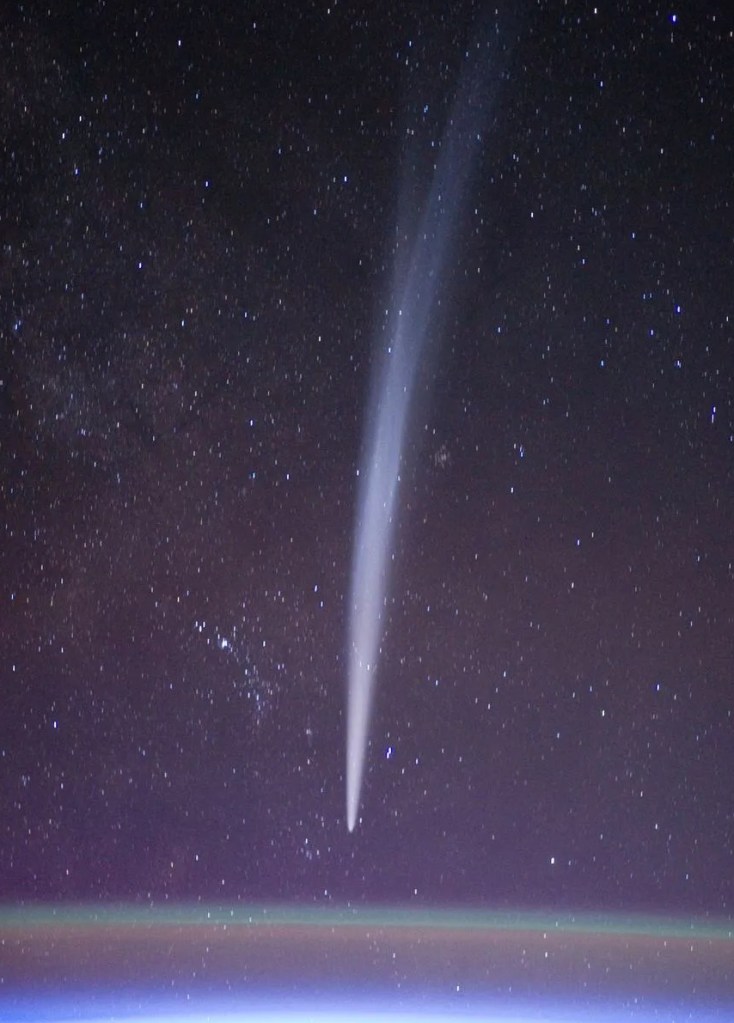


Was the Star of Bethlehem a Comet?
Article written by Clare Merry January 2023
KEY QUESTIONS
- What evidence is there that the Star of Bethlehem was a comet?
- How does the visit of the Magi and the flight into Egypt pinpoint the year of Jesus’ birth?
- Are there any records of a comet appearing at the right time to be a sign of the birth of Christ?
- What is the significance of the title ‘Lamb of God’ and the time of year when Jesus was born?
- Is the ‘Three Kings’ visit just a story or does it show something of deeper significance?
1. Introduction
At Christmas this year I decided to entertain the local Association of Christian Writers group at their Christmassy mince pie do with a piece on the Three Wise Men. Hence, I did some research on the origins of the three wise men coming from Persia and found they were priests and astronomers.
I started to look into what the Star of Bethlehem could have been? A recent BBC 2 programme “Chris and Michaela: Under the Christmas Sky” shown on Boxing Day 2022 suggested that the Star of Bethlehem was actually a conjunction of the planets. There was a conjunction of the planets Jupiter and Saturn three times in 7 BC. Mars joined Jupiter and Saturn in 6 BC. This is a very rare occurrence. It was recorded on a Babylonian clay tablet, the star almanac of Sippar dated to 7 BC. But this, although an unusual happening that could be taken as a sign, would look like points of light in close proximity, not something moving across the sky as the star was supposed to have done.
I then remembered Halley’s Comet, a well-known sign and quickly found that it has been proposed that Halley’s Comet was the Star of Bethlehem. But Halley’s Comet appeared in 12 BC – a bit too early to correspond to the birth of Christ, even if Jesus was born before 1 AD. And then I found Colin Humphrey’s article ‘The Star of Bethlehem’ published in Science and Christian Belief Vol. 5 in 1995. Colin Humphreys proposes that the phenomenon named the ‘Star of Bethlehem’ was indeed a comet.
I got my light-hearted speech done in time for Christmas, and then continued to write an article on this theme after Christmas comforted by the thought that the Three Wise Men only arrived in Bethlehem after Jesus was born, and we celebrate the ‘Three Kings’ at Epiphany on the 6th January. The three kings have been journeying around our church all through Advent, getting ever closer, arriving at the stable at midnight of the 24th December. They’ll be gone by next Sunday, but not before I finish writing this article.
2. Second chapter of the Gospel of Matthew
“After Jesus was born in Bethlehem in Judea, during the reign of King Herod, Magi from the east came to Jerusalem and asked, ‘Where is the one who has been born King of the Jews? We saw his star when it rose and have come to worship him.’”
Persia has the oldest tradition of astronomy – star-gazing – in the world. The earliest catalogues of stars dating from 1200 BC were Babylonian. The clay tablets recording observations of celestial phenomena in cuneiform writing are known as the Enuma Anu Enlil. Magi is a Persian word for priest astronomer among the Medes. These priests discerned signs and messages in stars and planets. They also navigated across deserts using the astrolabe to plot the stars.
The Magi arrive at Jerusalem and approach Herod. King Herod did not like the sound of what he heard; he didn’t want any rivals to the throne. He was informed by the Jewish teachers of the law that the prophet Micah had prophesied that the Messiah would come from Bethlehem. So Herod sent the wise men to Bethlehem to find the child, saying that he also would go there to worship him, although he intended nothing of the sort.
Matt 2:9 “After they had heard the king, they went on their way, and the star they had seen when it rose went ahead of them until it stopped over the place where the child was. When they saw the star, they were overjoyed. On coming to the house, they saw the child with his mother Mary, and they bowed down and worshipped him.”
The wise men set out again travelling south from Jerusalem towards Bethlehem. They were overjoyed to see the star ahead of them. It confirmed that they were heading in the right direction. In Bethlehem they found the baby, bowed down and offered their gifts. The three wise men were warned in a dream not to return to Herod, so they returned to their country by a different route.
3. When was Jesus born?
At this point we need to discuss when Jesus was born to see if any comet appeared coinciding with this date. It is actually certain that Jesus was not born in 1 AD, but several years before this date.
Matt 2:13-20 tells how, after the Magi left, Joseph had a dream in which an angel tells him to take the mother and child and flee to Egypt. Herod had all the baby boys of Bethlehem killed. Joseph and Mary get up and flee from Bethlehem in the night. They reside in Egypt until sometime later when Joseph has another dream of an angel. The angel tells him that Herod is dead so it is safe to return to Israel with the mother and child.
Herod the Great came to the throne in 37 BC and died in 4 BC. Joseph and Mary return to Israel sometime after this. They avoid Jerusalem, the seat of power, and go to the little quiet unknown place of Nazareth. It means that Jesus must have been born at least one year before 4 BC. This implies he could have been born in 5 BC.
Jesus was in his 30s when he started his three year ministry and he was crucified in AD 33. If Jesus was born in 5 BC it means that he started his mission aged 34 and was aged 37 when he died.
(Note that in calculations of Jesus’ age there was no zero AD or zero BC so 1 AD = 1BC).
4. A comet of 5 BC?
The article, ‘The Star of Bethlehem’ in Science and Christian Belief written by Colin Humphreys was a great find. It supplies most of the facts upon which this article is based. He recommends that rather than thinking that the Bible is untrue, as many people think today, or surmising that the Biblical authors were using literary devices to make stories more exciting for their readers, we should start out with the premise that the Bible is true. If we knew enough about the phenomena described in the Bible, we might see that the Biblical description was accurate after all. Colin Humphreys believes that the Star of Bethlehem and other events that are part of the Bible refer to real, naturally occurring phenomena. Often the miracle is not in the phenomenon itself, but in the timing of its occurrence.
Colin Humphreys takes the stance that the report of a star appearing as part of the birth of Christ narrative in the gospel of Matthew is a correct description of events. He investigates whether any astronomical phenomena fit the description given in the Bible.
The Chinese kept careful records of comets. They labelled tailed comets ‘sui-hsing’ or ‘suibsing’ meaning broom. There is a Chinese catalogue of comets called Ho Peng-Yoke that records a bright comet for 5 BC under catalogue number 63. The Ho Peng-Yoke record relies on the Han shu record which was the official history of the Han dynasty.
The comet of 5 BC is described thus, “Second year of the Chien-p’ing reign period, second month (5 BC, March 9-April 6), a suibsing appeared at Ch’ien-niu for over 70 days.”
Ch’ien-nui is a part of the sky that would have been visible to the east in the early morning. Thus, a comet rose in the east. It appeared between the 9th March and 6th April 5 BC. It was visible for 70 days. This implies that it must have been very bright during some of that time, and so quite exceptional. It was labelled “sui” which means tailed comet.
Thus, Colin Humphreys in his article ‘The Star of Bethlehem’ in Science and Christian Belief Vol. 5 (1995) gives convincing evidence that the star was a comet that appeared in 5 BC.
5. Three indications that the Star of Bethlehem was a comet:
The Star of Bethlehem behaved like a comet in three particular ways.
The first indication of it being a comet is its unexpected appearance
Comets are actually giant snowballs made of water ice covered with tar. They orbit the Sun in highly elliptical orbits that swing out into the outer Solar System and back around the Sun again. As they approach the Sun, the heat melts the ices and causes a stream of gases to flow out from the comet as a tail streaming behind. Comets may be seen once as they approach the Sun or twice if they are seen on their way back out again.
Halley’s Comet is a short-period comet that returns to pass the Earth regularly every 76 years on average, but there are long-period comets with orbits of over 200 years. Their orbits are very elliptical going out far beyond the planets. Long-period comets approach the Sun from all angles and many have retrograde motion around the Sun.
Thus, comets may suddenly appear. They can be extremely bright with long tails. Their brightness gets more and more intense as they pass by the Earth and approach the Sun turning them into dramatic events.
The second indication of it being a comet is that it moved across the sky
Over a certain number of days or weeks a comet may move across the sky. Comets that are visible to the naked eye often appear to be low-lying to the Earth compared to the background of stars that do not move.
They may move slowly or rapidly across the sky in various directions as comets approach the Sun from all angles.
Halley’s Comet moves northwards across the sky, visible for a number of days or weeks depending on the position of the Earth in relation to the Sun.
We know that the wise men’s first port of call was Jerusalem and Herod’s palace. Bethlehem is 6 miles south of Jerusalem. The star goes ahead of the wise men on their way to Bethlehem. This means that the star was moving southwards. It is perfectly possible for a comet to be moving southwards, especially if it were a long-period comet.
This implies that the wise men travelled southwards, not northwards from Persia to Judea. If the wise men came from Media in the region below the Black Sea and Caspian Sea, and maybe from a part called Lydia (now Turkey), they would have travelled south to reach Jerusalem and Bethlehem. The Magi were a priestly group that originated in the 6th century BC among the Medes of Media.
Thus, while Halley’s Comet moves towards the north, the comet of 5 BC may well have been moving towards the south.
Colin Humphreys explains that during the 70 days the comet of 5 BC was seen, the constellations would move round by a certain number of degrees so the direction would appear to change. The constellations of stars form a backdrop to a comet moving within the Solar System.
The third indication of it being a comet is that it stopped over Bethlehem
A curious thing about comets, and proof that it was a comet is that comets can be seen to ‘stand over a city’ pointing down to it. When a comet points in this way, its tail is vertical so it looks like an arrow in the sky. Maybe the comet is receding away at this point, as it may then disappear. The Star of Bethlehem stopped over Bethlehem before disappearing.
The Chinese called comets ‘broom stars’ due to their shape and orientation, while ancient texts of the West described them as resembling swords. A sword over a city would be more ominous.
When the Star of Bethlehem stops, the wise men find Mary and the baby. It may be that they made inquiries in Bethlehem or that the star was seen to stop just as they were passing by a particular house, and so they went in. By the time the three wise men reach Bethlehem, Mary, Joseph and baby Jesus are no longer staying in a stable as at least two months have gone by.
6. Comets as signs
From ancient times comets seen as bright stars in the sky were taken as signs of momentous happenings on Earth – portents of changes of power in government. The Star of Bethlehem was not a customary event, but an unexpected appearance indicating that it had special significance.
The Chinese called these stars ‘broom stars’ due to their shape. For one of these comets that appeared in 524 BC the Chinese account said that it was a ‘new broom’ that would sweep away traditions and the old order of things.
In the ancient world of the West, a star appearing and shining brightly was seen as a sign that a great king had been born. Pliny the Elder (Natural History 11,23) records that Caesar Augustus dedicated a temple to a comet that appeared during the athletic games he sponsored in 44 BC. Caesar Augustus later reigned the Roman Empire from 27 BC to 14 AD. He had coins minted in 18 BC with a comet above his head with eight rays. This shows that comets were viewed as a good sign.
It was only later, maybe after 1066, that some started to see comets as omens of destruction. Some English monks described the appearance of Halley’s Comet in 1066 in these terms, while the Normans proudly had it embroidered onto the Bayeux Tapestry.
A comet standing over a city was sometimes likened to a sword pointing down. Bethlehem was to experience both the birth of a king, and the sword of blood shed.
7. Was Jesus born at Passover?
The first appearance of the star seems to mark the exact time of Jesus’ birth – at least King Herod interpreted it this way:
Matt 2:7 “Then Herod called the Magi secretly and found out from them the exact time the star had appeared.”
This implies that the Messiah – Jesus was born on the day the star appeared in the sky, and it appeared before Passover.
The comet of 5 BC recorded by the Chinese appeared sometime between the 9th March and 6th April in 5 BC in China. In 5 BC the Passover in Jerusalem was on the 20th April. People arrived for Passover a week before so they could do purification rites, and the feast itself lasted a week.
The Passover lambs – without spot or blemish – were chosen on the 10 Nisan of the Jewish calendar which was Sunday 14th to Monday 15th April 5 BC.
Colin Humphreys does not say this, but in my estimation, the latest date on which the star appeared was the 6th April – if Jesus was born on the 6th April and circumised eight days later, he would have been circumcised on the 14th April. Thus, he would have received the symbol of being born of the chosen people on the day that the sacrificial lambs were chosen.
Colin Humphreys notes that in the gospel of the Apostle John, John the Baptist twice says “Look, the Lamb of God” as Jesus came near (John 1:29; 1:36). This is strange phraseology, unless John the Baptist knew that Jesus was born at Passover. John the Baptist would have known when Jesus was born as they were related to each other through Mary and her aunt Elizabeth.
He also notes that Jews expected the Messiah to come in the month of Nisan of the Jewish calendar. This marks the season of the Exodus from Egypt and Passover.
I believe that Jesus was born just before the Passover lambs were chosen for the sacrifice of Passover. It means that both his birth and death were linked to his identity of being the ‘Lamb of God’.
8. Supporting evidence that Jesus was born at Passover
There are two lines of evidence to support the view that Jesus was born just before Passover in the month of April:
“There was no room at the inn.”
Jerusalem and Bethlehem nearby would have been very busy between the 13th and 27th April 5 BC as all adult Jewish males were required to celebrate Passover at the Temple.
Jewish families went to Jerusalem before the festival to prepare for it. Thus, the guest room of Joseph’s family house in Bethlehem may have been full due to it being the festival of Passover, coinciding with a census.
If everywhere was crowded due to Passover, this would be the reason that there was nowhere to stay, except in a stable.
Shepherds on the Hills
The shepherds mentioned in Luke chapter 2 are watching their flocks at night when angels appear to them on the hills to say that a Saviour has been born and as a sign they will find him lying in a manger.
At this time, sheep were only pastured out on the hills all night between March and November in Judea. Between December and February it was too cold for them outside at night so they were kept inside in barns after dark.
The shepherds mentioned in the narrative of the birth of Christ show that he was not born in December, but could have been born in April. The shepherds descended to Bethlehem from the hills above the town, with sheep and lambs and found the baby hidden in the feeding receptacle beneath the hay. It was probably the sheep that found him when they went to feed on the hay.
We already know that Jesus was not born on the 25th December. December was chosen for the celebration of the birth of Christ because it was put in the place of the pagan celebration of the winter solstice in Europe. The solstice was mistakenly thought to occur on the 25th December rather than the 21st December.
9. Visit of the Magi
The comet of 5 BC was visible for a very long time – 70 days. The Magi see this star rise in the east and get ready and set out for Jerusalem.
I see the appearance of the star as marking the birth of the Messiah as the exact time of its appearance seems to be important. After Jesus was born, he was circumcised on the 8th day and dedicated in the Temple on the 40th day after birth. Mary and Joseph are offering a sacrifice of two doves when Simeon and then Anna come up and prophesy over him (Luke 2:21-38). Having done this, they return to Bethlehem and are living in a house, not a stable. Sometime later, maybe a month later the Magi turn up.
The 70 days or 2 months and 10 days time scheme implies that the journey either took a very long time, although it should not take this long, or that the wise men in search of the Messiah were held up by Herod in his palace for a very long time. The latter is implied by their joy that the star was still visible when they continued their journey from Jerusalem to Bethlehem (Matt 2:9 ).
The whole time scheme seems strange unless you consider that Herod might have been holding them up and trying to dissuade them, and make them turn back. The Magi are not dissuaded. They probably warned Joseph and Mary of danger, as they flee to Egypt as soon as the Magi have left.
This is the chronology around the birth of Jesus given by Colin Humphreys:
Birth of Jesus in Bethlehem (13-27th April 5 BC, but I think 6th April 5 BC)
Visit of the shepherds
Circumcision on the 8th day
Presentation in the Temple 40 days after birth
Visit of the Magi after this
Flight to Egypt after the Magi leave
Death of Herod in 4 BC
Return from Egypt in 3 BC
10. Conclusion
The three wise men followed an actual astronomical phenomenon that appeared in the east. It led them from Persia to Judea. The phenomenon travelling across the sky was a comet probably travelling southwards.
As stated in the birth narrative of the gospel of Matthew, the star, in the line of sight of the wise men setting out again from Jerusalem, stopped over Bethlehem. It stood over the town, pointing down – as only comets can do when their tails stream out vertically. It pointed to the place where the Magi found the long-awaited Messiah, born King of the Jews.
Colin Humphreys shows that a bright comet did appear in 5 BC. It was recorded in a Chinese catalogue of comets. This comet, I firmly believe, was the comet of the birth of Christ – who is known to have been born at least a year before 4 BC.
The month in which the comet of 5 BC appeared shows that Jesus must have been born just before Passover which was on the 20th April in 5 BC. He was born and circumcised eight days later as the lambs were being chosen and prepared for the Passover sacrifice. This symbolically reveals Jesus Christ’s identity as the Lamb of God.
3488 words.
Bibliography:
NIV Bible Gateway
Humphreys, Colin 1995 The Star of Bethlehem in Science and Christian Belief Vol. 5, pages 83-101.
Wikipedia:
Halley’s Comet ; List of Halley-type comets
The Assumption of Mary: Jerusalem or Ephesus?
Article written by Clare Merry May 2023
- Introduction
The Assumption of Mary is a belief shared by Orthodox and Catholics, but not shared by Protestant Christians.
The Assumption of Mary has been celebrated throughout the church since before the 5th century. The Feast of the Assumption was established in the eastern church on the 15th August by Emperor Maurice in about 600 AD. In the East it is called the Feast of the Dormition. It was brought to the West in the 7th century where it later changed its name to Feast of the Assumption.
At the Reformation most Protestants ceased to venerate Mary. The Lutheran Church retained the 15th August but in a lesser way as a celebration of ‘Mary, Mother of Our Lord’, while the Anglican Church dropped this festival in 1549.
I, personally, do believe in the assumption of Mary – that her body was taken up after she died. I am also very familiar with Rosary groups and other devotions having been a Catholic, but I think an over-emphasis on Mary is not the right way to go and over-piousness is not a good option.
This article will cite various pseudepigrapha writings as these have been used to derive certain beliefs or originate from certain beliefs about Mary.
2. No Bodily Relics of Mary
There are relics of many, if not most saints, but there are no relics of the Virgin Mary.
John of Damascus or John Damascene (c.675 – c.750), a Christian Arab theologian wrote the following about a request for the relics of Mary to be sent:
“St Juvenal, Bishop of Jerusalem, at the Council of Chalcedon (451), made known to the Emperor Marcian and Pulcheria, who wished to possess the body of the Mother of God, that Mary died in the presence of all the Apostles, but that her tomb, when opened upon the request of St Thomas, was found empty; wherefrom the Apostles concluded that the body was taken up to heaven.”
The following year the burial shroud left behind in the tomb of Mary was sent instead:
John Damascene preaching on the Feast of the Assumption at Gethsemani recalled that the shroud of the Blessed Virgin that had been preserved in the Church of Gethsemani was sent by Bishop Juvenal of Jerusalem to Emperor Marcian and Pulcheria his wife in Constantinople in 452. This relic was then venerated in the Church of Our Lady of Blachemae in Constantinople.
A clothing relic of Mary was the Holy Girdle. This was Mary’s belt that she is said to have dropped for the apostle Thomas to pick up when he saw her being assumed into heaven. The belt was a knotted cord like the one worn by priests today. It was kept in the Vatopedi monastery on Mount Athos, Greece.
Very much less reliable Medieval relics for Mary were hair, nails and breast milk. Her hair was exposed for veneration in Rome and churches in France. Today there is no veneration of these relics of Mary that I know of, although this type of veneration was very abundant in the past.
The Chapel of the Milk Grotto in Bethlehem is a Marian shrine constructed above three caves. Tradition has it that the Holy Family hid in this cave during the Massacre of the Innocents before they could flee to Egypt. The story goes that while there, a drop of Mary’s milk fell to the floor of the cave and changed its colour to white.
3. Enoch and Moses Assumed Assumption
There are two cases of possible assumptions in the Old Testament. The first was of a man who disappeared and the second of burial in a grave that was never found.
Enoch
Enoch was the great grandfather of Noah. He was a prophet who walked with God. He is the first example of someone assumed into heaven. In the case of Enoch it is not stated that he died before being taken up.
Genesis 5
21 When Enoch had lived 65 years, he became the father of Methuselah. 22 After he became the father of Methuselah, Enoch walked faithfully with God 300 years and had other sons and daughters. 23 Altogether, Enoch lived a total of 365 years. 24 Enoch walked faithfully with God; then he was no more, because God took him away.
Hebrews 11:5
“By faith Enoch was taken from this life, so that he did not experience death; he could not be found, because God had taken him away, for before he was taken, he was commmended as one who pleased God.”
Jude 14 is another reference to Enoch in the New Testament. Enoch who lived in the seventh generation from Adam prophesied about the judgment of ungoldly men.
Moses
There is a tradition that Moses was assumed into heaven. There is no tomb for Moses. Deuteronomy 34 records the death of Moses as follows:
1Then Moses climbed Mount Nebo from the plains of Moab to the top of Pisgah, across from Jericho. There the Lord showed him the whole land—
5 And Moses the servant of the Lord died there in Moab, as the Lord had said. 6 He buried him in Moab, in the valley opposite Beth Peor, but to this day no one knows where his grave is. 7 Moses was a hundred and twenty years old when he died, yet his eyes were not weak nor his strength gone.
Belief in the assumption of Moses is alluded to in the New Testament in Jude 9:
9 But even the archangel Michael, when he was disputing with the devil about the body of Moses, did not himself dare to condemn him for slander but said, “The Lord rebuke you!”
It is said that the letter writer Jude was referring to a pseudepigrapha book called The Assumption of Moses or Testament of Moses written in the 1st century AD. However, this writing does not say anything about the assumption of Moses after he died, although a good part of the text is missing. The key thing is that after burial in a cave, the cave and the body were never found again.
Ezra
Some Jews saw Ezra as the new Moses and claimed he was assumed into heaven at the end of his life. Ezra lived at the time of the return from exile in Babylon and was the priest and prophet who set up Second Temple Judaism. The Jewish historian Josephus Flavius wrote that when Ezra died there was a big funeral and he was buried at Jerusalem. There is no evidence of any assumption for Ezra.
When I googled it, I found that there was the assumption that Ezra was the prophet Malachi. But this is a different meaning of the word assumption.
4. Elijah Collected by Chariot
Elijah was born in c.900 BC. He saved the religion of Israel from being corrupted by the worship of Baal. Baal was a collection of gods including the Canaanite god of fertility. These gods had representations – idols that were worshipped in the idolatry prohibited by the Ten Commandments.
When the prophet Elijah knew it was time to depart from this world, a chariot appeared that he was expecting. It took him up to heaven but as he went up, he dropped his cloak for Elisha to pick up.
2 Kings chapter 2:
1When the Lord was about to take Elijah up to heaven in a whirlwind, Elijah and Elisha were on their way from Gilgal. …….
7 Fifty men from the company of the prophets went and stood at a distance, facing the place where Elijah and Elisha had stopped at the Jordan. 8 Elijah took his cloak, rolled it up and struck the water with it. The water divided to the right and to the left, and the two of them crossed over on dry ground.
9 When they had crossed, Elijah said to Elisha, “Tell me, what can I do for you before I am taken from you?”
“Let me inherit a double portion of your spirit,” Elisha replied.
10 “You have asked a difficult thing,” Elijah said, “yet if you see me when I am taken from you, it will be yours—otherwise, it will not.”
11 As they were walking along and talking together, suddenly a chariot of fire and horses of fire appeared and separated the two of them, and Elijah went up to heaven in a whirlwind. 12 Elisha saw this and cried out, “My father! My father! The chariots and horsemen of Israel!” And Elisha saw him no more. Then he took hold of his garment and tore it in two.
13 Elisha then picked up Elijah’s cloak that had fallen from him and went back and stood on the bank of the Jordan. 14 He took the cloak that had fallen from Elijah and struck the water with it. “Where now is the Lord, the God of Elijah?” he asked. When he struck the water, it divided to the right and to the left, and he crossed over.
15 The company of the prophets from Jericho, who were watching, said, “The spirit of Elijah is resting on Elisha.” And they went to meet him and bowed to the ground before him. 16 “Look,” they said, “we your servants have fifty able men. Let them go and look for your master. Perhaps the Spirit of the Lord has picked him up and set him down on some mountain or in some valley.”
“No,” Elisha replied, “do not send them.”
17 But they persisted until he was too embarrassed to refuse. So he said, “Send them.” And they sent fifty men, who searched for three days but did not find him. 18 When they returned to Elisha, who was staying in Jericho, he said to them, “Didn’t I tell you not to go?”
This passage in the history of Israel written by Baruch and Jeremiah seems to suggest that Elijah did not die, but was taken up. Although he may have died and at once his body was transported away and so did not undergo corruption on earth. The same may be true of Enoch. In the case of Moses it is stated that he died and was buried in a cave.
Moses and Elijah join Jesus at the Transfiguration
The assumption of Elijah is not disputed. I decided to go with the tradition that Moses was assumed as well because he reappeared at the transfiguration of Jesus. Bodily reappearance appears to be dependent on the person having been assumed after death.
Luke 9
29 As he was praying, the appearance of his face changed, and his clothes became as bright as a flash of lightning. 30 Two men, Moses and Elijah, appeared in glorious splendor, talking with Jesus. 31 They spoke about his departure, which he was about to bring to fulfillment at Jerusalem.
When Jesus was transfigured on the mountain in the time leading up to the crucifixion, he was joined by these two prophets testifying that they lived and were not dead. Moses represented the Law, while Elijah was chief of the prophets. These two symbolically summed up the Old Testament, as Jesus came to fulfill the Old Testament prophecies.
5. Assumption of Mary
Assumption is a word associated with the Virgin Mary, although we have seen that there were two and maybe three precedents for this in the Old Testament with Enoch, Moses and Elijah.
The New Testament does not describe the later years of Mary or how she died. Information concerning Mary’s death, burial and assumption come from a pseudepigrapha work called The Passing of Mary attributed to Joseph of Arimathea.
In The Passing of Mary all the apostles gather round Mary when she is dying at her house in Jerusalem. The pseudepigrapha work claims that they were miraculously brought back to Jerusalem to be there from the countries where they had gone for their missions.
Thomas is not there. He comes late, but in time to see Mary’s resurrected body being assumed into heaven three days after she died and was buried in a tomb. Mary sees Thomas and throws down her belt (girdle) to him as a sign.
Thomas, the doubter is now the believer in resurrection and assumption. He tells the other apostles that Mary has been asssumed into heaven, but they don’t believe him. Thomas demands that her tomb be opened to show them he is right. The tomb is found to be empty.
I think that the apostles could have all been present when Mary died, but they returned from their mission fields to attend the Council of Jerusalem in 50 or 51 AD. They were found back in Jerusalem by natural means, and at this point, just before the council took place, Mary died naturally of old age.
The miraculous sign of throwing down the girdle by which she could be identified may just be embellishment. However, in essence, I do believe that Mary lived and then died in Jerusalem, and that her resurrected body was assumed into heaven from her tomb outside Jerusalem. This is confirmed to me by there being no relics of Mary even though there are relics of many other saints, and pilgrims in early times all went to see her empty tomb.
Thomas was the apostle who was not present at the first appearance of the resurrected Christ. He was the one who doubted. This fault is corrected when Thomas is the witness of the assumption of Mary or had the revelation that she had been assumed into heaven. It was he who ordered that her tomb be opened and then confirmed to be empty.
The story of doubting Thomas appears in the gospel of John 20:24-28:
24 Now Thomas (also known as Didymus), one of the Twelve, was not with the disciples when Jesus came. 25 So the other disciples told him, “We have seen the Lord!”
But he said to them, “Unless I see the nail marks in his hands and put my finger where the nails were, and put my hand into his side, I will not believe.”
26 A week later his disciples were in the house again, and Thomas was with them. Though the doors were locked, Jesus came and stood among them and said, “Peace be with you!” 27 Then he said to Thomas, “Put your finger here; see my hands. Reach out your hand and put it into my side. Stop doubting and believe.”
28 Thomas said to him, “My Lord and my God!
6. Mary Ward of the Temple
The tradition that Mary’s parents were called Anne and Joaquin is derived from the pseudepigrapha writing called the Gospel of James. The book presents Mary as being brought up as a ward of the Temple. The text is thought to have been written in the second century and not by James, the brother of Jesus.
The text asserts that Joseph was a widower with children when he married Mary. James, the supposed writer of this book was Joseph’s eldest son. He asserts that Mary was not his mother. Joseph was much older than Mary, and James his son was older than Jesus.
The aim of this writing is to say that Mary remained a virgin before, during and after the birth of Jesus. It is the oldest source to assert the perpetual virginity of Mary and her purity.
I think it is plausible that Mary’s father was a priest in the Temple because there are two different genealogies of Jesus, and one is the genealogy of Mary. The genealogy given in Matthew chapter 1 is the genealogy of Joseph husband of Mary, and the genealogy in Luke chapter 3 could be a list of priests that led from Mary’s father.
If Mary’s father had died and Mary’s mother also, she could have been taken as an orphan to be protected by the Temple. I see the prophetess Anna as Mary’s grandmother on her mother’s side and Simeon as her uncle on her father’s side – but I plan to write about Mary’s family in another article later on.
I think that the brothers and sisters of Jesus were the children of Joseph from a previous marriage, so Joseph would be much older than Mary. Joseph died while Jesus was in Capernaum. I wrote about this in a previous article about Mary.
Mystery Plays
The Gospel of James reads like a mystery play script. It is not anything like the Letter of James included in the New Testament.
Mystery plays about Biblical characters were very popular in Europe during the Middle Ages. There are well-known written plays dating from the 15th century, but their history goes back to the 5th century. At this time living tableaux with actors and locals taking part were introduced into sacred services to bring to life the Bible stories for the faithful. At first liturgical dramas were written by monks and put on by priests.
The popularity of these Biblical plays grew enormously with troops of actors going from place to place with a cart containing the relevant scenery and props. Miracle plays about the lives of saints and their miracles joined the Mystery plays. Many Miracle plays involved St. Mary, although apart from the Virgin Mary, Mary Magdalene’s life was a common theme.
When the Pope finally banned these dramas as part of religious liturgy in 1210, the craft guilds took over their organization. Each guild did a play connected to their profession, for example, the builders’ play was about building Noah’s Ark, the goldsmiths did the Visit of the Magi and the bakers did the Miracle of the Five Loaves and Fishes.
Eventually these plays became more and more secular with entertainment, rather than faith as their focus, and comic scenes were added in. The Protestant Reformation and establishment of the Church of England in 1534 put an end to these plays in Engand, which were by then often irreligious.
I feel convinced that pseudepigrapha writings of the 1st to 3rd century AD were the forerunners of Mystery Plays. I’ve had a go myself at turning a set of historical facts into a drama by converting the facts into dialogue between characters. What happens is that, while the bare bones of the story are real historical facts, all of the dialogue is fictious.
Pseudepigrapha works always contain a strong story line, dialogue between the main protagonists, and an amazing miracle. Most of them have a moral too for the audience to take away.
Playwrights make their dramas entertaining by employing artistic licence. This is not aimed at deceiving, but of enthralling the audience. However, you would not rely on the content of the story as being true.
Pseudepigrapha works are not ‘non-canonical books of the Bible’, or books that missed inclusion in the Bible nor are they anything like most books of the Apocrypha included in Orthodox and Catholic Bibles. Pseudepigrapha works are dramas about known characters of the Bible which were never intended for any inclusion in the Bible itself.
7. Ark of the Covenant
Mary living at the Temple is linked to her being symbolically the ‘Ark of the New Covenant’. Assumption is a belief connected not only to people, but also to the Ark of the Covenant.
The Ark of the Covenant was a wooden case covered with pure gold. The lid was elaborately designed with two cherubim. God spoke to Moses from between the two cherubim on the Ark’s cover. Inside it contained the two tablets of the Ten Commandments as well as Aaron’s rod and a pot of manna.
The Ark was carried ahead of the Israelites as they moved out of Egypt towards the Promised Land. When encamped, it was kept in the tent of meeting or tabernacle.
When they arrived in the land of Israel, the Ark of the Covenant was kept in a shrine at Bethel. The location of Bethel is now the West Bank close to Jerusalem. Elijah and Elisha passed by Bethel just before Elijah was taken up.
King David decided to build a temple in Jerusalem to house the Ark. The Temple was finally built by Solomon and at the inauguration the Ark was taken by priests into the Holy of holies.
In 587 BC the Babylonian conquest of Israel led to the destruction of the Temple and the exile of the Jews, carried off to Babylon. The Ark was not taken to Babylon. Some say it was hidden in a cave and never found again, but Orthodox Jews believe it was assumed into heaven.
What actually happened to the Ark of the Covenant is recorded in the second book of Maccabees which is a book belonging to the Apocrypha in Orthodox and Catholic Bibles.
This is a shortened version of 2 Maccabees 2:4-8:
According to the official records the prophet Jeremiah, in obedience to a divine revelation, issued orders that the tent and the Ark should accompany him to the mountain that Moses ascended to view the promised land. Upon arriving there Jeremiah found a cave where he placed the tent, the Ark and the alter of incense, after which he blocked off the entrance with stones. Some of his companions came up later with the intention of marking out the path, but they were unable to find it. When Jeremiah learned of this, he rebuked them and said “This place is to remain hidden until God has compassion on his scattered people and gathers them together.” Then the glory will appear as at the time of Moses and Solomon.
Jewish Orthodox belief is that the Ark of the Covenant was taken up from the place where it was hidden, and assumed bodily into heaven. God took it away because those on earth did not have a level of holiness that could accomodate this holy container.
In Revelation chapter 11 after the blast on the 7th trumpet it is proclaimed that “the kingdom of the world has become the kingdom of our Lord and of his Christ” and at verse Rev. 11:19
“God’s temple in heaven was opened, and within his temple was seen the ark of the covenant. And there came flashes of lightning, rumblings, peels of thunder, an earthquake and a great hail storm.”
The apostle John wrote Revelation. This verse indicates that John believed with other Jews that the Ark had been taken up to heaven and was still there awaiting the coming of the Kingdom of God.
When the Jews returned from exile they built the Second Temple. This was greatly expanded by Herod into a huge Temple complex with outer courts and inner courts, and at the centre, the Holy of holies separated by a long curtain. But the Holy of holies was empty. There was no Ark of the Covenant, no tablets of the Law and no shekhinah glory – for the light of God was elsewhere.
Jesus was the fulfilment of the Law represented by the stone tablets of the Ten Commandments. Mary was the bearer of the Christ. She was the holy receptacle who brought Christ into the world to share our human nature. Just as the Ark was the golden container of the tablets of the Law, Mary was the container bearing the Christ. In this way she is the Ark of the New Covenant.
As God’s glory rested on the Ark, God’s favour rested on Mary, and she was full of grace.
The most sacred place of the Temple was the Holy of holies, but while in the First Temple it contained the Ark of the Covenant, in the Second Temple it was empty. Mary living as a child in the Second Temple had brought back the Ark; she was the Ark, the container that would bring back the presence of God to this world.
At the exile, the Ark of the Covenant was buried in a cave by the prophet Jeremiah, and disappeared. At the end of her life, Mary died and was buried in a cave – her tomb was found to be empty three days later. The Ark and Mary were assumed into heaven because they were the containers of God.
8. Mount Zion
It is known that Mary spent the remainder of her days after the crucifixion in the household of the apostle John:
From the cross Jesus gave the care of his mother to his youngest apostle, John, and the care of John to his mother.
This is what the Gospel of John records:
“Near the cross of Jesus stood his mother, his mother’s sister, Mary the wife of Clopas, and Mary Magdalene. When Jesus saw his mother there, and the disciple whom he loved standing near by, he said to his mother, “Dear woman, here is your son,” and to the disciple, “Here is your mother.” From that time on, this disciple took her into his home.” (John 19:25-27)
Where was John’s house?
There is no dispute that John lived with Mary in Jerusalem after 33 AD for at least about 12 years. Mary played a key role in holding the very early Christian community together in Jerusalem participating in their prayer meetings.
The early tradition is that John continued to live in Jerusalem and only left after Mary died and after the Council of Jerusalem in AD 50/51. A later thesis is that John went to Ephesus with Mary so she spent the last period of her life in Ephesus.
I decided that to form an opinion on this issue I would look at the location of churches built to mark the locations of events in the life of Jesus and of the early church.
Abbey of the Dormition on Mount Zion
The Abbey of the Dormition was built to mark the spot where Mary lived and died according to early church tradition. The church marking the location of Mary’s house is outside Zion Gate on Mount Zion, south west of the city. It is near the site of the Last Supper. It is an ancient Christian Quarter now the Armenian Quarter.
During the Byzantine period of the 6th century there was a church called Abbey of Hagia Sion. It was destroyed in the Persian sack of Jerusalem in 614. The foundations of this church were rediscovered in 1899 and the present Abbey of the Dormition constructed in 1900. It belongs to the Benedictine Order in Jerusalem.
Dormition in French and Latin means ‘falling asleep’. It denotes that Mary died naturally of old age peacefully falling asleep. The church marking the spot where Mary died on Mount Zion also marks the location of the house where she lived.
The connection of Mary with Mount Zion is seen in an Orthodox Ethiopian Church named Church of Mary of Zion in the ancient city of Aksum. This church claims to possess the Ark of the Covenant, but it was last seen in 1691.
9. Tomb of Mary
On the east side of Jerusalem there is a deep valley and ravine called the Kidron Valley or the Valley of the Cedron. Part of it is also called the Valley of Josaphat. There are olive groves and cementeries on the other side of the valley. The Garden of Gethsemani was an olive grove.
Church of the Sepulchre of Saint Mary
North of the Garden of Gethsemani there are some first century tombs cut into the rock. One of these tombs was the tomb where Mary was laid. It is therefore from this location that the assumption took place.
In 455 AD the first century burial caves were expanded by cutting out the rock into the form of a cross with Mary’s tomb in the centre. In the 6th century a church was constructed above it, but this church was destroyed in 614 AD. Crusaders rebuilt the church in 1130 but this church was also destroyed in 1187 AD.
What is left now is a courtyard with a 12th century porch and a stairway of 48 steps leading underground. The 20th step leads into the fifth century church cut into the rock in a cross shape. The tomb of Mary is a bench hewn from the rock. At one time the walls were painted with frescoes and marble slabs marked the spot.
During the first centuries AD many pilgrims went to see Mary’s tomb. Fourth century writings place her tomb at Gethsemani. Fifth century pilgrims went to venerate Mary’s empty tomb outside Jerusalem locating it in the Valley of Josaphat.
Church of the Holy Sepulchre
The Church of the Holy Sepulchre marks the site of Calvary where the crucifixion of Jesus took place and the site of the garden and newly hewn cave where Jesus was buried. Helena mother of Emperor Constantine (reigned 306-337 AD) found the site of the tomb of Jesus and Constantine had the church built above it.
It is very unusual that a burial cave would be located within the city, but Joseph of Arimathea, a rich member of the Sanhedrin owned the garden, and he had commissioned a cave to be hewn for his own burial in the garden.
What this means is that the Resurrection of Jesus Christ took place within the city of Jerusalem.
10. Ascension on the Mount of Olives
Acts 1:9-13
9 After he said this, he was taken up before their very eyes, and a cloud hid him from their sight.
10 They were looking intently up into the sky as he was going, when suddenly two men dressed in white stood beside them. 11 “Men of Galilee,” they said, “why do you stand here looking into the sky? This same Jesus, who has been taken from you into heaven, will come back in the same way you have seen him go into heaven.”
12 Then the apostles returned to Jerusalem from the hill called the Mount of Olives, a Sabbath day’s walk from the city. 13 When they arrived, they went upstairs to the room where they were staying.
Jesus was the first to rise from the dead. Ascension and assumption are different. Thomas Aquinas explains in Summa Theologica Volume 7 pages 647, 649 and 650 that Jesus in his resurrected body ascended into heaven by his own power. On the contrary, when a holy person is assumed into heaven, it is by the power of God, and not by their own power.
The assumption of a holy person is preceded after their death by resurrection. God honours the holy on some rare occasions by not leaving their bodies here on earth after death to undergo the corruption of the grave.
Therefore, Jesus’ ascension was unique. Christ died, was buried and after three days he rose from the dead. He appeared to his disciples over a period of 40 days. Then the apostles witnessed his ascension from the Mount of Olives.
With assumption the person dies naturally and is buried in a cave. From the burial cave the body is resurrected and then immediately taken up as a person alive into heaven.
Church of Eleona
Eleona is Greek for olive grove. Church of Eleona or church of the olive grove is associated mainly with the site of the Ascension of Jesus into heaven.
Originally a church was built in the 4th century under the direction of Emperor Constantine’s mother Helena to mark the site of the Ascension of Jesus. It was called the Church of the Disciples. The church was built over a cave where Jesus is supposed to have taught his disciples according to the Acts of John. This church was destroyed by the Persians in 614 AD.
The Crusaders built another church on these ruins linking this church with the teaching of the Lord’s Prayer in the cave. This church fell down. In the 19th century another church was built and the foundations of the 4th century church and the cave were found.
It is now the Roman Catholic Church of the Pater Noster (which means Lord’s Prayer) and Carmelite monastery on the Mount of Olives.
11. The Apostle John in Ephesus
Did Mary spend the last days of her life in Jerusalem or in Ephesus? If she lived in Ephesus, then the Assumption occurred in that place and not from her tomb outside the walls of Jerusalem.
Apostle John and the Virgin Mary
The current Roman Catholic claim is that as it is known that the apostle John went to Ephesus as a missionary, and Mary was given to him as a mother to live in his household, then she went with him to Ephesus.
John 19:25-27
25 Near the cross of Jesus stood his mother, his mother’s sister, Mary the wife of Clopas, and Mary Magdalene. 26 When Jesus saw his mother there, and the disciple whom he loved standing nearby, he said to her, “Woman,[a] here is your son,” 27 and to the disciple, “Here is your mother.” From that time on, this disciple took her into his home.
Epiphanius of Salamis (ruined city in Cyprus) in the 4th century said that the Virgin Mary may have gone with the apostle John to Ephesus, but he later stated that she was buried in Jerusalem. No early sources make any mention of Ephesus in relation to the Virgin Mary.
Ephesus was part of the Persian Empire and later part of the Greek Empire of Alexander the Great, but in the first century it was part of the Roman Empire. Ephesus was in the Roman province of Asia. Today it is in Ionia, Turkey.
In the years following the crucifixion, the other apostles left Jerusalem to go on mission to other parts of the world, but it is known that John remained in Jerusalem until after the Council of Jerusalem in AD 50/51. Irenaeus wrote that John went to Ephesus after Mary had died. Irenaeus was the pupil of bishop Polycarp who was taught and appointed bishop of Ephesus by John.
The apostle John lived a very long life, staying in Ephesus, being banished to the Island of Patmos, returning to Ephesus and dying of old age sometime after the times of Trajan which means after 98 AD. If John, the youngest apostle was aged 18 at the crucifixion in 33 AD, then he must have lived until over the age of 83, but he may well have been older. Tradition locates the tomb of John under the former basilica of Saint John at Selcuk, a small town near Ephesus.
The church in Ephesus had been founded by Priscilla and Aquila who had been converted by John the Baptist. It was led by Apollos. Paul had contributed to founding this church on his journeys.
Ephesus is now a collection of impressive ruins 3 km southwest of Selcuk in the Izmir province of Turkey. The city was abandoned in the 15th century after the Fall of Constantinople and the end of the Byzantine Christian Empire.
12. ‘Doorway to the Virgin’
The House of the Virgin Mary is located on Mount Koressos 7 km from Selcuk. When the ruin of the first century house was found in the 19th century, it was a venerated place visited by descendants of early Christians living in a nearby mountain village. They called it ‘Doorway to the Virgin’ and went there on pilgrimage each 15th August which is the Feast of the Assumption.
House of the Virgin Mary
The Ephesus connection started with Sister Catherine Emmerich (1774-1824) and her vision that the Virgin Mary lived and died in a place south of Ephesus in Turkey.
The author Clemens Bretano recorded the German nun’s visions and embellished them using tourist guides. Two missionary priest then discovered an ancient ruined house in the vecinity of Ephesus in 1881 and again in 1891. The house was acquired and restored.
The house now called ‘House of the Virgin Mary’ is considered by Catholics to have been the home of Mary before she ascended into heaven. It is now a Catholic shrine serving as a chapel, complete with spring of water underneath the house and a steady flow of pilgrims visiting the house.
In 1896 Pope Leo XIII and in 1961 Pope John XXIII removed plenary indulgences from the Church of the Dormition in Jerusalem and instead bestowed them on pilgrims who visited Mary’s House in Ephesus. Sister Anne Catherine Emmerich (1774-1824) was beatified by Pope John Paul II in 2004. The dogma of the Assumption proclaimed in 1950 by Pope Pius XII elevated the status of the Ephesus site to ‘Holy Place’.
Arguments against the connection of the Virgin Mary with Ephesus:
- There is no early tradition of Mary living in Ephesus by any Church Father – Orthodox Christians would vouch for this.
- Acts of St John by Prochurus is a pseudepigrapha writing about the apostle John in Ephesus and his memories of Jesus. It was declared heretical at the Council of Nicaea in 787 AD and is classified as a Gnostic text. I am not saying it is a reliable document, but, none-the-less it makes no mention of the Virgin Mary ever having gone to Ephesus. It claims that John went there in the company of Prochurus himself.
- In the 13th century a prothonotary of Ephesus (prothonotary = chief clerk of a Byzantine law court) called Perdicas visited “the glorious tomb of the Virgin at Gethsemani” describing it in a poem. If this writer went from Ephesus to Jerusalem to seek out the tomb of the Virgin Mary to venerate it, he must have known she was not buried in Ephesus.
Who was the virgin of the ‘Doorway to the Virgin’?
There is another writing now entitled Acts of John in Rome but formerly entitled Acts of the Holy Apostle and Evangelist John the Theologian.
This text portrays John as remaining unmarried and being known as ‘the virgin’ in Ephesus. In my opinion, the ‘Doorway to the Virgin’ referred to John’s house with he himself being the virgin in question.
Acts of John in Rome describes John’s arrest in Ephesus for causing trouble at the
Temple of Artemis, his trial in Rome before the Emperor Domitian, and his banishment to the Island of Patmos instead of execution after the miracle he performed at the trial. Later on he returned to Ephesus, there are miracles of people being brought back to life, John organizes the church and appoints Polycarp as bishop of Ephesus.
Although presented among the writings labelled pseudepigrapha, this book Acts of John in Rome rings true to a much higher degree than other pseudepigrapha writings. It is said that Acts of John in Rome consists of stories about John handed down orally and written down by the Greek historian Eusebius of Caesarea sometime before he died in 339. (Acts of John, although written before 180 AD earlier than than the above, belonged to the Gnosticism movement of the 2nd century whose aim was to obtain secret spiritual knowledge (gnosis) – Gnostic writings are not reliable at all).
13. Assumption of the Virgin John
The Basilica of St. John was constructed in the 6th century over the burial site of John the Apostle. It is located in what is now Selcuk about 3.5 km from Ephesus and 7 km from the ‘Doorway to the Virgin’ house on Mount Koressos.
From Basilica of St. John Wikipedia:
Legend has it that John knew a week before that he was going to die and told his disciples that he had been called home. On the following Sunday he went to preach at the small church that existed at that time at Selcuk. After preaching he entered the cave below the church. An intense light filled the cave so that none of John’s disciples could go in. When the light dissipated John had also gone.
Thus, if this legend were true, this cave marked the spot where the apostle John died, was resurrected and his body was at once assumed into heaven.
When this cave tomb was opened during the time of Constantine I in the 4th century no body or relics were found in it. This advanced the legend that St. John was assumed into heaven.
Procopius, a Roman historian of the 6th century wrote that on the site at Selcuk of a small ruined church dating from the time of apostle John, the Emperor Justinian had a huge and beautiful church built. It was completed in 565 AD. The tomb of St. John below the church was also reconstructed. This church, the Basilica of St. John was considered one of the holiest churches at that time, but after the 9th century it was no longer mentioned as another church dedicated to John the Theologian had been built.
The thing which supports belief in the assumption of John is that there are no relics of St. John. John is the only saint apart from the Virgin Mary whose body has not been claimed by anyone anywhere.
As with Jesus and Mary veneration for John consisted only of things that were not the body itself. For Jesus and Mary it was the burial shroud, the wood of the cross, or Mary’s belt. For John it was dust around his tomb that they called ‘manna’. At the Basilica of St. John on the 8th May the dust around the tomb would stir. It was collected into flasks for pilgrims to take home. This went on for hundreds of years.
The Eastern Orthodox Church commemorates the ‘Repose of the Holy Apostle and Evangelist John the Theologian’ on the 26th September; the ‘Feast of the Holy Apostle and Evangelist John the Theologian’ on the 8th May; and John as a member of the twelve apostles on the 30th June.
Therefore, it is my belief that the apostle John lived at the house on Mount Koressos from where he went to a small church at Selcuk 3 ½ miles away to preach. It is here that he entered a cave beneath the church and disappeared from earth. This cave was his empty tomb.
Thus, the assumption that took place near Ephesus was that of St. John when he was very old and called home as the beloved disciple of Jesus. The empty tomb of Mary is located at Jerusalem near where she lived on Mount Zion. Mary’s assumption took place near to Gethsemani at Jerusalem.
Pilgrims went to the small church and later the large basilica of St. John at Selcuk for over a thousand years to see his empty tomb and get a flask of miraculous dust to take home. The assumption of John meant that there were no relics of John to see.
14. Temple of the goddess Artemis
Apparently in the 1st century, Ephesus had 25 to 30 temples to different gods and goddesses, but the biggest temple was for the goddess Artemis. The Temple of Artemis dating from 550 BC was not only big, but it was one of the seven wonders of the world of Classical Antiquity.
The statue of the Lady of Ephesus was adorned with large beads. These beads were found in an excavation showing them to be tear-shaped amber beads that hung on the painted wooden statue.
Artemis was the goddess of hunting as well as being a virgin. In her mythology Artemis refused to have a romantic relationship with any of the gods, and this meant that she could remain independent and free. The chastity of the goddess Artemis meant that virginity was a theme well-known and valued by the inhabitants of Ephesus.
The people, and especially the craftsmen of Ephesus hung on to the veneration of their goddess jealously against Christians in the first centuries. The Christians threatened to bring down their lucrative commerce in statuettes of the goddess and other merchandise sold to pagan pilgrims. Paul’s visit to Ephesus gives a clear insight into this pagan world:
Acts 19:23-41 The Riot in Ephesus
23 About that time there arose a great disturbance about the Way. 24 A silversmith named Demetrius, who made silver shrines of Artemis, brought in a lot of business for the craftsmen there. 25 He called them together, along with the workers in related trades, and said: “You know, my friends, that we receive a good income from this business. 26 And you see and hear how this fellow Paul has convinced and led astray large numbers of people here in Ephesus and in practically the whole province of Asia. He says that gods made by human hands are no gods at all. 27 There is danger not only that our trade will lose its good name, but also that the temple of the great goddess Artemis will be discredited; and the goddess herself, who is worshiped throughout the province of Asia and the world, will be robbed of her divine majesty.”
28 When they heard this, they were furious and began shouting: “Great is Artemis of the Ephesians!” 29 Soon the whole city was in an uproar. The people seized Gaius and Aristarchus, Paul’s traveling companions from Macedonia, and all of them rushed into the theater together. 30 Paul wanted to appear before the crowd, but the disciples would not let him. 31 Even some of the officials of the province, friends of Paul, sent him a message begging him not to venture into the theater.
32 The assembly was in confusion: Some were shouting one thing, some another. Most of the people did not even know why they were there. 33 The Jews in the crowd pushed Alexander to the front, and they shouted instructions to him. He motioned for silence in order to make a defense before the people. 34 But when they realized he was a Jew, they all shouted in unison for about two hours: “Great is Artemis of the Ephesians!”
35 The city clerk quieted the crowd and said: “Fellow Ephesians, doesn’t all the world know that the city of Ephesus is the guardian of the temple of the great Artemis and of her image, which fell from heaven? 36 Therefore, since these facts are undeniable, you ought to calm down and not do anything rash. 37 You have brought these men here, though they have neither robbed temples nor blasphemed our goddess. 38 If, then, Demetrius and his fellow craftsmen have a grievance against anybody, the courts are open and there are proconsuls. They can press charges. 39 If there is anything further you want to bring up, it must be settled in a legal assembly. 40 As it is, we are in danger of being charged with rioting because of what happened today. In that case we would not be able to account for this commotion, since there is no reason for it.” 41 After he had said this, he dismissed the assembly.
There has long been a cult of a virgin in Ephesus. The Cult of Artemis celebrated the virginity of the goddess from 550 BC. During the time of the early church the apostle John who went to live at Ephesus became the well-known virgin of that town.
It is my belief that John lived in the house that locals called ‘Doorway to the Virgin’. This house is now the chapel of ‘House of the Virgin Mary’ on Mount Koressos.
This description of the experience of Paul in Ephesus from Acts of the Apostles was similar to the experience of John in Ephesus as described in Acts of John. This was the background to the early church within the Roman Empire, showing how a cult to the virgin could arise.
15. History of the Veneration of Mary
Early sources describing Mary’s death in Jerusalem include: De Orbitu S.Dominae, Transitus Mariae and Liber Requiei Mariae.
Authorship of the prototype of these writings has been ascribed to Leucius Charinus a disciple of the apostle John. The writings dating from the 2nd century appear to be liturgies used at the Tomb of Our Lady.
Devotion to Mary started by the 3rd century in Egypt with the title Theotokos meaning Mother of God or Bearer of God, and a Marian prayer Sub tuum praesidium or Beneath Thy Protection written on a papyrus dated to 270 AD.
The Council of Ephesus in 431 AD brought the first official Marian liturgy. Also, churches started to be dedicated to Mary such as the 5th century Church of Mary in Ephesus which was a cathedral. It was also called Church of the Councils as two church councils took place there.
One of the earliest churches dedicated to Mary was the Church of the Seat of Mary or Ecclesia Kathismatis = Church of the Seat, built in 456 AD and financed by a weathy widow named Ikelia. It was located between Jerusalem and Bethlehem in a place where Mary was alleged to have sat down and rested on the road to Bethlehem.
It was an octagonal church and monastery dedicated to the ‘Birth Giver of God’ or Theotokos. Ikelia introduced a candle lit procession to mark the purification of the Virgin Mary in the Temple 40 days after the birth of Jesus. This festival became ‘Candlemas’ and spread to churches both in the East and West.
The earliest Marian feast of Mary as Mother of God took place at Church of the Seat on the 15th August, inaugurated by Bishop Juvenal, bishop of Jerusalem. The feast was later changed to the 13th August because the feast of the Assumption was fixed on the 15th August.
The 15th August, the Feast of the Assumption was made a public holiday in England by King Alfred the Great in the 9th century. It remains a holiday today, although in the UK the day has become August Bank Holiday Monday.
Church of St. Mary of Blachernae
The Empress Aelia Pulcheria began the construction of a church near a spring of holy water near Constantinople in 450 AD. It was completed by her husband Emperor Marcian after she died. It hosted the Holy Reliquary containing the mantle and robe of the Virgin brought from the Holy Land in 473.
The imperial Palace of Blachernae, the residence of Roman emperors, was constructed beside the church. This proximity made the church one of the most important sanctuaries of the Byzantine Empire. The church housed the icon of Our Lady of Blachernae which was reputed to be powerful as a protection against invading armies and brought out when sieges were threatened.
The early history of devotion to Mary seems to especially figure Jerusalem and Ephesus, with Leucius, a disciple of the apostle John playing a pivotal role. Constantinople with its church dedicated to St. Mary beside the palace of Roman emperors also promoted this devotion.
Ephesus, the centre for the worship of the virgin goddess Artemis in her grand temple appears as the background to the veneration of Mary which grew up in the 5th and 6th centuries.
Collyris cakes
Epiphanius of Salamis wrote about and opposed a heretical sect that arose in Arabia in 300 AD. It consisted of women who worshipped the Virgin Mary as a mother goddess. The women performed rituals and made bread cakes called ‘collyris’ to place on Mary’s alter.
Epiphanius wrote about this sect in Panarion published in 376 AD. The sect was condemned as heretical by the Church.
It appears that the adherents may have considered that Mary was part of the Holy Trinity as God the Father, Mary the Mother and Jesus the Son. Some verses of the Qur’an imply that Muhammad believed that Christians believed this about the Trinity at the time he was writing the Qur’an in 632 AD.
The Trinity in Christianity is God the Father, Son and Holy Spirit. The story of this sect of devotees to Mary indicates that devotion to Mary can lead to a distorted understanding of basic Christian doctrine. It also indicates that this happened early on.
16. Novenas, Litanies and Mediatrix
The 15th August has been Mary’s day since the 5th century both in the East and West. Popes of the West in the 9th century put the Feast of the Assumption on a par with Christmas and Easter by adding various solemnities to it.
The recognized forms of prayer to Mary include the Hail Mary on the beads of the Rosary, and novenas of Rosaries. In the Catholic Church it is or was not customary to use any books as all the prayers were known off by heart.
Novenas
Novenas are prayed in preparation for a liturgical feast or as a petition for a divine favour. The prayers and petitions take place on nine consecutive days leading up to the feast day. The prayers consist of the Rosary and other prayers to saints and to Mary. The Hail Mary is prayed as decades on the Rosary beads and it concludes with Hail Holy Queen mother of mercy….. People usually gather in the church each day to pray, but you can also do it alone at home.
In the month of Mary which is May in the northern hemisphere and October in the southern hemisphere, people gather to pray the Rosary every day in the local church and each day they take a flower from their garden to add to the vase of flowers before her shrine as an offering. Hymns are sung to Mary on these occasions.
Mary is often invoked as one of her marian titles such as Our Lady of Lourdes, Our Lady of Walsingham, Our Mother of Perpetual Help, or Mary Untier of Knots. You have to invoke Mary untier of knots if your problems are difficult and knotted.
This mode of praying using Rosary beads and short prayers known off by heart along with Litanies of Saints is a normal form of prayer in the Catholic Church. However, its use is being more and more confined to small groups now.
Litanies
Litany is Greek for petition or supplication. Litanies were used for penitential processions. In a litany a member of the clergy leads the prayers invoking saints by name, to which the procession followers repy “Pray for us”. Articles of belief about God are also in the list to which the response is “have mercy on us”.
The Litany of Loreto is a litany to Mary which uses all the titles and symbols attributed to Mary by Catholics.
Mediatrix
Mediatrix is a title given to Mary. It rests on the belief that Christ gives graces through his mother Mary. Mary’s mediation is thought to be higher than that of the intercession of any other saint.
Historically the title of mediatrix came from St Ephraim (306-373) a Syrian theologian from Edessa. It was used by St. Bonaventure (1221-1274) a Franciscan bishop from Italy. The culmination of devotion to Mary and the imploring of her intercession came with Louis de Montfort (1673-1716), a French Catholic priest and Alphonsus Liguori (1696-1787), an Italian bishop.
Thomas Aquinas (1225-1274) wrote in Summa Theologica that Jesus Christ is the only perfect mediator between God and human kind. Thomas Aquinas offered a much more moderate position than any of his contemporaries on many issues.
Mary Mediatrix of All Graces was promoted by the Marian visionary Emma de Guzman (born 1949) in the Philippines. This movement awaits Vatican approval not obtained yet. It seems extreme to say ‘all graces’ and in my experience not the case.
17. Allowing and Banning of Religious Images in Church Councils
The veneration of Mary was allowed by church councils from early on, but it was not very long before there were attempts to ban religious images as objects of veneration. Thus, there was an acknowledgment of excess as well as a clinging to this type of piety.
Eucumenical Church Councils
The initial Council of Jerusalem in 50 or 51 AD was attended by the apostles. After this there were four councils of the church attended by the five church patriarchs of Jerusalem (Jewish Church of Judea), Antioch (Syriac Church), Alexandria (Coptic Church of Egypt), Constantinople (Greek Church) and Rome (Latin Church). The councils were as follows:
- Council of Nicaea 325 AD – established the Nicene Creed
- Council of Constantinople 381 AD – on the divinity of the Holy Spirit
- Council of Ephesus 431 AD – rejection of Nestorianism regarding the human nature of Christ and proclaimed Mary as the Mother of God
- Council of Chalcedon 451 AD – defined the two natures of Christ human and divine, and planted the equality of bishops of Constantinople and Rome. The bishop of Rome and his papal delegates rejected this last proposition.
These four councils of the 4th and 5th century are recognized by Orthodox, Catholic and Protestant Christians. They all took place in what is now Turkey but at the time was called Asia Minor.
The Council of Ephesus took place at the Church of the Councils built on the site of a Roman building called ‘Hall of the Muses’. This church was dedicated to the Theotokos, Mary Mother of God.
The Council of Ephesus gave rise to the approval of liturgies, prayers and processions to honour Mary. An excessive piety based on religious images such as icons and statues of Mary and the saints grew up over the next 300 years. Christianity started to resemble the Cult of Artemis to a far greater extent than to the early Jewish Church of the first 40 years in Jerusalem. It was the Byzantine emperors, the successors to Constantine the Great who attempted to rectify this situation.
The Byzantine Emperor Leo III issued a decree in 726 against the worship of icons whether religious images of Christ or of the saints.
Emperor Constantine V summoned the Council of Hieria in 754 AD. It took place in the palace of Hieria at Chalcedon, Constantinople. This council condemned the veneration of icons and images in liturgy as heretical. However, the five patriarchs who led the church were not present: the episcopal sees of Alexandria, Antioch and Jerusalem didn’t go as they were by then under Islamic dominion; Constantinople was vacant; and Rome was not invited. It was dubbed the ‘Headless council’.
The ‘Headless Council’ decisions to ban the veneration of icons was overturned by the Lateran Council of 769 in Rome. The upholding of piety through religious images was made official with the Second Council of Nicaea in 787. This council took place in Hagia Sophia Church, Iznik. This church is now the Orhan Mosque. With this council the veneration of holy images was entirely reinstated both in the Eastern and Western churches. It was also agreed that every alter should contain a relic – usually the physical remains of a saint.
The Second Council of Nicaea was the 7th eucumenical council and it was the last recognized council of the Eastern Orthodox and the Western Catholic Church.
By the Fourth Council of Constantinople in 869 Pope Leo III had gained a new title given to him by Charles the Great or Charlemagne King of the Franks, Lombards and Emperor of the Romans. He had also got the keys to the tomb of St. Peter on Vatican Hill in Rome (not only the symbolic keys, but the actual keys).
When Pope Nicholas I of Rome went to the eucumenical council, he refused to recognize the patriarch Photios I of Constantinople. They had a disagreement on the Holy Spirit and the creed. This was the last time that Orthodox and Catholic Churches met for a council meeting. This is where the schism took place between East and West.
Subsequent councils of the High Middle Ages in Rome included Latin Catholics only. They dealt with the election of the Pope, problems with anti-popes and the celibacy of priests was imposed as priests’ marriages were declared non-existent in 1139 AD.
The Catholic Church of the West was a Norman Church fitting in with this new power structure.
The Protestant Reformation of the 16th century finally brutally swept away the veneration of statues of saints and religious images, along with reliquaries, incense dispensors, alter candles and all the prayers, processions and pilgrimages that went with these devotions.
The Council of Trent (Trento, Italy) in 1545-1565 was the council of the Counter-Reformation. It defined Catholic belief and condemned Protestant beliefs as heresies. This set the battle lines between Protestants and Catholics which are still felt today.
The Protestant Reformation which began in 1517 with Martin Luther and the 95 theses nailed to a church door totally banned all religious images whether statues, icons, frescoes or paintings. Only the symbol of the cross was maintained but with no figure on it.
18. Doctrines of East and West concerning Mary
The Orthodox and Catholic Churches share three basic beliefs about Mary: that of her perpetual virginity, that she has the title ‘Bearer of God’ or ‘Mother of God’, and that she was assumed into heaven.
Ever virgin
The perpetual virginity of Mary was proclaimed at the Synod of Milan in 389 AD. Mary is called ‘ever-virgin’ meaning that she was a virgin when Jesus was conceived, virgin at his birth, and remained virgin throughout her life.
In the pseudepigrapha Gospel of James Salome is said to be a midwife who examines the Virgin Mary after the birth of Jesus and finds her still to be intact. This forms part of the belief in the perpetual virginity of Mary for some devotees.
A Biblical indication in support of Mary being a virgin is that she went to live with the apostle John after Jesus died. This indicates that her husband Joseph had died as he was much older than her, and that the brothers of Jesus were not her children. If James and the other brothers had been Mary’s sons, she would have gone to live with one of them. But Mary had no other children apart from Jesus, which means it is possible that she remained ever virgin.
Mother of God
At the Council of Ephesus in 431 AD Mary was proclaimed ‘Mother of God’. It is a title that had been used as early as the 2nd century, for example, by Origen in Alexandria.
The Rosary prayer includes this address: “Holy Mary, Mother of God pray for us sinners now and at the hour of our death. Amen”
I, personally would feel more comfortable with ‘Bearer of God’ as a translation from the Greek ‘Theotokos’ or ‘Bearer of Christ’. However, Nestorius proposed that Mary should be called ‘Christotokos’ or ‘Bearer of Christ’ as a more suitable title. He rejected Theotokos or ‘Mother of God’. But at the Council of Ephesus Nestorius was rejected as a heretic on the basis that he separated the human and the divine nature of Jesus. I would not want to be called a Nestorian by using the term ‘Bearer of Christ’, although it seems to me to be a better title.
Assumption of Mary
Belief in the assumption of Mary came from the twelve apostles themselves. They were there when she died and saw her empty tomb knowing her body had been buried in the tomb three days earlier. As a dogma it was the last to be formalized: Pope Pius XII proclaimed this dogma only in 1950.
There are some Roman Catholic devotees who visit the House of the Virgin Mary near Ephesus, and believe that Mary did not die, but was taken up alive and immortal from her house. They believe she had no sin and so did not need to die.
Orthodox Christian belief is that Mary died a natural death, was buried, and that her body was resurrected and then taken up body and soul into heaven. Thus, Mary was resurrected before the general resurrection of everybody at the end of time. This belief means that Mary has passed beyond judgment and now enjoys the glory of the resurrected life already now.
Nobody seems to believe that the dead body was taken up to heaven from the tomb. Epiphanius of Salamis wrote in another text in the 4th century that Mary was taken up into heaven like Elijah. But we don’t know whether Elijah was alive, dead or resurrected before he went up in a whirlwind and a chariot.
There are a range of beliefs among those who believe in the Assumption. All agree that Mary’s pure and sinless body was not left to the corruption of the grave after she died.
The above three beliefs are shared by Orthodox and Catholic Christians. The fourth belief of the Immaculate Conception outlined below is only a Roman Catholic belief.
19. The Immaculate Conception
This dogma is the belief that Mary herself was conceived without original sin by her mother Anne and father Joaquin. It was proclaimed by Pope Pius IX in 1854.
In the pseudepigrapha book Gospel of James Mary’s conception occurs miraculously without sexual intercourse. This idea may have contributed to the idea of a sinless conception.
The Roman Catholic Council of Trent held between 1545 and 1563 in Italy affirmed Mary’s freedom from personal sin, but not original sin. This council of the Catholic Church embodied the Counter-Reformation condemning Protestantism and defining Catholic belief.
During the 19th century a great movement of popular devotion to Mary grew up after the visions of Catherine Labouré in France in 1830 became known. The confection of the Miraculous Medal helped to spread devotion to Mary. This was the background to the Papal bull Ineffabilis Deus on the Immaculate Conception.
Four years after the Papal bull was issued, a child Bernadette Soubirous saw an apparition of Mary at Lourdes in southern France. The lady of the apparition announced that she was the Immaculate Conception. Our Lady of Lourdes Marian apparition was approved as authentic by the Vatican. It was deemed to confirm the dogma as a young uneducated girl aged 14 could not know what the immaculate conception was. Bernadette later became a nun, died aged 35 and was made a saint. When her body was exhumed, it was found to be incorrupt.
The feast day of the Immaculate Conception is the 8th December for Catholics. For Eastern Orthodox churches it is the 9th December and commemorates the ‘Feast of the Conception by Saint Anne of the Most Holy Theotokos’. Orthodox Christians believe that Mary was filled with the grace of the Holy Spirit from her conception, and did not commit a personal sin during her lifetime. The celebration of Mary’s conception dates from the 5th century in Syria.
Eastern Orthodoxy does not accept the Immaculate Conception or have the same understanding of original sin. Orthodox theology does not accept hereditary guilt that is original sin; they only accept the consequences of the Fall which is mortality and death.
The Eastern Orthodox Constantinopolitan Synod of 1895 dubbed the Immaculate Conception and papal infallibility as “Roman novelties” and called on the Roman church to return to the faith of the early centuries.
Thomas Aquinas and Summa Theologica Volume 7 (pages 295 – 316)
The Immaculate Conception was debated among Medieval Catholic theologians long before it was pronounced as a dogma. In the Middle Ages Franciscans favoured the doctrine of the Immaculate Conception while Dominicans opposed it. Thomas Aquinas (1225-1274) – Dominican – objected that if Mary were free of original sin at her conception then she would not need redemption, and this would make Christ superfluous. Duns Scotus (1264-1308) – Franciscan – answered that it was a ‘preservative redemption’. Others believed that God had made Mary sinless as a fitting vessel to bear the Saviour.
St. Augustine and Thomas Aquinas believed that Mary was conceived in the normal way, and this leads to the contraction of original sin. Then the question becomes whether Mary was sanctified by grace at the moment of her conception in the womb of St. Anne or whether she was sanctified at the moment of Jesus’ conception in her womb? (or whether she was sanctified at all?)
Reflecting on the Feast of Our Lady’s Nativity Aquinas states that the Blessed Virgin was holy from birth; therefore, she was sanctified in the womb. Augustine points out that Scripture does not say this, but nor does it relate that her body was assumed into heaven (which both St. Augustine and Aquinas firmly believed). When the angel addresses Mary “Hail full of grace” (Luke 1:28) it is because she had already received greater privileges of grace than any other person.
Explanation on pages 296 – 298: The Blessed Virgin was sanctified in the womb from original sin as to the personal stain, but she was not freed from the guilt of original sin to which the whole of nature is subject. For this reason she could not enter Paradise other than by the sacrifice of Christ.
The purity of the Blessed Virgin holds the highest place after Christ. Christ did not contract original sin in any way whatever, but was holy in His very conception (Luke 1:35).
On pages 301 – 303 and 316 Aquinas ascribes perfect virtue to Mary. He believed that any inordinate acts were fettered in Mary.
“God so prepares and endows those, whom He chooses for some particular office, that they are rendered capable of fulfilling it …….. Now the Blessed Virgin was chosen by God to be His Mother. Therefore there can be no doubt that God, by His grace, made her worthy of that office, according to the words spoken to her by the angel ……… But she would not have been worthy to be the Mother of God, if she had ever sinned.” (302-303)
“We must therefore confess simply that the Blessed Virgin committed no actual sin, neither mortal nor venial: so that what is written (Canticle 4:7) is fulfilled: ‘Thou art all fair, O my love, and there is not a spot in thee.’” (303)
The virginal womb was the shrine of the Holy Spirit wherein He formed the flesh of Christ. It was unbecoming that it should be desecrated by intercourse with man. Mary did not have anything carnal with Joseph and did not have other children. (316)
Therefore, Thomas Aquinas who followed the thoughts of St. Augustine closely believed that the Virgin Mary was conceived in the normal way, but sanctified before being born due to the role she had been chosen to play. He believed that she was pure and without sin in any personal way, and thus filled with grace throughout her life. This early sanctification made her a fitting vessel to bear Jesus Christ the Saviour who was both God and man. Her continual state of virtue and chastity was the reason for her Assumption into heaven after she died.
20. The Queen of Heaven of Revelation Chapter 12
“A great and wonderous sign appeared in heaven: a woman clothed with the sun, with the moon under her feet and a crown of twelve stars on her head. She was pregnant and cried out in pain as she was about to give birth.
Then another sign appeared in heaven: an enormous red dragon with seven heads and ten horns and seven crowns on his heads. …………
She gave birth to a son, a male child, who will rule all the nations with an iron sceptre. And her child was snatched up to God and to his throne. The woman fled into the desert to a place prepared for her by God ……” Revelation 12:1-6
Commentary in the NIV Protestant Bible:
- ‘a woman clothed with the sun’ = the believing Messianic community
- ‘twelve stars’ = the 12 tribes of Israel
- ‘cried out in pain’ = the rebirth of Jerusalem
- ‘red dragon’ = enemy of God and of Israel
- ‘a son, a male child’ = the Messiah
- ‘snatched up to God’ = the ascension of Christ
My Catholic Bible commentary indicates that the woman who appears surrounded with glory, but suffering labour pains represents humanity cooperating with God’s plans, and also the church ‘fleeing to the desert’, that is to say, living spiritually withdrawn from the world. The woman also represents Mary who gave birth of Jesus.
In popular Catholic belief this verse is pre-eminently about the special place of Mary: the woman with the crown of twelve stars is Mary crowned as Queen of Heaven.
This is the only Bible verse that could be interpreted as linked to a special role and place for Mary. The crowning of Mary in heaven is part of belief in her assumption.
Revelation chapter 12 is quite a curious passage of the New Testament. Let us remember that it was written by the apostle John when banished to the Island of Patmos. It is probable that he did not understand the symbolism of what was revealed to him.
Sanctified by grace
Mary’s charisma was her virginity. Orthodox and Catholic Christians are sure that she was mother to only one child. Mary is described by the angel as “full of grace”.
You could believe that Mary was filled with grace when Jesus was conceived in her womb; that she was sanctified by carrying and giving birth to the Son of God. Her acceptance of the role of bearing the Messiah at the Annunciation allowed her to be filled with grace. This might represent a modern understanding of Mary. Or you can believe that she was prepared in advance for this role right from before the time of her birth. This is Catholic belief regarding Mary.
Excessive Piety
The problem with belief in the special place of Mary comes when she is accorded a higher divine status than Christ himself. Some people believe that Mary in the Immaculate Conception was conceived free of original sin and so was perfect from the beginning of her existence, and never committed any sins or experienced temptations.
Yet, although Jesus was conceived through the Holy Spirit without contracting original sin and was sinless from birth, he was tempted by the devil. This means his human nature gave him the possibility to sin. When he hung on the cross he suffered pain because he had a human body. Before rising from the dead, he had to die because in life Jesus was fully human.
There are devotees who believe that Mary was so perfect that she did not need to die, but was assumed into heaven from being alive here on earth. This is a status beyond human status. It is more akin to the status of a goddess who is supposedly divine, and not human at all.
21. Conclusion
Belief in the assumption of Mary is both a Catholic and Orthodox thing, not followed by Protestants. But in its favour there are Old Testament precedents as Enoch and Elijah are shown to have been assumed into heaven. There are also Jewish traditions that Moses and the Ark of the Covenant were assumed into heaven.
Pseudepigrapha works, although not reliable and not like the Bible at all, can be right about some details about a person’s life. The Gospel of James locates Mary as being brought up in the Temple.
The Holy of holies in the Second Temple had no Ark of the Covenant as this had already disappeared at the time of the exile; it was, in fact, empty. However, Mary living there as a ward of the Temple was symbolically the Ark of the New Covenant, the vessel that would bear the Christ.
Early tradition testifies to Mary living with the apostle John on Mount Zion after the crucifixion, resurrection and ascension of Jesus. The Passing of Mary portrays all the apostles being present at the death of Mary which could be because they had returned to attend the Council of Jerusalem in 50/51 AD. Mary was buried in a cave tomb marked by the Church of the Sepulchre of Saint Mary. Thomas, who doubted the resurrection of Jesus, is not however, present. The pseudepigrapha work attributed to Joseph of Arimathea the Passing of Mary claims that the apostle Thomas sees the assumption of Mary into heaven and she drops her belt for him to pick up. Thomas orders that Mary’s tomb be opened three days after she died. The tomb is found to be empty. Belief in the Assumption of Mary came from the apostles themselves and was spread to all the churches that they founded.
In the 19th century the Catholic Church, influenced by the visions of a German nun, decided that Mary had lived with the apostle John at Ephesus in Turkey. A ruined first century house found near Ephesus, called ‘Doorway to the Virgin’ was restored and renamed ‘House of the Virgin Mary’. Many Catholic pilgrims visit this shrine now instead of Abbey of the Dormition and Church of the Sepulchre of Saint Mary in Jerusalem.
The apostle John departed after the council of 51 AD and after Mary died for Ephesus to continue the work of Paul and others in founding a church there. In Ephesus he himself became known as the virgin as he remained unmarried and chaste in this way, leading, I believe, to the place where he lived and was arrested to be called ‘Doorway to the virgin’.
The tomb of St. John beneath the Basilica of St. John at Selcuk near Ephesus was also found to be empty. There have never been any bodily relics for the apostle John. There is a legend that he died and was assumed into heaven.
For Jesus, his mother Mary and John the beloved disciple there have never been any bodily relics, although there were relics for all the other saints. This fact makes it more plausible and believable that it is because Jesus rose from the dead and after 40 days ascended into heaven, while Mary and John both died, were resurrected and were immediately assumed into heaven.
The veneration of the goddess Artemis at Ephesus as a virgin goddess is an interesting coincidence. The cult of Artemis is well-documented in the book of Acts in connection with Paul’s visit to Ephesus.
Liturgies to Mary grew up in the fifth century after the Council of Ephesus proclaimed Mary as Theotokos, or Mother of God. Processions with litanies and novenas were established with the festivals of Mary. The question arises, is Mary the Mediatrix of graces or the Mediatrix of all graces?
In the 8th century the successors to emperor Constantine tried to get the church to ban religious images as the pious devotion to statues and icons had replaced the faith of the early church, and now more closely resembled the cult of the goddess Artemis. Decisions to ban religious images as idolatry were quickly reversed by a Lateran council in Rome and an eucumenical Second Council of Nicaea. This marked the schism between the Orthodox churches of the East and the Catholic Church of the West.
The Catholic Church later adopted belief in the Immaculate Conception of Mary – that she was conceived without sin. This belief was rejected by Thomas Aquinas in the 13th century and by other Dominicans. It was also rejected by Orthodox churches.
The Protestant Reformation from 1517 swept away religious images, statues and processions. It also swept away any belief that could not be established from the Bible, so beliefs concerning Mary ceased to have any place in Protestant Christianity.
There is, however, the curious passage of Revelation 12 written by the apostle John while banished to the Island of Patmos where a woman clothed with the sun and crowned with twelve stars gives birth to a male child. All commentaries agree that the male child is the Messiah and Catholic commentaries identify the woman as Mary Queen of Heaven.
It is my belief that bearing the Son of God gave Mary a special place whether she was sanctified by grace before her birth or at the Annunciation.
I believe with Orthodox and Catholic Christians in the Assumption of Mary from her tomb outside Jerusalem, north of Gethsemani. That the assumption of Mary was not the first assumption, as assumption is prefigured in Judaism with the prophet Elijah makes this belief easier. I also see Mary as identified with the Ark of the Covenant as holy receptacles – the Ark of the Covenant bearing the stone tablets of the Law and Mary as bearing Christ of the New Covenant. I believe that both were assumed into heaven. I tend to agree with Thomas Aquinas and so do not believe in the Immaculate Conception of Mary.
I can see exactly why the Protestant reformers felt the need to stop the Cult of Saints and make a clean sweep. Although I want to adopt a conciliatory approach that not all devotion is wrong, although the emphasis can be wrong.
In the prayers I would be more comfortable with Mary ‘Bearer of Christ’ rather than Mary ‘Mother of God’ to translate ‘Theotokos’.
Should Protestants think again?
Maybe there is a more nuanced position to take regarding Mary.
Finally, as a footnote, I looked at many pseudepigrapha writings to see what they contain in order to write this article. It is obvious why they were not included in the canon of the Bible – not any Bible whether Orthodox, Catholic or Protestant – as they are totally different to biblical writings. Not only are their authors almost certainly not the real authors, but the tales they contain are like Mystery Play scripts.
Mystery Plays portrayed the stories of Biblical characters as part of liturgy from the 5th century, while Miracle Plays later on portrayed the lives of saints and their miracles. I feel certain now that pseudepigrapha works of the 1st to 3rd centuries were the forerunners of Mystery Plays written by playwrights to enthrall their audiences and inspire faith, but never written as accurate accounts of events.
Thus, pseudepigrapha works are not ‘non-canonical books of the Bible’, not ‘missing books of the Bible’ and not among the ‘Apocryphal books of the Bible’ which come from the Septuagint Bible in Greek, they are literary works written by playwrights as plays to gain popularity among Christian audiences. The gentile Christian audiences of the early centuries were converted directly from the cults of gods and goddesses all with their mythologies that preceded the coming of Christianity.
13 555 words
Appendix on Pseudepigrapha Writings
Bibliography
Bible Gateway: New Catholic Bible (NCB)
New International Version (NIV)
Bernhard Pick (1909) The Apocryphal Acts of Paul, Peter, John, Andrew and Thomas Chicargo, The Open Court Publishing Co. (Page 123 onwards for Acts of John reproduced in Wikipedia)
Bart D. Ehrman (2003) Lost Scriptures: Books that did not make it into the New Testament Oxford University Press (Acts of John in Rome)
Archive.org/details/apocryphal acts of the holy apostle and evangelist John the theologian
Newadvent.org Tomb of Mary
Meistermann, B (1912) Tomb of the Blessed Virgin Mary. In The Catholic Encyclopedia New York Robert Appleton Company
Thomas Aquinas Summa Theologica Volume 7 Catholic Way Publishing pages 291-319
Wikipedia: Abbey of the Dormition; Acts of John; Acts of John in Rome; Apocryphon of John; Artemis; Ark of the Covenant; Assumption of Mary; Assumption of Moses; Basilica of St. John; Bernadette Soubirous; Chapel of the Milk Grotto; Church of Mary; Church of the Seat of Mary; Church of the Pater Noster; Collyridianism; Constantine the Great; Council of Ephesus; Ephesus; Ezra; Feast of the Immaculate Conception; Gospel of James; House of the Virgin Mary; John the Apostle; Immaculate Conception; John the Apostle; John of Damascus; Mary, mother of Jesus; Mediatrix; New Church of the Theotokos; Novena; Original sin; Second Council of Nicaea; Second Temple; Thomas the Apostle; Tomb of the Virgin Mary
Basilica of St. John Wikipedia – footnote 8:
Zuzic, Marko A Short History of St. John in Ephesus Private print American Society of Ephesus 1st edition pages 37-45
Pseudepigrapha Writings
Pseudepigrapha writings are attributed to authors who were not the authors of these texts. For example, Acts of Thomas was not written by the apostle Thomas. Thomas is a pseudonym, an assumed name.
There are pseudepigrapha works of four main types:
- Jewish mystic probably written by a member of the Essene community and read by the Essenes
- Christian Gnostic writings on personal secret knowledge – gnosis
- Marian Sect writings
- Forerunners of Mystery Plays, Miracle Plays and Passion Plays
- Essene Jewish Mystic writings
The first type of pseudepigrapha writings are of Jewish origin written between the first century BC and the first century AD. The Jewish writings were allegedly written by prophets from the Bible, but actually written many hundreds of years later by unknown authors.
1 Enoch
In this category there is the Book of Enoch. It is an exhortation of Enoch to the priest Methuselah. It describes angels, fallen angels and demons; giants called Nephilim; astrology and astral journeys; and the punishment of the wicked.
The Biblical Enoch of Genesis chapter 5 was the great grandfather of Noah and the father of Methuselah.
The Book of Enoch and the Book of Giants were found among the scrolls of the Qumran Caves also known as the Dead Sea Scrolls. Many of the scrolls appear to have been written by members of the Essene community and it may have been the Essenes who hid the scrolls in the caves when the Jews were once again sent into exile. The Essenes were a mystic Jewish sect with many members from the 2nd century BC to the 1st century AD. The Essenes were an ascetic sect keen on the names of angels and knowledge about angels and demons.
Testament of Moses / Assumption of Moses / Ascension of Moses
Among Early Jewish Writings translated by R. H. Charles in 2000. This Jewish work was only conserved as a 6th century manuscript in Latin kept in Milan. It was found in the mid-19th century.
It is supposed to be the dialogue of the dying Moses instructing Joshua. Moses prophesies that things will go wrong in Israel, evil things will be done and they will go into captivity but a king will return them to their land.
The manuscript is incomplete. The extant text has no reference to an assumption of Moses into heaven. It is not known if this was part of the missing text.
2. Christian Gnostic writings
A second category of pseudepigrapha writings were written by Christians during the first to third century AD. These writings have as their subject matter the lives of the apostles after the crucifixion, as well as writings about Mary Magdalene and the Virgin Mary.
These Christian writings as well as some Jewish writings belonged to the Gnostic movement of people seeking personal spiritual knowledge – gnosis. Mystical insights were given more weight than orthodox Christian views coming from the Bible and the Church Fathers.
Gnostic writings containing esoteric knowledge were found at Nag Hammadi in Upper Egypt in 1945. Other collections of Gnostic writings were found in the 19th century at Akhmim in Upper Egypt. They were written in a dialect of Coptic, date from the 5th century and are known as the Berlin Codex.
Acts of John / Acts of St John by Prochurus
The text is attributed to Prochurus who travelled to Ephesus with John. This makes it a pseudepigrapha work, as it is very unlikely that any companion of John was the real author.
In the 9th century bishop Photius thought that a companion of John called Leucius Charinus had written this text, but this is extremely unlikely if he had actually listened to the teachings of the apostle John. Acts of John is very different to the Gospel of John or the letters of John in the New Testament.
What is certain is that Acts of John was written before 180 AD as by this time Irenaeus was condemning the text as heretical.
Acts of John has stories about the miracles performed by the apostle John in Ephesus, raising several people to life. It speaks about destruction occurring in the temple of Artemis due to John’s presence there.
The text has John reflecting on his experiences of knowing Jesus. It claims that Jesus’ body was sometimes material and sometimes not material, and that Jesus did not suffer on the cross as humans suffer. This identifies the text as Gnostic, as this was a belief in Gnosticism.
It ends with John having a trench dug, lying down in it and dying.
Acts of John was declared heretical at the Council of Nicaea in 787 AD.
Apocryphon of John / Secret Book of John / Secret Revelation of John
In this book Jesus appears to John after the Resurrection and Ascension, and gives secret knowledge (gnosis) to him. The book is about the spiritual realms and the spiritual history of humanity.
It was written before 180 AD and is identifed as Sethian Gnostic Christian pseudepigrapha. The Sethians lived in Egypt and the Roman province of Syria Palaestina in the 2nd and 3rd centuries. Sethians believed that Seth (the third son of Adam and Eve) was Christ.
This book was preserved as 4th century Coptic translations of the Greek. It was found among the Berlin Codex and Nag Hammadi Library collections of Gnostic writings.
3. Marian Sect writings
A third category seems to be writings akin to the mythologies ascribed to gods and goddesses of the previous cults of the pagan world.
We must bear in mind that during the first to fourth century AD every city of the Roman Empire had its temple dedicated to a Greek or Roman god or goddess. This was the context of early gentile Christianity. Myth-making was the norm in this society, and a form of devotion.
In pagan religion, each god and goddess had parents and offspring, and a whole mythology about their lives on Mount Olympus. Each god was said to have done certain things, have particular interests, like certain animals, help certain people and have a particular skill set in powers to achieve certain things.
Each local god or goddess had their polychrome painted statue in their temple, for the protection of local people. They had festivals with particular rites and offerings prescribed. Each god or goddess had their own following and craftsmen making merchandise to sell.
Ephesus with its huge temple to the goddess Artemis was a prime example of such a cult. Artemis was a goddess of virginity as well as hunting. She liked deer and had a golden chariot pulled by golden hinds. Her virginity made her strong and independent of male gods.
Six Books Dormition Apocryphon
Content: The Virgin Mary prays using incense, she performs miracles, healing people and instructing women. Mary is based in Jerusalem but travels by translocation. Jesus tells Mary that her body will be taken to Paradise to await the resurrection. Mary visits heaven in a chariot with Jesus. She has a vision of heaven and hell.
The apostles write down the liturgy they should use for Mary, to observe her festivals three times a year and put bread on her alter.
Notice that putting bread on the alter of Mary was exactly what the women following the ‘collyris cult’ of Mary were doing in 300 AD in Arabia. They were baking bread cakes called collyris to take to the shrine of Mary.
Mention of liturgies for Mary being written down and festivals in the calendar being kept may link the writer of this pseudepigrapha work to an early form of Marian devotion. Devotions to Mary started before the Council of Ephesus allowed them, and by 431 AD were already performed according to certain customs.
4. Forerunners to Mystery Plays
The Emperor Constantine converted the Roman Empire to Christianity in 312 and consolidated it with the First Council of Nicaea in 325 in which the Nicene Creed was drafted.
However, as the temples of gods went out along with their mythologies, a certain degree of Christian shrines came in with their heros and their miracle stories.
I’ve noticed that many pseudepigrapha writings have certain elements in common:
- A Biblical figure is identified by where they came from, where they went to and where they lived. There is a historical framework. They are also idenified by who they were related to.
- Dialogue is used to dramatize the story, but the dialogue is ficticious. Playwrites use diaglogue to make events come to life for the audience. Pseudepigrapha books often read like scripts of plays for popular audiences.
- The story always includes the performance of an amazing miracle.
- There is usually a moral to be drawn out of the narration of events. Heroic virtues bring blessings.
The style of writing in pseudepigrapha works makes it likely that they were actually written as scripts for mystery plays to be performed for entertainment within the context of sacred liturgy. They were a means to faith, more than a desire to be well-informed.
Gospel of James
Content: Joaquin and Anna are childless and then conceive Mary miraculously without intercourse. They make a promise like Hannah (or Anna) the mother of the prophet Samuel to take Mary to the Temple aged three.
Mary lives at the Temple until aged 12. At puberty she could not stay at the Temple any longer so a priest is chosen to marry her. Joseph is a widower with children and old, but he is chosen to marry Mary. He takes her to his house. She conceives Jesus miraculously. Salome a midwife finds that Mary is still a virgin after giving birth to Jesus.
It reads like a play script, and not like the letter of James in the Bible.
earlychristianwritings.com
Infancy Gospel of James
The Apocryphal New Testament Translation and notes by M. R. James Oxford Clarendon Press 1924
Book of Mary’s Repose
Content: There is a dialogue between the apostles Paul and Peter. The apostle John says you must be a virgin or you will not see God. John is proud to be a virgin. Andrew says you must preach that you must leave everything you have. Paul says let people marry and fast. The apostles debated Paul’s words.
The apostles were sitting at the entrance to Mary’s tomb. Jesus appears with an angel saying that Paul is right and the mysteries have been revealed to him. Jesus’ greeting is:
“Greetings Peter, the bishop, and greetings John, the virgin, you who are my heirs. Greetings Paul, the advisor of good things.”
It was translated by Stephen Shoemaker from Syriac 1865.
Although the dialogue is invented in the same way a playwright invents dialogue, it shows that the apostle John was identified as a virgin. This relates to the stories of the virgin at Ephesus.
The Passing of Mary
By Joseph of Arimathea
Story line: The apostles gather because Mary is dying in Jerusalem, but Thomas is not there. Thomas is in India on mission. He is brought from India to Mount Olivet miraculously. He sees Mary being assumed into heaven out of her tomb. He calls out to her and she threw down her girdle or belt as a testimony for him to take.
Thomas tells the other apostles that Mary has been taken up to heaven. After three days they go and open her tomb, and find it to be empty. There is no body in the tomb, only a shroud showing that Thomas was right and she had been assumed into heaven.
The manuscript is signed off by “Joseph of Arimathea who laid the Lord’s body in my sepulchre”, as if he wrote this testimony.
Clerus.org Text of manuscript in html
Mystery Plays, Miracle Plays and Passion Plays
As early as the 5th century living tableaux were introduced into sacred services as liturgical dramas. Local people dressed up as Biblical figures and stood in front as songs were sung and a story told.
At first Mystery Plays were written by monks and priests who participated in the performance of them. Later this was forbidden by the Pope and so the craft guilds took on the plays.
Mystery Plays about Biblical characters led on to Miracle Plays about the lives of saints and the miracles performed by them. Another form was and still is Passion Plays performed on Good Friday.
I think that pseudepigrapha writings were the forerunners of Medieval mystery plays as the style of dialogue is clearly a playwright method of portraying a story.
5. Assessment of Pseudepigrapha Writings
Having just gone to a Bible study group which just read the historical books of the Old Testament as they are written, and now looked at the texts of non-canonical books, I can say that Bible books and non-canonical books are completely different. There are clear and obvious reasons why the non-canonical books were not included in the Bible.
The books of the Apocrypha are mixed, but the main ones and the most acclaimed ones are also clearly different to these non-canonical books. Several books of the Apocrypha are written by Bible authors such as Baruch, Daniel and Ezra, and extend what has been included in the Bible.
The non-canonical pseudepigrapha writings rightly do not form part of the Biblical canon of the Hebrew Bible, Septuagint Old Testament, Orthodox, Catholic or Protestant Bibles.
Pseudepigrapha books should not be labelled ‘non-canonical books of the Bible’ as they have no place in the Bible and never have had.
Pseudepigrapha books also should not be labelled as ‘Apocryphal books of the Bible’ as they certainly are not included in Catholic or Orthodox Bibles.
Pseudepigrapha books are in no way ‘missing books of the Bible’ as they are a completely different genre from Bible books.
There are, however, two books of the Apocrypha that could be placed under pseudepigrapha and removed from Catholic Bibles. These are the books of Judith and Wisdom of Solomon which was not written by King Solomon.
Judith seems to belong to the Cult of the Greek hero. It commemorates events that occurred in 161 BC with a woman as the protagonist.
Wisdom of Solomon contains parts which raise wisdom to too high a level which Solomon’s writings did not do.
I have outlined in a previous article why these two books are problematic. The article is entitled ‘Bible Books and Apocrypha in Chronological Order’.
Despite classifying pseudepigrapha works as Jewish Essene mystic, Christian Gnostic, Cult of Mary, and Mystery Play forerunners I think that some information can be gleaned from these ancient writings, although the dialogue, miracle story and morality derived from it need to be taken as ficticious. Thus, you derive a nugget of truth while ignoring the embroidering of the story.
6. Writings of saints and theologians of the Church
There are many writings by known writers in the church. Many of these writers were bishops. Eusebius bishop of Caesarea (260-339 AD) collected up what was known of the lives of early martyrs and recorded their stories. He also wrote the history of the church in a text entitled Ecclesiastical History. Eusebius influenced church theology with his writings.
Eusebius is thought to be the author of Acts of John in Rome written from stories handed down to him orally.
The original title was: Acts of the Holy Apostle and Evangelist John the Theologian: Of his exile and his passage.
Content: John is arrested in Ephesus for causing trouble at the temple of Artemis. He is put on trial in Rome before the Emperor Domitian. John survives drinking deadly poison, although a slave drinks it and dies immediately. John raises the slave to life.
John is not executed, but banished to the island of Patmos where he writes the book of Revelation. Later John returns to Ephesus.
He raises a couple called Cleopatra and Lycomedes to life.
A painting is made of John but he thinks this is a bad idea.
John organizes the church and appoints Polycarp as bishop.
This text feels more true than the other texts with which it is often grouped. It is not a Gnostic work, but has been confused with them.
I would not classify Acts of John in Rome as pseudepigrapha.
Another church writing is Life of the Virgin by Maximus the Confessor (580-662). He was a monk and theologian from Constantinople and Carthage. He states that he compiled the biography of the Virgin Mary by merging information from multiple sources.
Maximus presents Mary as a leader in the early Christian Church after the death of Jesus. Mary was the source of many accounts of the life of Jesus in the Gospels. She was the counselor and guide to many women disciples who followed Jesus during his life and later in the life of the church.
2791 words
Bibliography
Earlychristianwritings.com
M.R. James (1924) The Apocryphal New Testament Oxford Clarendon Press
earlychristianwritings.com
Infancy Gospel of James
The Apocryphal New Testament Translation and notes by M. R. James Oxford Clarendon Press 1924
Six Books Dormition Apocryphon:
Academic.oup.com
Nasscal.com
Shoemaker, Stephen J. (2002) Ancient Traditions of the Virgin Mary’s Dormition and Assumption Oxford University Press Pages 46-57
Wikipedia
1 Enoch; 2 Enoch; 3 Enoch; Acts of John; Acts of John in Rome; Acts of Thomas; Apocryphon of John; Assumption of Moses; Berlin Codex; Gospel of James; Life of the Virgin (Maximus); Mystery play; Nag Hammadi library; Pseudepigrapha

Bible Books and Apocrypha in Chronological Order
Clare Merry November 2022
Key Ideas: *Neither Catholic nor Protestant Bibles have the books in chronological order so the reader finds following the story line of the Old Testament confusing. *I have put the books in order mainly using the clues given in the texts themselves. *Catholic Bibles have more books than Protestant Bibles because they have varying numbers of Apocrypha books. *I describe the contents of the books of the Apocrypha and assess their value. *I contend that the Old Testament authors should number 24, but Protestant Bibles only have 22, so two books are missing from their canon.
1. Introduction
In this article I am going to place the books of the Bible in chronological order. In between these books that belong to the Protestant Bible canon, I will place the books of the Apocrypha also in chronological order. The Apocryphal books are found in Orthodox and Catholic Bibles.
How did I arrive at this chronology?
I read the books themselves to find out which author each book is ascribed to in the book itself. If no author is named, I looked at which king was reigning at the time and mentioned in the book, then looked up the dates of the reigns of kings.
As I read the books, I memorized the names of certain prophets who are mentioned by other prophets. This way I knew that if one prophet had met another prophet, they lived at the same time as, for example, was the case for Elijah and Obadiah.
Also, genealogies in the books of Kings and Chronicles show who was a son of whom. Some prophets are descended from other prophets.
These four lines of inquiry may seem simple, but they are largely ignored by modern scholarship who I think have got too ‘clever’ for their own good. They’ve got so clever that they now know nothing, and this is folly.
For each book of the Bible I’ve tried to state simply the genre of the writing and what it contains. Many will recognize the familiar stories and thus see where they come from.
At the end of this article I will make an assessment of the value of each book of the Apocrypha based on what it contains, who wrote it and which language it was originally written in. Although all books of the Apocrypha appear in Greek in the Septuagint Old Testament, some of them were originally written in Hebrew.
I will make some of my own comments on authorship of the Old Testament, wisdom literature, and the role of the prophet, but my main theme is to trace the history of Israel and Judah leading up to the Jewish nation prior to the coming of Jesus as Messiah.
There is a 400 year gap between the Old Testament and the New Testament in Protestant Bibles, but if some books of the Apocrypha are admitted as legitimate books of the Bible, there is an almost unbroken history.
2. Septuagint Bible
The Septuagint is the Old Testament in Greek translated by 70 Jewish scholars. ‘Septuagint’ or ‘LXX’ means ‘70’. It was written in the 3rd century BC and may have been commissioned by Ptolemy II Philadelphus (285-247 BC) to put in the library in Alexandria. It was used by Alexandrian Jews living in Egypt.
The Septuagint was translated from Hebrew into Greek from the Hebrew Bible with the Hebrew canon of scripture. In addition to this, mainstream books used by rabbis were included in the appropriate locations in between the other books. These additional books are now known as the Apocrypha or ‘hidden books’.
The later books of the Apocrypha such as Maccabees and Sirach were added to the Septuagint Bible in the 2nd century BC. Thus, there was more than one version of the Septuagint.
During the Second Temple era most Jews could not read Hebrew so they read the Bible in Greek. The Septuagint written in Greek was in widespread use among Hellenized Jews.
The apostles and other Christians, both Jews and gentiles, read the Septuagint Bible. St Paul’s letters quote the Septuagint Bible. This implies that Jesus approved of the Bible in Greek with all of the canonical and non-canonical books in it. Jesus himself would have read the Greek Bible.
It was natural that Orthodox Christians who were Greek-speaking adopt the Septuagint as the basis to their Christian Bible. The Septuagint was the basis for Armenian, Coptic, Syriac and Slavonic Bibles. The Catholics followed suit and also included all of these Apocryphal books when they translated the Bible into Latin.
Most of the church fathers knew the Bible from the Greek versions of it. St Augustine promoted the Septuagint Bible when St Jerome started to compile his Latin Vulgate Bible by translating the Hebrew Bible into Latin. St Jerome wanted to leave out the books written in Greek, but was persuaded to put them in.
The Jews who were exiled after the destruction of the Second Temple found themselves as rivals to Christians in a new Christian world. These exiled Jews wanted to distinguish themselves from Christians and show that they had the more authentic tradition. For this reason they reverted from the Septuagint Bible in Greek to the Hebrew Bible in Hebrew called the Tanakh with the books of Moses called the Torah.
At the Reformation, Protestant reformers were seeking to throw off all the overlays that were obscuring the Christian faith under Catholicism with its centuries of church traditions. One major thing they did was to translate the Bible into the language of the people from the Hebrew. They adopted the Hebrew Bible canon of scripture which excluded the Apocryphal books. Thus, Protestant Bibles in English, German or French etc have less books than Orthodox and Catholic Bibles.
Orthodox and Catholic Bibles have now been translated into languages other than Greek and Latin, but they retain the additional books of the Septuagint Bible in varying numbers.
One Protestant Bible, the King James Bible written in quaint old English, retains the Apocrypha but as a separate section.
3. Old Testament Books Reordered into Chronological Order
After reordering the Protestant canon of Scripture for the Old Testament, I have placed the books of the Apocrypha in chronological order in between these Bible books.
I have used capital letters for the books belonging to the Protestant canon, and small letters in bold for the additional books of the Catholic canon of Scripture.
For each book I’ve tried to ascertain the following:
- Who the author was
- The date it was written
- The subject matter
- The genre or type of writing it belongs to
JOB
- The book of Job was written before the Patriarchs or any events relating to Israel took place. No events of Hebrew history are mentioned because it predates them.
- Author: there is a strong argument that Job was Jobab, youngest son of Joktan who lived in about 2200-2500 BC, sometime after the Flood but four generations before Abraham.
- There is a special younger-son genealogy for Joktan and Jobab in Genesis 10:21-31. Genealogies are recorded for people who have importance for some reason.
Jobab was descended from Noah via Shem and Arphaxad – thus he was a Semite. Arphaxad’s line leads to Abraham through his son Shelah, his son Eber and his son Peleg. Eber’s second son was Joktan. Joktan had 13 sons, of which Jobab was the youngest. Genesis 10:21-31 has a special genealogy side-shoot that leads to Jobab. This indicates that it was important to know who Joktan’s sons were because the youngest one was probably Job who wrote a very important book of the Bible.
Another reference to Jobab is in 1 Chronicles 1:20 in the genealogy from Adam to Abraham. Abraham lived in about 2000 BC:
Noah – Shem – Arphaxad – Shelah – Eber – Peleg/Joktan – Reu – Serug – Nahor – Terah – Abram
In Genesis chapter 36 there is the genealgy for the descendants of Esau the Edomites. In the region of Edom there were the Horites, the sons of Seir. One of them was Dishan, whose sons were Uz and Aran.
Job came from the land of Uz. From the Genesis chapter 10 genealogy Uz was Jobab’s great great great uncle.
Eliphaz the Temanite who appears in the book of Job, is named as a descendant of Esau in Genesis 36.
There were kings of Edom long before there were kings of Israel. Jobab son of Zerah from Bozrah was the second king of Edom in Genesis 36.
Thus, Job appears to have been a descendant of Seir and to have come from the region of Uz in Edom close to the territory of the Temanites where his friend Eliphaz came from. Job was very rich before his ordeal and became fabulously rich after it. Job may even have been descended from Jobab son of Zerah, the King of Edom.
- The subject of the book of Job is the human condition and why suffering is allowed.
- God is portrayed as speaking with a voice of thunder; He is a God of the natural elements. There are poetic descriptions of thunder storms over what is now the desert of Arabia.
- Job displays an ancient literary style used when writing was first invented. It was probably one of the first books written in a Semitic language using Cuneiform writing. It would have been transcribed into Hebrew with alphabetic writing later on. It is for this reason that some words in the book of Job are not translatable as no one knows what they mean.
- Genre: Wisdom
GENESIS, EXODUS, LEVITICUS, NUMBERS, DEUTERONOMY 5 books written by Moses in about 1446 BC
JOSHUA Written by Joshua
JUDGES, RUTH Written by Samuel
PSALMS
- Psalms means stringed instruments. The book was called ‘Praises’ in the Hebrew Bible. Some psalms are prayers rather than praises and songs.
- The psalms were written mainly by King David (1040–970 BC) as songs of praise to be sung in the First Temple. Solomon also wrote some psalms.
- The sons of Korah wrote 11 psalms. Korah was descended from Levi, he revolted against Moses in the desert and died, but his three sons did not die. One of his sons was called Abiasaph. The Korahites were later put in charge of ‘things made in pans’ in the Temple. Chronicles 20:19 has them down as singers. Thus, they composed some psalms as they were singers in the Temple.
- Asaph, a Levite music composer composed psalms that were sung when the foundations to the Second Temple were laid in 515 BC onwards. He was a descendant of the son of Korah, Abiasaph.
- Asaph and his descendants are mentioned by Ezra as Levites and singers. The sons of Asaph sounded cymbals in praise as the foundations of the Second Temple were laid (Ezra 3:10).
- 1 Chronicles 6:31-46 has all the genealogies of the Temple musicians written by Ezra. These include the genealogy of Asaph as well as that of Heman. Asaph and Heman worked together to lead the music at the Second Temple. Heman was descended from the prophet Samuel and his son Joel.
- Each psalm is attributed to someone: David wrote 73 psalms, Solomon 2 psalms, the sons of Korah 11 psalms, Asaph wrote 12 psalms, , Ethan the Ezrahite 1 (ancestor of Asaph), Heman the Ezrahite 1 and Moses 1. The psalms with no title are continuations of preceding psalms.
- The Temple musicians first ministered in front of the Tabernacle containing the Ark of the Covenant and in front of the Tent of Meeting before the Temple was built. But most of the psalms were written around 1000 BC for the First Temple, and 500 years or more later for the Second Temple.
- The numbering of psalms may differ in Catholic and Protestant Bibles depending on whether certain psalms are presented as one or split into two.
- Genre: Prayer book to music of the First Temple and Second Temple, but also of Jewish synagogues from the 3rd century BC.
Psalm 151
- In Protestant Bibles the last psalm is psalm 150. Psalm 151 is attributed to David in some Catholic Bibles and omitted in others.
SONG OF SONGS, ECCLESIASTES, PROVERBS Written by King Solomon
OBADIAH
- In 1 Kings chapter 18 the prophet Elijah, King Ahab, and his administrator the prophet Obadiah all meet up to sort out a famine in Samaria.
- Obadiah was an Edomite who converted to Judaism. He was a descendant of Eliphaz who appears in the book of Job. Obadiah became a servant to King Ahab and his wife Queen Jezebel from Sidon who reigned in 869-850 BC. Obadiah hid a hundred prophets from Jezebel so that they would not be killed. He was wealthy and used his money to fund poor prophets. He himself was also given a prophecy against Edom.
- The Philistines and Arabs invaded Jerusalem in 853-841 BC. The prophecy may have arisen from this invasion coming from Edom.
- The Edomites are descended from Esau, Jacob’s twin brother, Isaac and Rebecca’s son. Genesis 25:26 recounts how Esau was born before Jacob but Jacob later steals Esau’s birthright.
- Edom later became known as Idumea, and today is part of Jordan.
- Genre: Minor prophet
JONAH
- Written by Jonah son of Amittai, from Gath Hepher in Zebulun. Zebulun is in Sidon in Lebanon now.
- Jonah was contempoary with Elisha and outlived him. Elisha was born in 910 BC and died in 800 BC, so Jonah lived after 800 BC.
- The prophet Jonah is mentioned in 2 Kings 14:25 during the reign of Amaziah in Judah and Jeroboam in Israel in the year 793 BC. Jeroboam king of Samaria restored the boundaries of Israel from Lebo Hamath to the Sea of Arabah “in accordance with the word of the Lord, the God of Israel, spoken through his servant Jonah ….”
- Assyria defeated Damascus and this put a stop to Damascus controlling parts of the northern kingdom of Israel.
- Jonah is sent to Nineveh by the Lord, but doesn’t want to go. He tries to take a ship going in the opposite direction. A storm blows up and Jonah is thrown overboard, gets swallowed by a whale and spat out three days later back on land. After this experience Jonah goes to Nineveh and calls for repentance and they repent.
- There is a shrine to Jonah in the Nineveh ruins; the prophet Jonah was well-known in Persia.
- Genre: Minor prophet
AMOS, HOSEA, MICAH, JOEL – Prophets who wrote their own books
ISAIAH – Much has been written about the prophet Isaiah so I am not going to expand too much. He began his ministry in 740 BC. In verses 44:28; 45:1; and 45:13 of Isaiah he names Cyrus as a ruler chosen to subdue nations and cause Jerusalem and the Temple to be rebuilt. This prophecy was given 200 years before it came to pass.
Isaiah 45:13 “I will raise up Cyrus in my righteousness: I will make all his ways straight. He will rebuild my city and set my exiles free ……”
NAHUM
- The book is introduced as the vision of Nahum the Elkoshite. Elkosh is probably Alqosh which is a village in the Nineveh Plains of Northern Iraq.
- Nahum belonged to the Hebrew diaspora. The Tomb of Nahum is found inside the synagogue of Alqosh.
- In 700 BC King Sennacherib made Nineveh the capital of the Assyrian empire. The preaching of the prophet Jonah in about 800 BC had caused repentence and averted the destruction of Nineveh, but the people had soon dropped back into wickedness.
- Most of Nahum’s prophecies concern Nineveh and its coming woe. It will have a problem with grasshoppers – which sounds like the prophecy of Joel.
- Nahum asks the Ninevans, ‘Are you better than Thebes on the Nile?’ Thebes in Egypt was sacked in 663 BC. Thus, Nahum was prophesying sometime after 663 BC but before 612 BC which is the date when Nineveh fell.
- Nineveh was destroyed by the Babylonians, Medes and Persians. It would never rise again, and is now marked only by ruins across the river from modern-day Mosul.
- Genre: Minor prophet
Book of Tobit
- Tobit is a devout Hebrew from the tribe of Naphtali in the Northern Kingdom of Israel. His family have turned to worshiping the golden calf “Baal” set up by King Jeroboam in Dan, but he alone goes to Jerusalem to worship God on feast days.
- When the Assyrians attack Israel in 722 BC Tobit and his wife Anna are deported to Nineveh.
- Tobit becomes a purchaser for the Assyrian ruler King Shalmaneser and goes to Media to do business on behalf of the king until the king dies. His wife Anna works in a rich Assyrian household.
- Tobit secretly helps people of his own tribe of Naphtali. The new king Sennacherib finds out and confiscates all of Tobit’s goods and detains him. But Sennacherib is killed by his sons, and Esarhaddon becomes king. Sennacherib reigned from 705 – 681 BC.
- Tobit’s nephew Ahikar is appointed head cup bearer, keeper of seals, accountant and chief administrator to King Esarhaddon ruler of Assyria. He intervenes for Tobit to be released and return home to Anna in Nineveh.
- Tobit and Anna’s son Tobias seeks a wife with the help of the angel Raphael. He finds Sara who comes from Ecbatana in Media, Persia.
- Tobit proclaims a song of praise to God and prophecy for Jerusalem aged 112 and then dies.
- Tobias and Sara leave Nineveh and go to live in Ecbatana. Tobias lived to age 127 and before he died he saw the destruction of Nineveh with the Assyrians reduced to slavery.
- The book of Tobit starts off written in the first person by Tobit. But the final chapter must have been written by Tobias and one of his descendants.
- The book is about caring for other people’s needs as both Tobit and Tobias help their fellow Hebrews. (The archives of the citadel of Ecbatana will later play a key role in the return of the Jews from exile as the decrees of Persian kings are kept there).
- The Dead Sea Scrolls have some Aramaic and one Hebrew fragment of this book, but it was not included in the Hebrew Bible. Only the Greek copies of this book survived.
- Genre: Personal story of exiled Hebrew (Apocrypha)
ZEPHANIAH
- Zephaniah prophesied during the reign of King Josiah (640-609 BC).
- He was descended from the royal line of King Hezekiah and moved in court circles in Jerusalem.
- His prophecies concern the coming punishment of Jerusalem.
- Zephaniah was also an end times prophet.
- Genre: Minor prophet
1 Chronicles 6:31-46 lists the descendants of the Levite Korah. Zephaniah is among these descendants and is the father of Azariah.
This Azariah may be the same one as the Azariah thrown into a furnace by King Nebuchadnezzar in Babylon. In Babylon he was known as Abednego. Azariah and two other young Jewish men who survived the furnace were the friends of the prophet Daniel (Daniel chapter 3).
This is the genealogy from Patriarch Israel to Zephaniah and Azariah in 1 Chronicles chapter 6:
Israel – Levi – Kohath – Izhar – Korah – Ebiasaph – Assir – Tahath – Zephaniah – Azariah –
HABAKKUK
- Habakkuk lived around 612 BC and probably saw the initial attack on Jerusalem by the Babylonians in 597 BC.
- Habakkuk argues with God about his ways and whether they are just. He wrestles with God. The book is written as Habakkuk’s complaints and the Lord’s answers.
- Liturgical notations show that this text was used in Jewish liturgy.
- Genre: Minor prophet
Daniel when thrown into the lion’s den is said to have been accompanied by the prophet Habakkuk. This aided Daniel’s miraculous escape from the lions. There are two references to Daniel escaping from lions:
The Apocryphal part of the book of Daniel named ‘Daniel in the Lion’s Den’ may refer to the incident described in Daniel chapter 6 when King Darius has Daniel thrown into a lion’s den but Daniel survived unharmed. But the Septuagint additional chapter states that the Persian priests of the idol of Bel and of the dragon are upset with Daniel for exposing their trickery. They have Daniel thrown into another den of lions.
The Septuagint chapter of Daniel starts with the label: “From the prophecy of Habakkuk, son of Joshua, of the tribe of Levi”. It explains that in this den of lions there were seven lions and that Daniel was in there for seven days. Daniel escapes unharmed because the prophet Habakkuk is called up and feeds either the lions or him such that the lions don’t eat Daniel. Daniel is taken out of the den of lions and his accusers thrown in instead, and devoured immediately.
Habakkuk was translocated to Babylon by an angel. This means that Habakkuk was not called up as a spirit after he died, but translocated while alive from Judea to Babylon.
EZEKIEL – in Babylon
JEREMIAH – in Judea
1 SAMUEL
- 1 and 2 Samuel, and 1 and 2 Kings were written by Baruch who was Jeremiah’s scribe. Originally these four books were one book called The Book of Kings. In Catholic Bibles the four books can be labelled 1 Kings, 2 Kings, 3 Kings and 4 Kings.
- The history covers 1105 BC to 586 BC. It was written during the Babylonian exile.
- Baruch compiled the books using the Annals of King David, the Annals of the Kings of Judah, the records of Samuel the Seer, the records of Nathan the Prophet, and the records of Gad the Seer. These records were kept in the First Temple but destroyed when the Temple was destroyed.
- The book opens with the birth of Samuel. Elkanah and Hannah Samuel’s parents lived at Ramah 8 km north of present-day Jerusalem.
- Samuel went to serve in the sanctuary at Shiloh 31 km north of Jerusalem under the priest Eli when he was about three years old.
- The Ark of Covenant was captured by the Philistines and then returned, Samuel the prophet anoints Saul as King of Israel, Saul fails, Samuel anoints David King of Israel, David and Goliath, David spares Saul’s life, Saul’s son Jonathan is helpful to David, Saul is finished.
- Genre: History of Saul and David, the first kings of Israel and the prophet Samuel.
2 SAMUEL
- King David consolidates his reign, the Ark is brought to Jerusalem, the prophet Nathan advises David, God’s promises to David, David and Bathsheba, Nathan rebukes David, David’s son Absalom organizes a rebellion against his father but dies, David’s wars against the Philistines, David’s song of praise.
- King David reigned from 1010 to 970 BC.
- Genre: the Kingdom of David and consolidation of Israel as one nation.
1 KINGS
- Adonijah and Solomon vie to be king as David is old, David favours Solomon. Solomon’s throne is established, God gives Solomon wisdom, Solomon has the First Temple built, the Ark is brought into the Temple and the Temple is dedicated. Visit from the Queen of Sheba, Solomon’s splendour, Solomon’s many wives and trouble starting. Solomon’s failure and death. The prophet Ahijah opposes Jeroboam who set up golden calfs at Bethel and Dan. A series of bad kings of Israel and Judah. The prophet Elijah confronts the prophets of Baal on Mount Carmel. Elisha joins Elijah and opposes Ahab king of Samaria and his wife Jezebel. Ahab is killed in battle.
- King Solomon reigned from 970 to 931 BC.
- Elijah (900–849 BC) lived in the Northern Kingdom; Elisha (892-832 BC) also went to Samaria after visiting Mount Carmel.
- Genre: History of the King Solomon and then the divided kingdom.
2 KINGS
- Elijah is taken up to heaven and Elisha becomes the chief prophet. The story of Elisha is told with the various miracles performed by him. There is a series of kings of Israel and kings of Judah whose rule causes idolatry to take hold of the land. Assyrian invasions of Israel and Judah occur during the 8th century BC. Hoshea is the last king of Israel, Samaria comes under siege and the Isrealites (the ten tribes) are deported to Assyria. Judah and Jerusalem are delivered from the Assyrians with the good king Hezekiah in Judah. Manasseh and then Josiah succeed as kings of Judah, the book of the Law was found in the Temple, and the covenant with God renewed. Despite King Josiah being a good king, the situation cannot be saved.
- Nebuchadnezzar’s campaign against Judah takes place in 605-586 BC. The King of Babylon lays siege to Jerusalem, sets fire to the First Temple having plundered all the gold, silver and bronze from it. The Temple priests are taken prisoners, executed and the tribe of Judah goes into captivity.
- Genre: Story of the prophet Elisha and history of the loss of the Northern Kingdom, some good kings in Judah, but it ends with the fall of Jerusalem.
LAMENTATIONS
- Jewish and Christian tradition ascribes Lamentations to Jeremiah. It is written in the style of the book of Jeremiah by Baruch.
- Lamentations describes the divine judgment on Jerusalem in 586 BC. Jeremiah and Baruch were eye-witnesses of this event.
- The book was written after 586 BC and before 575 BC.
- It is a poetic book consisting entirely of laments. Ancient literature has a tradition of laments over the destruction of cities.
- It is read on Jewish festival days commemorating the destruction of the two temples.
- Genre: Poetic metaphor
Baruch
- This book belonging to the Apocrypha is written in Jeremiah’s style by Baruch son of Neriah, Jeremiah’s secretary.
- It was written in the 5th year of the destruction of Jerusalem when Baruch had joined the exiles.
- Baruch read this book to the exiles living in Babylon near the River Sudi.
- It is a prayer, a lament and a warning to do what is right.
- Chapter 6 is a copy of a letter sent by Jeremiah to the captives in Babylon.
- It is apparent that after 586 BC Baruch has ended up as an exile in Babylon, while Jeremiah became an exile in Egypt where he was martyred.
The above 7 books were written by Baruch
DANIEL
- The book of Daniel was written by the prophet Daniel about his own life between 586 BC and sometime after 486 BC. Daniel was aged about 20 when he was deported from Judea to Babylon so he must have lived a very long life to about age 120.
- Nebuchadnezzar, king of Babylon has dreams, but no one can interpret them. Daniel is given a vision explaining the dream that he tells to the king. Daniel is recompensed by being made governor over Babylon.
- Daniel’s three fellow Jewish administrators Shadrach, Meshach and Abednego are put in a fiery furnace but they come out unsinged.
- Nebuchadnezzar finally goes insane and his son Belshazzar takes over. However, Belshazzar is no more after the writing on the wall episode.
- Nebuchadnezzar II reigned from 605 BC until 562 BC when he died aged 80 in Babylon. King Belshazzar ruled in Babylon from 556 to 539 BC. Then the Mede Darius from Persia takes the throne. Darius I or Darius the Great reigned the Achaemenid (Persian) Empire from 522 to 486 BC.
- Daniel becomes one of King Darius’ administrators.
- Darius makes an unwise decree for everyone to worship himself which leads to Daniel being thrown into a lion’s den but Daniel is unharmed.
- The book of Daniel has the theme of God’s sovereignty over the kingdoms of men. The visions of Daniel speak not only of his own time, but also of the end times with prophecies referring to events far in the future.
- Daniel has a vision and identifies four empires. These empires could be those of the ancient world: Assyria, Babylon, Persia and Ancient Greece. Or they could be the four empires of modern industrial society that bring the end times to an end. It is possible that both interpretations are true – this is because symbolic things can refer to an actual thing and a metaphorical thing as well.
Apocryphal chapters of the book of Daniel
- Daniel chapters 1-6 are about the court of Nebuchadnezzar and then King Darius written in Aramaic and chapters 7-12 are Daniel’s prophetic visions concerning empires written in Hebrew. Chapters 13 and 14 are Apocryphal chapters mainly about Daniel at the court of Cyrus the Great in Persia written in Greek.
- Cyrus the Great ruled from 559 to 530 BC from the capital city he built at Pasargadae in Iran where his tomb is still found amongst the ruins of the ancient city.
- The dates of the reigns of Nebuchadnezzar II, the Akkadian king, of Cyrus II or Cyrus the Great, and Darius I of Persia indicate that:
- Daniel was first of all an advisor for King Nebuchadnezzar in Babylon until King Belshazzar took over – Daniel chapters 1 to 5. This covers the time period from the exile in 586 BC to 539 BC.
- It appears that Daniel then goes to be an advisor for King Cyrus II at his court at Pasargadae in Persia from 539 to the death of King Cyrus in 530 BC. During this time the Apocryphal chapters 13 and 14 of the book of Daniel are lived and written. After a gap of 8 years Daniel becomes an advisor to King Darius whose reign started in 522 BC. This is covered by Daniel chapter 6 when he is thrown into a den of lions. The Apocryphal chapter Bel and the Dragon also has Daniel thrown into a den of lions.
- Darius I was king of the whole Achaemenid Empire including what is now Iran and Iraq so Daniel is likely to have traveled with him from Pasargadae to Babylon and to other places in Persia.
In Daniel 6:3 King Darius wanted to put Daniel as chief administrator over the whole kingdom but other administrators who are jealous of Daniel cause him to be thrown to the lions. King Darius frets in his palace. Nothing in this chapter says that these events took place in Babylon. In fact, they are unlikely to have taken place in Babylon and much more likely took place in Pasargadae.
- Daniel’s visions occur during the reign of King Belshazzar (this name means the idol ‘Bel protect the king’) between 556 to 539 BC.
- Therefore, it would appear that after serving King Nebuchadnezzar in Babylon, Daniel served King Cyrus II in the Persian court and then King Darius also in the Persian court. Thus, the Apocryphal chapters 13 and 14 should precede chapter 6.
- Daniel’s influence in Persia was long-lasting as it brought monotheism to the empire during the 6th century BC.
- The rabbinic Babylonian Talmud claims that Daniel was killed by Haman who was a royal official in the court of King Ahasueras / Xerxes I. Haman is in the Book of Esther as the man who hated Jews and plotted to destroy them in Persia. Daniel’s body is reported by the Jewish historian Josephus to have lain in the tower of Ecbatana with the bodies of the kings of the Medes and Persians. It is said he was later buried at Susa.
- Genre: Daniel and other Jewish administrator’s service at the courts of Babylonian and Persian kings. Prophecies concerning empires.
Three apocryphal stories of Daniel
Prayer of Azariah and Song of the Three Holy Children
- Hananiah, Mishael and Azariah are the three young Jewish administrators who end up in the fiery furnace due to Nebuchadnezzar’s unwise decree. In Daniel chapter 3 they are called by their Babylonian names: Shadrach, Meshach and Abednego.
- In the furnace the three youths are joined by a fourth man who “looked like the son of God.”
- The Prayer of Azariah and the Song of the Three Young Men come from this miraculous rescue.
- This prayer and song are sung in Orthodox church matins. Thus, this additional chapter is one used for church liturgy.
Susanna and the Elders
- Susanna bathing in a pool is spied upon by two elders. When accused, they lie about her to save their own reputation. They accuse her of committing adultery near the pool, and for this she will be stoned to death. Daniel employs wisdom to expose the two elders as liars, and thus saves Susanna’s life.
- It is a Persian tale that is uncomfortable for Jewish leaders who would not want to be caught out in this manner. This could be a reason for cutting this chapter out of the book of Daniel in the Hebrew Bible.
Bel and the Dragon
- Bel is an idol in a temple in Persia. Cyrus the Great believes in this idol and that each night it eats quite a lot of food, proving it to be a god. Daniel reveals the idol to be a fake set up by the priests who serve it. (The priests, their wives and children go each night through a secret tunnel into the temple and eat the food themselves, then say the idol ate it).
- Having lost their statue idol and its temple, the people bring in a dragon and say it is a god. Cyrus says he can see it is a living animal and it eats a lot, so it must be a god. Daniel feeds the animal tar inside barley cakes. There is a note that dragon slayers fed the animals hot embers wrapped in skins that caused the animals to breathe out smoke before dying. Anyway, the stomach of the dragon busts open and it dies, so it cannot be a god.
- Daniel shows King Cyrus that the God of the Jews is the true God. Cyrus adopted monotheism and made a decree that the Jews in his empire should be set free to return to Jerusalem and build a temple to their God.
Exiled Jews Close to Kings
When I examined the lives of the Old Testament prophets and the rulers under which they lived, I realized that half of them lived as exiles outside Israel. I realized that many Jews became governors and administrators in the kingdoms they were exiled in. Daniel was one of these exiled Jews close to kings. I found that every king had been directly influenced by a Jewish prophet, but I could not find which prophet had influenced Cyrus the Great. Through the influence of someone, Cyrus had decided to drop idol worship, take on belief in the one God of heaven and make a favourable decree. It is when I read this Apocryphal book ‘Bel and the Dragon’ that I got the answer to my question. I knew for certain that a Jewish prophet had taken Cyrus in hand, but I needed this evidence to know which one: it was the prophet Daniel.
HAGGAI, ZECHARIAH Wrote their own books while exiled in Babylon.
ESTHER
- Esther was married to Xerxes I – Xerxes the Great who ruled the Achaemenid Empire from 486 to 465 BC. He was also called King Ahasuerus. He was the son of King Darius and was born in 518 BC. The name Xerxes is pronounced ‘zerk zeez’.
- The central purpose of this book is to record the institution of the annual festival of Purim as a Jewish festival, although it was only later that the Jews in Judea celebrated Purim.
- King Xerxes reigned from the citadel of Susa over the Persian kingdom that stretched from India to Ethiopia. Queen Vashti who is vain and superior disobeys her husband, but there is a decree that every man should rule over his household and his wife, so a search starts for a new bride for the king – a Jewess called Esther is found of the household of Mordecai. Esther is put in the king’s harem. Esther becomes the king’s favourite and he makes her queen instead of Vashti. Esther uses her influence to annul the persecution of her people the Jews put in place by Haman. When the persecutors are killed and the Jews get back their freedom they celebrate with feasting on the Day of Purim.
- Vashti was the grand daughter of Nebuchadnezzar and daughter of King Belshazzar.
- The events of this book which took place in Persia post-date the return of some of the Jews to Judea.
- The story of Esther was probably recorded by Mordecai who appears in the story. Mordecai raises Esther who is an orphan when her parents, Mordecai’s uncle and aunt die. Mordecai is from the tribe of Benjamin. He becomes a governor in the Persian Empire second in rank to the king. The book of Esther may have been written up by Ezra the priest.
- Genre: Story of how a Jewess becomes queen of Persia and uses her influence to free her people.
Esther chapters 10:4 onwards, 11, 12, 13, 14, 15 and 16 are additional parts of the same text and story belonging to the Apocrypha. These chapters include the text of the first and second decrees of King Xerxes I / Ahasuerus to governors of the provinces of the Persian Empire. These Apocryphal chapters of the book of Esther amplify the story of Esther and the setting free of the Jews in Persia.
EZRA
- The author of Ezra, Nehemiah and Chronicles is thought to be one and the same person – the priest Ezra (also called Esdras in Greek).
- Ezra was key in organizing the return of the Jews to Jerusalem and the rebuilding of the Temple. Before leaving he secures the Decree of Cyrus found in the archives of Ecbatana. It is also in Ecbatana, Susa and Babylon in Persia that I believe Ezra managed to gather up copies of the book of Daniel, the book of Esther and the book of Tobit to bring back to Jerusalem.
- Ezra followed the instruction of the disciples of Baruch ben Neriah who was Jeremiah’s secretary, as these disciples had remained in Babylon.
- Ezra returns during the reign of Artaxerxes I who reigned from 465 – 424 BC (see Ezra chapter 7). He has a strong influence over King Artaxerxes to cause the return to happen.
- The book of Ezra is compiled from official documents, letters, and personal memoirs.
- The book opens with the decree of Cyrus, King of Persia for the Jews to return to Jerusalem and rebuild the Temple, there is a list of the exiles who return. These returnees include Nehemiah, Mordecai (Queen Esther’s relative) but not Ezra himself.
- Jeshua, Zerubbabel and other priests supervise the rebuilding of the Second Temple amidst some opposition. King Darius made a decree to find the decree of King Cyrus. King Artaxerxes King of Persia commissions the priest Ezra to organize the return to Jerusalem taking silver and gold. List of those who return with Ezra. It is discovered that many of these Jews had intermarried with foreign women in Babylon, the offenders are listed and the women sent away.
- Genre: History of the return to Jerusalem and rebuilding of the Temple.
NEHEMIAH
- Originally this was part of the book of Ezra, and not a separate book so its author – compiler was Ezra. It opens, however, with Nehemiah speaking in the first person.
- The book opens with Nehemiah’s prayer, Nehemiah arrives in Jerusalem and inspects the walls, he oversees the rebuilding of the walls and gates of the city. List of exiles who first returned from Babylon. Ezra the scribe reads the Book of the Law of Moses and Nehemiah the governor encourages people to celebrate. They built booths to live in for a week – this became the Feast of Tabernacles. They institute the Day of Atonement, with fasting, putting on sackcloth and confessing their sins. List of those who set seals to an agreement to observe the laws and not sin again. They cast lots to decide who will live in Jerusalem with the others living in the surrounding towns of Judah. Dedication of the wall of Jerusalem and Nehemiah’s reforms to observe the sabbath.
- Genre: Political and religious organization of Jerusalem under governor Nehemiah.
1 CHRONICLES
- This book was written as a supplement to the book of Samuel and the book of Kings.
- Ancient Jewish tradition attributes the book of Chronicles to the priest Ezra as the author. He used many other books of the Old Testament and annals of kings as sources.
- The purpose of the chronicler was to instruct the restored community after return from exile in the meaning of God’s covenant for them and address issues of continuity with the past before exile.
- The writer of Chronicles loved lists just as the writer of the book of Ezra loved lists – as they were the same person.
- Chronicles starts with the genealogy of the sons of Noah, sons of Abraham, sons of Israel, sons of David and the 12 tribes of Israel. There is the story of Saul the Benjamite and David becoming king. The Ark is returned to Jerusalem and the Levites celebrate. Genealogy of the Levites – priests, singers, gate-keepers, army divisions and the king’s overseers are listed. David’s desire to build the Temple, and the death of David.
- Genre: History of the monarchy with all the genealogies listed.
2 CHRONICLES
- 2 Chronicles continues from 1 Chronicles with the life of King Solomon.
- Solomon asks God for the gift of wisdom, Solomon builds and dedicates the Temple, Solomon’s life and death. Subsequent kings do not do what is right but Hezekiah is a righteous king. Sennacherib King of Assyria invades Judah but with the help of the prayers of Isaiah, the angel of the Lord annihilated the camp of the Assyrian king and they retreat. Josiah’s reforms, more kings do evil in the sight of the Lord, leading to the fall of Jerusalem.
- Genre: History of the monarchy continued until Judah ceases political existence.
Prayer of Manasseh in 2 Chronicles 33:11-13 – Part of the Apocrypha
- Manasseh, king of Judah repents of idolatry and is forgiven. He is one of the evil kings and later drops back into his wicked ways.
- Manasseh’s story also appears in 2 Kings chapter 21.
1 Esdras This is the Greek version of the book of Ezra which was written in Hebrew.
2 Esdras (4 Esdras)
- 2 Esdras is only conserved in Greek and was not included in the canon of the Hebrew Bible. It is sometimes labelled 4 Esdras. It is part of the Apocrypha.
- This is a different book and not just a Greek translation. It describes the seven visions and questions of Ezra, with the archangel Uriel answering the questions.
- It is an apocalyptic book speaking about the rise of an empire symbolized by a three-headed eagle. It is explained that this empire is the 4th kingdom in the vision of Daniel. The Messiah appears who is the Son of God and he triumphs over this final evil empire.
- It is thought that the Jews did not want to conserve this book as it was too messianic, sounding like what Christians believe about Jesus.
- It is said that 2 Esdras (or 4 Esdras) only exists in Latin, but some parts of it have been found in Greek, translated from Hebrew.
- I think it is a valid book of the Bible. Ezra is always labelled as a scribe, but he was also a prophet, and probably the prophet Malachi.
- Genre: Apocalyptic vision
MALACHI
- Malachi means ‘my messenger’ so it may mean this or be his actual name. Chapter 3 “ I will send my messenger, who will prepare the way before me.” Some claim that Ezra was the prophet of the book Malachi, as this was not a name but a description. The messenger could be John the Baptist preparing a way for the Messiah or Ezra himself making a way forward.
- The message of this book is addressed to priests in the newly rebuilt Temple – serve God faithfully and distinguish what is right. Do not bring blemished sacrifices.
- Ezra’s entire focus was on the setting up of the Second Temple so it would make sense if he was, in fact, the prophet Malachi.
- Ezra may have returned to Jerusalem with the first returnees, gone back to Babylon and returned definitively with the second lot of returnees. Thus, some of this writing was done in Babylon, some in Jerusalem and again in Babylon and again Jerusalem.
- Genre: Minor prophet
The above 7 books were written by Ezra
2 Maccabees
- 2 Maccabees consists of a short and a long letter from Jews in Jerusalem to Jews in Egypt. The second letter is from Judas Maccabeus and the senators of Jerusalem to Aristobulus, a priest and teacher of King Ptolemy. Thus, the author of 2 Maccabees was Judas Maccabeus written in about 160 BC before he died.
- The author’s preface in chapter 2 tells how the story of Judas Maccabeus was recorded by Jason of Cyrene, a historian in five volumes (2 Macc 2:19-32). This letter – 2 Maccabees – is a simple summary of that very detailed series of history books.
- Thus, the Apocryphal book of 2 Maccabees was written by Judas Maccabeus; it covers stories of persecution of the Jews at the hands of the Syrians and Greeks from Athens and covers all the exploits of Judas himself as leader of the Jews.
- The High Priests of the Second Temple become the leaders of the Jews in Judea much like the ancient Judges of Israel. After 175 BC the Maccabee brothers Mattatias, Judas, Jonathan and Simon and then Simon’s son John rule as High Priests.
- 2 Maccabees opens with Onias the high priest and King Seleucus. Events take place between King Seleucus IV dying in 175 BC, the reign of King Antiochus Epiphanes from this date, and King Antiochus Eupator who reigned from 172 to 161 BC.
- Story of Heliodorus trying to rob the Temple and the problem with Greek customs making people reluctant to serve in the Temple.
- King Antiochus from Tyre, Syria attacked Egypt and then laid siege to Jerusalem and emptied the Second Temple of its treasures. Then an Athenian god is set up in the Temple. The Greeks had orgies in the Temple and forced Jews to join a procession for the feast of Dionysus and wear flowers.
- Eleazar, a teacher of the Law was forced to eat pork. He was 90 years old and they beat him to death. Seven brothers were also forced to eat pork in front of King Antiochus, but they spoke up and had their tongues cut out. Each brother was killed one by one in front of their mother. She declares that they will rise again to life at the resurrection.
- While this torturing of Jews was going on, Judas Maccabeus was organizing rebellion. Thus, 2 Maccabees covers the same time period as 1 Maccabees but starts before it.
- Genre: A collection of stories and what they mean for Maccabean period Jews. It is a major book of the Apocrypha written in Greek.
1 Maccabees
- This is the history of the region of Judea after the conquests of Alexander the Great.
- It outlines the events of the uprising of the Jews against the Greeks led by five men of the Maccabee family from 170 to 130 BC.
- Antiochus despoils the Temple, religious persecution of the Jews. Mattathias and Judas Maccabeus engage in battles with the Greeks.
- Joseph and Azariah, the sons of Zechariah lead the Jewish army. General Nicanor from Syria was defeated and beheaded.
- The Jews make an alliance with the Romans to get protection from the empires invading them as they cannot hold out any longer.
- Judas dies and Jonathan Maccabeus takes over and leads the Jews amidst multiple attacks and deceits. Jonathan is killed and Simon Maccabeus his brother becomes high priest and leader of Judah. Warfare with King Demetrius and his son Antiochus from Syria. Simon is murdered by Ptolemy son of Abubos, general of the Plain of Jericho in 134 BC. Ptolemy is Simon’s son-in-law and his treachery is renowned.
- John the son of Simon takes over as high priest and leader of Judah.
- The author of the book is given in 1 Macc 13:3 “I, my brothers and the family of my father ….”. ‘I’ refers to Simon, so he wrote the book of 1 Maccabees. However, Simon is murdered by his son-in-law, so the post-script must have been written by John, his son. It is signed off by John saying that the rest of his deeds are written in the annals of his pontificate as high priest. Simon Maccabeus must have written this book sometime prior to 134 BC when he died.
- Genre: History of the Maccabees period and major book of the Apocrypha.
Book of Judith
- Judith means ‘Jewess’. This book of the Apocrypha is about a woman.
- Plot of the story of Judith: Judith, a widow, uses her beauty and charm to get in and kill an Assyrian general in his tent. Thus, she saves Jerusalem from attack and siege by the Assyrian army.
- The book is found in fragments of the Septuagint Bible which dates it to the 1st or 2nd century BC (not to the Middle Ages as some have said). But it is not found in later versions of the Septuagint Bible.
- It actually refers to an event which took place in 161 BC, but the history is deliberately obscured in order to protect the author’s life. The real event involved the Syrian army and General Nicanor’s siege of Jerusalem. After their leader has been decapitated (whether at the hands of a woman in his tent or on the battle field), the Syrian army flee back to Syria and Jerusalem is saved (1 Maccabees 7:33-50).
- Author and date? It was written shortly after 161 BC by someone who knew all the details of Judith’s exploits. It was not written by Judas or Simon Maccabeus as their version of events differs to this one. It was probably written or dictated to a scribe by Judith herself as she was a pretty feisty woman who was not going to lose her place in history.
- Genre: Story of bravery shown by a woman. It reads like a historical novel or film script.
3 Maccabees
- 3 Maccabees was originally written in Greek. It was included in the Septuagint Bible. It’s original title is unknown. Some Orthodox churches include this book in their Bibles, but Catholics and Protestants do not.
- It has the same characters as 2 Maccabees: it has the prayers of Eleazar the teacher of the Law and Simon the high priest. They lived between 170 and 130 BC.
- The focus of the book was on martyrdom and the persecution of the Jews outside Judah. Some Jews were killed by trampling by intoxicated elephants. The historian Josephus confirms that this did take place in Egypt under Ptolemy VIII Physcon (146-117 BC).
- Genre: Little-known book of the Apocrypha.
4 Maccabees
- 4 Maccabees was written in Greek by the author. The original title was ‘On the Sovereignty of Reason’.
- It is a meld of Hellenistic Judaism and Greek philosophy. It praises pious reason over the passions.
- It recounts the martyrdom of the seven sons and of Eleazar described in 2 Maccabees who were forced to eat pork. It asks the reader to emulate these examples of obedience to Jewish law.
- The author makes mistakes about Jerusalem so obviously did not come from there.
- These books were only conserved in Constantinople by Orthodox Christians, and not by Jews in Jerusalem. It was also rejected by Catholics.
- Genre: Little-known book of the Apocrypha.
Sirach / Ecclesiasticus
- Sirach is the wisdom of Yeshua ben Sira. He was a Hellenistic Jewish scribe living in Alexandria in Egypt under the Ptolemaic kingdom in 180-175 BC.
- The book was translated into Greek by Yeshua’s grandson who went to Egypt in 132 BC. Sira in Greek is Sirach so this is where the book got its name.
- The name ‘Ecclesiasticus’ means ‘church book’ in Latin because it was frequently read in Catholic churches. It was also highly esteemed in Orthodox churches.
- Yeshua’s father Sira lived in Jerusalem. Sira was the son of Eleazar.
- Who was Eleazar? There were two men called Eleazar at the time of the Maccabees. 2 Maccabees mentions an elderly teacher of the Law called Eleazar. Aged 90 he was forced to eat pork, but preferred to die than break Jewish laws. He was martyred in front of King Antiochus Epiphanes. Another Eleazar appears in 1 Maccabees 6:42-45 during the battle at Beth-Zechariah. The army of King Antiochus V Eupator (172-161 BC) were advancing with armoured elephants towards the Jewish army who were quaking with fear. Eleazar noted a particularly strong elephant and supposed it to be the king’s elephant. He charged towards the elephant and got underneath the animal and stabbed it in the belly. In this way he sacrificed his life as the animal fell on top of him, crushed him and he died. Judas and the Jewish army retreated before the mulberry-juice maddened elephants and the battles continued.
- The dates show that the grandfather of Yeshua must have been the old teacher of the Law called Eleazar who was martyred.
- The first part of Sirach, chapters 1 to 42 offer the advice of wisdom on all aspects of life. This part could have been written between 180-175 BC by Yeshua (or Jesus son of Sira).
- The second part, chapters 42 to 50 of Sirach starts with the wonders of nature, and moves on to an overview of the history of Israel highlighting the contributions of holy men of renown. This history culminates with the magnificence of Simon the High Priest. Simon was murdered in 134 BC so this historical part of Sirach must have been written after this date. This implies that Yeshua’s grandson who translated the first part of the book into Greek, was the author of this part of the book. Chapter 51 is the prayer of Yeshua added to the end.
- The book is called Sirach and not the author’s name Yeshua or Jesus. If the book had been called ‘Jesus’ there would be a lot of confusion.
- Genre: Major book of the Apocrypha on wisdom, Jewish history and Simon Maccabeus, high priest.
Wisdom of Solomon
- The Apocryphal book named the ‘Wisdom of Solomon’ ‘was not written by Solomon, but by a learned Jew living in exile in Egypt in the 1st or 2nd century BC.
- There was one such person who was the correspondent of Judas Maccabeus, to whom he sent 2 Maccabees as a letter containing news from Jerusalem. The correspondent’s name was Aristobulus and he was a priest and teacher of King Ptolemy. This letter must have been sent in about 150 BC.
- This erudite Jewish priest named Aristobulus may have been the author of the book of Wisdom sometime after 150 BC.
- The book of Wisdom was written in Greek only.
- The book attempts to give a summary of Solomon’s wisdom to the reader. Wisdom is the perfection of knowledge given to the righteous by God. A king might be interested in how King Solomon became so great and so want to study this book.
- Chapter 6 opens with “Listen, O kings, and understand; rulers of the most distant lands, take warning.” Aristobulus, teacher of “King Ptolemy” seems a likely candidate to be proclaiming this.
- “King Ptolemy” could have been Ptolemy Apion. He never had the title of Pharaoh, but he did become King of Cyrenaica in 116 BC and ruled there until his death in 96 BC. Ptolemy Apion’s mother came from Cyrene and he was probably born there. The historian Jason of Cyrene also came from there and wrote five volumes about the Maccabees – thus, there are various links between Cyrenaica and the Maccabees. Ptolemy Apion did not marry, had no heirs and left his royal estates to the Roman Republic when he died.
- It is unlikely that “King Ptolemy” would refer to his father, Ptolemy VIII Physcon who reigned from 169 to 116 BC because this Pharaoh was reputed to be cruel, degenerate and married his niece Cleopatra III. This king is unlikely to have had much interest in being taught wisdom.
- Genre: Wisdom in the Jewish Hellenized world.
Book of Odes
- The Book of Odes is only found in Eastern Orthodox Bibles. It consists of prayers and songs lifted from the Old Testament and sung during Orthodox matins.
- It would have been compiled by the Greek-speaking church as a liturgical song book.
- Genre: Minor Apocryphal book with songs copied from the Old Testament.
4. Bible Books, Authors and Dates Summary
- Job – from Uz or Edom, written by Jobab around 2200-2500 BC
- Genesis – compiled by Moses from early sources
- Exodus – The Israelites flee from Egypt in about 1440 BC, written by Moses
- Leviticus – Laws received by Moses
- Numbers – history written by Moses
- Deuteronomy – summary of events written at the end of Moses’ life in 1400 BC after 40 years in the desert
- Joshua – 1400-1340 BC, written by Joshua
- Judges – written by Samuel ~1020 BC
- Ruth – story collected by Samuel
- Psalms – written by King David (1st Temple) ~990 BC and Temple musicians (2nd Temple)515 BC
- Song of songs ~970 BC, written by young King Solomon
- Ecclesiastes ~940 BC, written by old King Solomon
- Proverbs collected by King Solomon
- Obadiah – Edomite in Jerusalem 845 BC
- Jonah – from the Northern Kingdom, he died in Nineveh in 800 BC
- Amos – from Judah but prophecies for the Northern Kingdom 760-750 BC
- Hosea – from the Northern Kingdom but went to Judea 750 BC
- Micah – predicted the fall of the Northern Kingdom in 722 BC
- Isaiah – Jerusalem 740-680 BC
- Joel – prophesies attacks on Judah
- Nahum – Nineveh, prophesying 663-612 BC
- Tobit – exiled to Nineveh in 722 BC, died ~630 BC
- Zephaniah – prophesying in Jerusalem between 640-609 BC
- Habakkuk – prophesying in Jerusalem between 597-530 BC
- Ezekiel – started his ministry in Babylon in 593 BC
- Jeremiah – called in 626 BC and exiled to Egypt in 586 BC, written by Baruch prior to exile
- 1 Samuel, 2 Samuel, 1 Kings, 2 Kings written by Baruch prior to exile using sources kept in the 1st Temple but later destroyed in 586 BC when the Temple was burned down.
- Lamentations written by Baruch shortly after exile
- Baruch – 581 BC, written by Baruch in the 5th year of exile
- Daniel – 606-486 BC, taken into exile, worked as an administrator, he must have lived for 120 years
- Haggai – returned to Jerusalem in 538 BC, message proclaimed in 520 BC
- Zechariah – returned from exile in Babylon in 538 BC
- Esther – married to Xerxes I (zerk-zeez) King of Persia 486-465 BC
- Ezra / 1 Esdras – written in Babylon before returning to Jerusalem in 465 BC during the reign of Artaxerxes I
- Nehemiah written by Ezra from various sources at the time of return
- 1 Chronicles, 2 Chronicles written by Ezra using the Book of Kings written by Baruch and other sources
- 2 or 4 Esdras – a vision of the final empire given to Ezra
- Malachi – Ezra’s prophecy written in old age
- 2 Maccabees – letter written by Judas Maccabeus in 160 BC
- 1 Maccabees – history covering 170-130 BC written by Simon Maccabeus with post-script
- Sirach – written by Yeshua ben Sira in 180 BC / translated and additions made after 132 BC by his grandson.
This is a total of 45 books. Six of these books belong to the Apocrypha, so only 39 of them are found in Protestant Bibles. There are five other books belonging to the Apocrypha, but I would not include them in the Bible (Judith, Wisdom, 3 and 4 Maccabees and the Book of Odes).
This chronology of the Bible shows that the Old Testament was written over the course of more than 2000 years.
5. Twenty Four Authors of Scripture
Hebrew Old Testament
- Job / Jobab from Uz near Edom – one of the earliest examples of writing
- Moses – wrote the 5 books of the Law
- Joshua
- Samuel – wrote 2 books
- King David – Psalms
- King Solomon – wisdom literature, 3 books
- Baruch (secretary of Jeremiah) scribe – wrote 6 books plus one not in the Hebrew / Protestant canon
- Ezra priest and scribe – wrote 6 books plus one not in the Hebrew / Protestant canon
= 8 authors
Each prophet wrote his own book for the most part, but Jeremiah did not. The main prophets were Isaiah and Ezekiel apart from Jeremiah, but also Daniel. This adds 3 authors.
The twelve minor prophets came from different eras and just wrote shorter books. This adds 11 authors if Malachi was Ezra.
Thus, there were 8 authors, 3 major prophets who wrote their own books and actually 11 minor prophets if Malachi was Ezra = 22 authors.
Septuagint Old Testament in Greek
In addition to the above authors:
- Tobit wrote the book of Tobit (where the first person is used).
- Judas Maccabeus wrote 2 Maccabees.
- Simon Maccabeus wrote 1 Maccabees.
- Yeshua ben Sira wrote most of the book of Sirach.
= 4 more authors
The Hebrew and Protestant Bibles recognize 22 authors, but they should recognize 24 authors of the Old Testament. Two books are missing from the canon.
Why 24 authors of Scripture?
The last book of the Bible, at the end of the New Testament, is the book of Revelation. In chapter 4 there are 24 elders seated on 24 thrones in heaven, dressed in white, wearing golden crowns. The 24 elders worship God on His throne in heaven (Rev. 4:4). What do the 24 elders represent?
I think, having looked at the canon of Scripture, that they represent the 24 authors of Old Testament Scripture. If this is the case, the Hebrew canon of Scripture taken up by Protestants at the Reformation is correct except that it lacks two books and two authors.
I think that Tobit written by Tobit and Sirach written by Yeshua ben Sira should be recognized as part of the canon as these two Apocryphal books were originally written in Hebrew.
1 and 2 Maccabees recount the history of the Jews between the Old Testament and the New Testament. These two books were written in Greek not Hebrew. They throw light on New Testament history, but are maybe not actually part of the Old Testament.
The New Testament authors number 9: Matthew, Mark, Luke and John, Paul, Barnabas, Peter, James and Jude. This makes the total number of authors of Old and New Testaments = 33. With two in-between-the-Testaments authors of Maccabees who were Judas and Simon Maccabeus there were a total of 35 authors.
6. The Authors of the Bible were Prophets
It is certain that each of the authors of the Bible was a prophet or someone who had the gift of prophecy. It is through this gift that the Bible was inspired as a true revealing of God and His purposes. The Holy Spirit speaks through chosen people who are His prophets (and not through committees taking a vote on what to say and do).
The Old Testament names three major prophets Isaiah, Jeremiah and Ezekiel plus Daniel, and twelve minor prophets.
The prophets foresee attacks on the Northern Kingdom inhabited by the ten tribes and on Judea of the tribe of Judah. It was foreseen that first the Northern Kingdom and later Judah would fall. They warn that exile will occur. Most of the prophets warning of impending disaster come from Jerusalem and the tribe of Judah.
Jonah and Nahum were exiled from the Northern Kingdom to Nineveh by the Assyrians. Tobit was also carried off from Naphtali in the Northern Kingdom to Nineveh. Hosea from the Northern Kingdom took refuge in Judea.
Ezekiel, Daniel, Haggai, Zechariah and Malachi were taken into captivity in Babylon. Jeremiah goes into exile in Egypt while Baruch his secretary goes to Babylon. Thus, there were as many prophets in exile as living in the land of Israel. Eight of the prophets lived in exile.
It was the prophets who actually got the people back from exile in foreign lands to return to Jerusalem and Judea. Haggai, Zechariah and Malachi return themselves to Judea with the first returnees from Babylon. These prophets are involved in the rebuilding of the Temple, and reforming of Judaism for this new era of the Second Temple.
7. The Shadowing of Kings
In exile it has happened time and again that Jews became administrators in the empires in which they were held captive. Jewish administrators used their gifts to help the rulers of empires enact just and wise decrees to the benefit of the diverse peoples of empires. They also used their influence to save their own people – the Jews in foreign lands.
Some of these administrators were the prophets of the Old Testament.
The first well-known story of an Israeli administrator was Joseph sold into slavery by his brothers and taken to Egypt (Genesis chapters 37, 39). Joseph becomes the second in command to Pharaoh in Egypt in about 1700 BC.
Tobit
The book of Tobit is among the Apocryphal books. Tobit who was exiled in Nineveh became a purchaser for the Assyrian king who had taken him captive, King Shalmaneser. Tobit gets into trouble with the next king Sennacherib and is put in prison. Sennacherib is killed by his own sons, and one them Esarhaddon becomes king.
Tobit’s nephew Ahikar gets the top job in the administration of King Esarhaddon and uses his influence to get Tobit released from prison.
Tobit’s son Tobias marries and goes to live in Ecbatana. It is in this city that the Persian Empire archives are kept including the decree of Cyrus. Could a Jewish descendant of Tobit and Tobias have become an archivist there? At any rate, it is there that the decree for the release of the Jews from Babylon and Persia is unexpectedly found.
Daniel
When Daniel was taken into exile in Babylon he at first worked for King Nebuchadnezzar. Nebuchadnezzar witnesses extraordinary miracles, but ends up going mad and eating grass. Later Daniel worked for King Darius, the Persian king who took over the Babylonian Empire. Darius started to adopt belief in the God of the Jews after also witnessing miraculous rescues of Daniel from lions. But the ruler who reversed the fate of the exiled Jews was Cyrus the Great, King of Persia.
Cyrus ruled the Achaemenid Empire which stretched across the whole Middle East after conquering the Assyrians and the Babylonians. He started off as a polytheist pagan worshiping idols but became a monotheist. Why did Cyrus make the just decree that the Jews should be set free to return to Jerusalem and rebuild the Temple?
I knew that things don’t just happen, and people don’t just make decisions like this. There is always a prophet who influences the course of events somehow. There is always a shadowing of kings. But for Cyrus II I could not locate the Old Testament prophet who influenced him.
That is not until I started to read the additional Apocryphal chapters of the book of the prophet Daniel. Chapters 13 and 14 show that Daniel served Cyrus the Great at the royal court in Persia – this occurred in between serving King Nebuchadnezzar and King Darius.
From the chapters on Bel and the Dragon in the book of Daniel, we learn that the prophet Daniel became an advisor to Cyrus the Great. He influenced him to become a monotheist and abandon belief in idols. The first idol that Daniel proves to be a fake is called Bel. Daniel discredits the priests of the temple of Bel showing that the statue is not, in fact, eating the food offerings brought to it. Cyrus concedes, but immediately turns to a living idol which is a dragon with a ferocious appetite. This idol does eat food and appears invincible. Daniel feeds it burning tar wrapped up in barley cakes, its stomach burns through and bursts open, so this idol is also dead. After this Cyrus is convinced that there is only one God and it is the God of Daniel.
Without the additional part of the book of Daniel, it made no sense that Cyrus set the Jews free. These texts show that he too was shadowed by a prophet and this brought about God’s plans.
Ezra
The foundations laid by Daniel are built upon by Ezra. Ezra works in conjunction with King Artaxerxes I who reigned the Achaemenid Empire from 465 – 424 BC. Under Ezra’s influence, Artaxerxes I sends him back to Jerusalem with silver and gold previously stolen from the First Temple.
Ezra builds on the influence of Queen Esther on Xerxes I – Xerxes the Great who ruled the Achaemenid Empire from 486 to 465 BC, and who was the father of Artaxerxes I.
The empires of the ancient world are very confusing, but when you start to see how God placed a prophet beside each ruler, the rise and fall of empires starts to make sense.
8. Historical Books of the Bible
The history books of the Bible were written by Moses, Joshua, Samuel, Baruch and Ezra – only five people. The period between the two Testaments has histories written by Judas and Simon Maccabeus, and by Yeshua ben Sira’s grandson.
Moses wrote the first five books of the Bible known as the Torah starting with Genesis. Exodus, Leviticus, Numbers and Deuteronomy are his own story of leading the Israelites out of Egypt. The real history book is Deuteronomy which summarizes all the events of the exodus out of Egypt.
Genesis would have been compiled by Moses from genealogies and other very ancient texts already in existence. Moses source materials probably went back to when cuneiform writing was first invented. Genesis includes the stories of the Patriarchs leading up to slavery in Egypt.
Joshua wrote his own book about entry into the Promised Land. Samuel wrote the book of Judges and like Joshua was one of the judges leading Israel himself at this time.
In the Septuagint Bible, 1 and 2 Samuel were named First and Second Books of Kingdoms. 1 and 2 Kings were named Third and Fourth Books of Kingdoms. These four books read as one continuous story as if written by one single author. That is because they were all written by Baruch, the scribe who accompanied Jeremiah.
The books were compiled using the Annals of the Kings of Judah, the Annals of the Kings of Israel, the Annals of King David, the Annals of Solomon, the records of Samuel the Seer, the records of Nathan the prophet, and the records of Gad the Seer. These records were kept in the First Temple and destroyed when the Temple was destroyed.
Evidence that Baruch compiled this history of Israel is that 2 Kings goes right up to the year 586 BC when the tribe of Judah was taken into captivity in Babylon. In that year Baruch parted company with Jeremiah and went into captivity in Babylon with his fellow Jews.
Baruch had already redacted the book of the prophet Jeremiah and Lamentations. Jeremiah didn’t write his own books, but dictated them to Baruch his secretary.
Five years after the destruction of Jerusalem, Baruch wrote a book with his name on it. It is included in the Apocrypha – the book of Baruch.
Essentially, Baruch salvaged the history of Israel by incorporating it into the Hebrew Bible before the original records were destroyed with the Temple. These history books contain minuscule detail about the life stories of every king and associated people of importance – exactly as if the account had been taken from eye-witness records – which indeed it had.
The books 1 Chronicles and 2 Chronicles are history books that go over the history of Israel again. They are an edited version of the books of Samuel and Kings. The priest Ezra wrote these books for the returning exiles to give them a sense of nationhood.
Ezra also wrote the history of the return to Jerusalem and the rebuilding of the Second Temple in the books Ezra and Nehemiah.
The painful history of many bad kings in both Judah and Israel interspersed with a few good ones shows that collective salvation is not possible; only individual salvation makes sense. Any situation resembling salvation on earth was short-lived no matter how hard the prophets worked to make God’s word known.
There is a gap in the history of Judea between the last prophets of the Old Testament and Ezra and the New Testament of about 440 years. This gap is filled in by the history of the Maccabees.
Jason of Cyrene wrote a history book about the Maccabees of five volumes (see 2 Macc 2:19-32). Judas Maccabeus realized that this was far too detailed to read. So Judas M. wrote a letter about his exploits to Jews in Egypt starting in 175 BC. This letter is now known as 2 Maccabees.
The fourth Maccabee brother, Simon Maccabeus, was the author of the continuing saga of the Maccabee high priests of the Second Temple between 170 and 130 BC. Simon’s account is now known as 1 Maccabees (the chronological numbering of the books is inverted).
The final account of Israel’s history appears in a book written by Yeshua ben Sira. Yeshua came from a Maccabean supporting family in Jerusalem as he was the grandson of Eleazar who preferred to die rather than eat pork. Yeshua wrote about wisdom in about 180 BC in Hebrew in the book named Sirach. In 132 BC his grandson took the book to Egypt and translated it into Greek. The history in Sirach runs from Abraham to the high priest Simon who was martyred in 134 BC. These dates mean that Yeshua could not have written the history; the history must have been added to the book by his grandson.
The book is called Sirach – meaning Sira in Greek. It is not called ‘Yeshua’ as this name is translated ‘Jesus’ and this would be confusing. It’s other name is Ecclesiasticus because it was read so much in Catholic churches. The history part of the book is from Chapter 42 to the end.
I have placed the books of the Bible in chronological order, rather than by order of importance of the author as is usually done. Another method of ordering Bible books is by the class of writing whether the law, history, prophecy, wisdom or writings. But the history of Israel emerges from the chronological order because the reader is less confused and starts to form a logical scheme in their mind. Thus, I believe this unorthodox approach is a valuable exercise.
9. The Apocryphal Book of Judith
The book of Judith describes how a Jewess used her beauty and charm to trick an Assyrian general into inviting her into his tent as he laid siege to Jerusalem. The story goes that she takes the opportunity of being alone with him to take his sword and cut off his head. She puts his head in her picnic bag that she uses for kosher food and escapes with her maidservant back to Jerusalem. The head is put on display and she gained great respect for her bravery. Thus, according to this book, it was a woman who saved Jerusalem from attack on this occasion.
The book of Judith appears to say that this story took place at the time of Nebuchadnezzar and that he was King of Assyria. This is not true, as Nebuchadnezzar was King of Babylon not Assyria. It also says that the chief of the Assyrian army was called Holofernes. This is also a dissimulation. Thus, certain historical details are not right.
The true event is described in 1 Maccabees chapter 7 and it took place in 161 BC.
1 Maccabees chapter 7 describes how Demetrius became King of the Seleucid Empire of Syria. King Demetrius sent Nicanor who had been governor of Cyprus, but was now a general of his army to Jerusalem to attack it.
The army of General Nicanor was opposed by Judas Maccabeus and his Jewish army. Nicanor sent false messages to Judas pretending to seek friendship. 1 Maccabees 7:33-50 describes how the two armies were camped near to each other. They met in battle and Nicanor’s army were defeated and fled.
The Maccabees story tells that Nicanor fell in the battle field and they later cut off his head and displayed it outside the walls of Jerusalem. The story of Judith tells how the night before the battle she entered the Syrian camp and his tent, and cut off his head, taking the head back to the city. Maybe the army of Nicanor went into battle against Judas and the Jewish army with their leader already dead?
It seems to be true that the Syrian army did suddenly cease their attack on Jerusalem and flee back home, even though up to that point they had been winning. Jerusalem was miraculously saved either by General Nicanor falling on the battle field and being beheaded or by a brave woman beheading him and making a mockery of him.
The false history and changed names was a deliberate dissimulation by the author to avoid retribution by the Syrian attackers of the Jews during the Maccabean period. The Jewish author may even have been exiled in Syria.
Although having a woman hero and protagonist of the plot is welcome, it is better to leave this book out of the Bible as it leads to confusion about historical details.
10. Wisdom Literature of the Bible
The Israelites have a very ancient tradition of wisdom literature that goes back at least to the time of King Solomon who became king in 970 BC. In comparison Ancient Greece and Athens only started to rise to power after 478 BC. Greek philosophy only took root with Socrates (470-399 BC), Plato (428-348 BC) and Aristotle (384-322 BC). Thus, while Biblical wisdom goes back to the 10th century BC, Greek philosophy only goes back to the 5th and 4th century BC.
The Greek philosophers were Theists who believed in One God, although not necessarily in a personal way. None-the-less light seems to have gone out of Judaism to pagans, rather than from pagans to Judaism.
The wisdom books of the Bible include Ecclesiastes and Proverbs written by King Solomon. He probably wrote these books of wisdom later in life as a reflection, while he wrote the poetry of love in Song of Songs when younger.
The Apocryphal book Sirach or Ecclesiasticus is mainly a book of wisdom. It was written by Yeshua ben Sira, the grandson of Eleazar a great teacher of the Law who was martyred aged 90. The wisdom part of it dates to about 180-175 BC, while the historical part dates to after 134 BC.
The book of Sirach affirms that wisdom comes from God. It gives sound advice on how to live an upright life. It speaks of the creation of wisdom by God. It speaks of the marvelous works of God’s wisdom. The author explains that all things have a purpose, and both good and evil serve a purpose and can be used by God.
Sirach was originally written in Hebrew.
The Wisdom of Solomon is the final book of the Apocrypha possibly written by Aristobulus teacher of King Ptolemy in Egypt after 116 BC.
The Wisdom of Solomon attempts to summarize the wisdom of King Solomon but was written nearly a thousand years after Solomon lived. It attempts to express faith in a way adapted to Greek culture, for Hellenized Jews. Some have said the text is based on Plato. The book of Wisdom is like Sirach, but not the same. The reader is encouraged to seek ‘lady wisdom’.
11. Discussion of ‘Lady Wisdom’
That Solomon was so wise and yet fell from grace is a cautionary tale. King Solomon asked God to give him wisdom rather than wealth. Solomon received this gift from God, as well as becoming fabulously rich.
In his writings, Solomon personifies wisdom as ‘she’ and compares her to ‘Lady Foolishness’ (Proverbs 9:13) inviting the reader to choose wisdom over foolishness.
Solomon himself was led astray by marrying foreign wives who came to the palace with foreign gods – idols in the form of statuettes. All subsequent wisdom after this warns against running after the wrong type of women – as this folly will lead to a man’s downfall.
There is pitfall to wisdom: if you start to love the gift more than the Giver of the gift, ironically it will take you away from God.
Wisdom is personified as ‘she’. Lady Wisdom is not named and may only be a metaphor used for instruction. However, it is maybe one small step from the love of wisdom for herself to the worship of a personification of wisdom as a goddess. This may have been the trap that King Solomon fell into.
There is also the trap of the objectification of wisdom. You can put all your effort and energy into cataloguing knowledge and discussing philosophy, and have no time left for God. This excessive love of knowledge occurred in Ancient Greek culture, but also in the Enlightenment that brought in modern society in the 17th century.
Today philosophy continues to be an alternative to religious faith. The fool can be both very clever and very far from God.
I would say that wisdom is profitable, but do not love the gift above the Giver. Wisdom is a gift given by God to the upright of heart.
The gift without the Giver leads to pride. The church has also been guilty of this. Hagia Sophia, the Church of Holy Wisdom in Constantinople built in 532 AD was the largest cathedral, with the widest dome in the world for nearly a thousand years. But this crowning glory of the church was removed in 1453 when Constantinople fell to the muslims and the church became a mosque.
Again and again philosophy and ‘erudite’ knowledge has replaced faith in the church. This is not to say that knowledge is wrong, but the use given to it can be wrong.
To return to the Apocryphal book of Wisdom, in chapter 8:13 it is stated: “Thanks to her I shall win immortality, and to those who come after me I shall leave an everlasting memory.” In chapter 9:18 that the human race has been set on the right path by wisdom and “were saved by Wisdom.” This does not accord with the Christian message of salvation therefore it was right not to accept it in the canon of the Old Testament.
12. Value of the Apocryphal Books
Dead Sea Scrolls
The Dead Sea Scrolls found in the Qumran Caves date from the 3rd century BC to the 1st century AD. The scrolls include entire books of the Hebrew Scriptures, Apocryphal books of the Bible and extra-biblical manuscripts some of which relate to the Essene community. They throw light on Rabbinic Judaism of the Second Temple era and the emergence of Christianity. It is thought that the Jewish sect called the Essenes conserved the scrolls and hid them.
The Dead Sea Scrolls contain parts of all books belonging to the Hebrew Bible (the Tanakh) except the book of Esther. (Esther was married to a Persian king and the festival of Purim which this book describes did not feature in the Qumran calendar). The Apocryphal or Deuterocanonical books found among these scrolls were Tobit, Baruch 6 (the letter of Jeremiah), Sirach and Psalm 151.
The Dead Sea Scrolls are labelled ‘Apokryphos’, ‘Apokalypsis’ or ‘Pseudepigrapha’:
‘Apokryphos’ means hidden. This word was used by Hellenized Jews for the deuterocanonical books which means ‘second canon’. Thus, the Apocrypha was a hidden second canon.
Other books found amongst the Dead Sea Scrolls were those labelled ‘Apokalypsis’ which means the revelation of secrets. Apocalyptic writings include the book of Daniel.
In Judaism the ‘Apokryphos’ books called the ‘outer books’ were not canonized in the Hebrew Bible. Many of them were written by Jews during the Second Temple period after the Hebrew Bible had been compiled.
The Orthodox churches and the Roman Catholic Church accept the books of the Apocrypha as part of their Biblical canon in various degrees, whereas all the Protestant churches that came after the Reformation do not have them in their Bibles. Some Protestants accept that some of these books have value, but they would not give them the status of books of the Bible.
The Dead Sea Scrolls also contained books labelled ‘Pseudepigrapha’ which means writings under false names. These books include the Book of Enoch, Testaments of the Twelve Patriarchs, and the Assumption of Moses written with pseudonyms.
References in Jude in the New Testament to the Assumption of Moses and the book of Enoch (Jude chapter 9; Jude 14:15) shows that these books were read at the time of Jesus.
Book of the Wisdom of Solomon
As already mentioned, the author of the book of the Wisdom of Solomon could have been Aristobulus who corresponded with Judas Maccabeus in 150 BC. The book addresses kings, and Aristobulus was the teacher of King Ptolemy. It was not written by King Solomon.
The book appears to be composed of various pieces of writing, some ok and some suspect. Chapters 6, 7 and 8 in the middle of the book starting with “Listen, O Kings ……” is about striving to possess wisdom as a bride, and all the benefits this can bring. This section of the book of Wisdom seems to contain a number of theological errors. For this reason, I would not include this book in the Bible.
A second reason is that the book of Wisdom ends in a long discourse about the stupidity of the Egyptians who pursued the Israelites when they left Egypt in the Exodus. When you consider that Wisdom was probably written by a Jew living in Egypt, you could imagine that this discourse could lead to renewed persecution of the Jews living there, so this negative part of the book seems unwise. The objective of the author of Wisdom was to promote Jewish wisdom and learning, and win a place for exiled Jews including himself.
I would put the Wisdom of Solomon with the books labelled pseudo-epigrapha. All the pseudo-epigrapha books – those whose author was not actually the author – that I have looked at all have problems and errors, while books labelled apocrypha do not necessarily have errors.
Apocryphal books not included in Catholic Bibles:
3 and 4 Maccabees
The books 3 and 4 Maccabees were written in Greek and conserved only in Constantinople by Orthodox Christians. They are not used or recognized by Catholics or Protestants.
The theme of these two books follows the details of martyrdoms among Jewish Maccabean followers, especially the martyrdom of Eleazar.
The mention of Simon the High Priest who was martyred in 134 BC dates the books to after this time, and the mention of martyrdom by being trampled by elephants may refer to an event which according to the historian Josephus took place under Ptolemy VIII Physcon some time between 146 and 117 BC.
The author of 3 and 4 Maccabees could have been Yeshua ben Sira’s grandson who went to Egypt in 132 BC. The reason for this connection is the insistence on the martyrdom of Eleazar to whom this author was related. The books are a repetition of the history given in the books of 1 and 2 Maccabees. 4 Maccabees original name was ‘On the Sovereignty of Reason’ as it was also about wisdom.
It is as well not to include 3 and 4 Maccabees in the Bible as they are a repetition of previous books.
The Book of Odes
The Book of Odes is a collection of songs taken from the Old and New Testaments to use in Eastern Orthodox liturgy. It is therefore not a Bible book.
Apocryphal Books of Value:
1 and 2 Maccabees
These two books are historically valuable. Maccabees helps fill in the Second Temple time between the last of the Old Testament prophets and the New Testament.
They show how Judaism formed during the centuries after the return from exile and how the Jewish nation survived in the years leading up to the coming of Christ.
The two books of Maccabees help fill the 400 year gap between the Old and New Testaments.
They give testimony to a strong belief in resurrection among those faithful to Judaism.
Extra parts of Bible books and additional books of Bible authors
There are extra Apocryphal chapters to the books of Daniel (chapters 13 and 14), Baruch has his own book called Baruch, and Ezra has 2 Esdras which is a messianic book with an evil empire appearing in the end times symbolized by a three-headed eagle. This final empire is overcome by the Messiah.
The additions to the book of Daniel: The Prayer of Azarias, Song of the Three Children, Susanna and the Elders, and Bel and the Dragon actually add a great deal of value and show the influence that Daniel had over Cyrus the Great who became a monotheist.
The book of Baruch has the letter sent by Jeremiah in Egypt to Baruch in Babylon. Ezra’s true messianic vision is revealed in books conserved by the church, but not conserved by Christian-era Jews.
Apocryphal books that should be excluded from the Bible are as follows:
- Book of Judith – due to it being attached to a pseudohistory
- Wisdom of Solomon – it is pseudo-epigrapha
- 3 and 4 Maccabees – repetition
- Book of Odes
Apocryphal books that should be included in the Bible canon:
- Book of Tobit
- Book of Sirach
1 and 2 Maccabees are valid as historical books allied to New Testament times.
I wrote that the authors of the Bible are represented by 24 elders who worship God in the book of Revelation. The Hebrew canon and Protestant Bibles only have 22 biblical authors. Two authors are missing. I suggest these two missing books are the book of Tobit and the book of Sirach. Both of these books are extremely valuable in their content.
The Apocryphal books found in conjunction with the Bible books among the Dead Sea Scrolls were Tobit and Sirach, as well as Baruch – an author already counted, and Psalm 151, a psalm of David already counted. Thus, the Dead Sea Scrolls complete the canon of 24 authors of the Bible.
In the Dead Sea Scrolls Psalm 151 and Sirach are written in Hebrew, while Tobit is written in Hebrew and Aramaic. Other Apocryphal books found elsewhere at different archaeological sites are written in Greek only. Thus, on account of the original language being of importance, Tobit and Sirach pass the test setting them apart from the other books of the Apocrypha.
14 234 words
Bibliography
The NIV Study Bible – Introductory notes on each book in the Bible.
New Bible Commentary Carson, D. A., France R. T., Motyer J. A. And Wenham G. J. InterVarsity Press 1953, 1994
Wikipedia:
2 Esdras; 3 Maccabees; 4 Maccabees; Book of Daniel; Book of Odes; Book of Wisdom; Cyrus the Great; Darius I; Dead Sea Scrolls; Esra; Ben Sira; Book of Judith; Korahites; Land of Uz; LXX Septuagint; Nahum; Nineveh; Obadiah; Psalms; Samuel

Story of Jesus from the four gospels combined
Clare Merry May 2021
KEY IDEAS: This is the story line of the life and death of Jesus Christ taken from the four gospels combined. What emerges is the threat to Jesus’ life at many points along the way and how he knew when was the right time for what he came to do.
Authorship of the Gospels
The four gospels basically tell the same story, but a few discrepancies occur. For example, the genealogies for Jesus given in Matthew and Luke are not exactly the same. It turns out that this can be explained. Sometimes sequences of events are different – this is not a major problem since people’s memories of real events can vary. The focal point for each gospel may be different so the emphasis is different.
Two of the gospels were written by apostles: the Gospel of Matthew was written by the apostle Matthew also known as Levi the tax collector. This tax collector was called by Jesus for a reason; apart from keeping records, he was also quite a good writer.
The Gospel of John was written by the apostle John, who with his brother James were known as the ‘sons of thunder’. Three short letters in the New Testament are also written by John. John culminated his great literary and theological feat by writing the last book of the Bible, the book of Revelation. Both the Gospel of John and Revelation are full of imagery and symbolic meaning; both soar to the heights of inspiration as if to touch the heavenly realm.
In disputed sequences of events I am going to go with the gospels of Matthew and John as eye-witness accounts.
The Gospel of Mark was written by a friend of the apostle Peter and based on Peter’s sermons. His actual name was John Mark. This account is contemporary, but slightly removed from events giving the gospel more simple clarity. It is the most straight forward of the gospels.
The Gospel of Luke was written by the doctor Luke, a friend of Paul. It is addressed to Theophilus who must have been a Greek with a name like that. Paul’s co-worker Titus was also a Greek. Paul was the Apostle to the Gentiles. Gentiles means non-Jews.
Luke gathered stories from all sorts of witnesses to Jesus’ life and wrote the most beautiful gospel with exclamations called ‘songs’ and anecdotes recounted by many people concerning Jesus’ extraordinary life. The gospel is a compilation of eye-witness accounts. One of the informants must have been Mary herself concerning the birth of Jesus.
The four gospels are, in my opinion, reliable sources of information as to the life of Jesus Christ as they are based on sources that come directly from first-hand accounts of the events.
The life story of Jesus the Christ
This is the storyline of Jesus’ life taken from the four gospels combined together.
Jesus’ conception
Mary aged about 30 is pledged to be married to Joseph aged about 50. The angel Gabriel visits the virgin Mary in what is known as the Annunciation. She accepts the plan of God. Her acceptance of the plan of God allows her to conceive Jesus through the Holy Spirit. This is the Incarnation.
Joseph, when he finds out, decides to break the engagement quietly without public fuss. However, the angel Gabriel visits him in a dream and explains.
Mary joins Joseph’s household as his wife. But Mary then goes off to the hill country in Judea to visit her aunt Elizabeth for three months. Elizabeth is six months pregnant with John the Baptist. Her husband Zechariah is a priest in the Temple where he also had a visit from the angel Gabriel. Zechariah is instructed to call the child that will be born to them in their old age, John rather than Zach.
John first meets his cousin Jesus while they are both in wombs, and they do somersaults as babies do in the womb when happy.
John is born to Elizabeth happy to no longer be barren. Mary returns to Nazareth (where her family came from) and Joseph joins Mary in Nazareth from Jerusalem. They find out there is going to be a census of the whole Roman Empire and Joseph has to go to Bethlehem to register.
It is near her time to give birth but it is decided that Mary must stay with Joseph so they go to Bethlehem together. They planned to get lodging at an inn, but everywhere is full. Finally, an inn-keeper offers them a stable to share with animals, and it is there that Mary gives birth.
Jesus’ birth
The stable where Jesus was born was actually a cave as depicted in Eastern Orthodox art. When Mary and Joseph hear people outside, they quickly hide the baby in the trough for hay to feed cattle (called a manger) out of fear for him (in traditional societies newborn babies are not put in cots so the manger was not like a cot). But the people outside turn out to be shepherds come down from the hills. They have been told by angels that a saviour has been born and they go to worship the babe. They are surprised to find him lying in a manger, but this is also a sign. Amazingly enough, some wise men also turn up from the East. The wise men are Zoroastrians from Persia who studied the stars for signs. They saw the ‘star of the Messiah’ rise in the heavens at that exact time. (The bright star could have been a comet as these occur from time to time).
On the eighth day after giving birth, Roman Empire census registration done, Joseph and Mary take the baby Jesus to the Temple in Jerusalem. They take him to the Temple for circumcision and to offer a pair of doves as a sacrifice. When they enter the Temple they meet Simeon who prophesies over the child.
Then they meet Anna, a prophetess who also prophecies. Tradition has it that Mary’s mother’s name was Anne. Anna’s age shows that she could have been Mary’s grandmother. It is possible that the prophetess Anna was the actual great grandmother of Jesus.
At this point Joseph is warned in a dream to take Mary and the child and escape to Egypt. Herod, in an attempt to eliminate all rivals to his kingship, had all the male children in Bethlehem killed.
Here we see the threat to Jesus’ life right from his very birth. We also see the protective role played by Joseph who makes all the decisions of what to do to keep Mary and Jesus safe. Joseph takes Mary and Jesus and they flee to Egypt until it is safe to return to Israel because Herod is dead. At this point they are the ‘Holy family’ the three of them.
Nazareth
When they return to Israel, Joseph after having another dream decides it is too risky to live in Jerusalem (where they had been living originally) and he takes the family up to Galilee. They settle in Nazareth where Joseph starts up a carpentry business.
Mary thinks she’ll adapt to a quiet life with her child Jesus. However, as I mentioned elsewhere, Joseph had been married previously and his wife had died. In this first marriage Joseph had four sons and several daughters. These sons were the four brothers of Jesus called James, Joseph, Simon and Judas. Joseph had left them with their grandparents when he went to Egypt with Mary, and in any case the eldest one was aged about 21 and the youngest about 7 at the time. The Judean grandparents now deliver the children back to Joseph. These details may be conjecture, but they make sense of the parts of the story that are told later. The upshot is that the virgin Mary who had one child, now actually had nine children to look after, and several of them teenagers.
Every year the family went to Jerusalem for festivals and participated in the Temple rituals. On one of these occasions Joseph and Mary mislaid Jesus. If you have one only child, you don’t lose him, but when you have nine children and other relatives it is easy to forget one. And so Jesus aged 12 stayed in the Temple to argue with the teachers of the Law. This was not a sin, but just a thing which 12 year olds do; they never realize how much trouble they are going to cause with their parents worried sick about them.
Jesus learnt his father’s trade and became a carpenter. Like all Jewish boys he also studied the Scriptures with the Pharisees in the local synagogue. The Pharisee movement had decentralized Judaism towards local synagogues instead of only having a central Temple for worship. They had made obedience to laws in everyday life their thing along with the reading of Scriptures kept as scrolls in the synagogues.
Jesus starts his ministry
By the time Jesus was thirty most of his older brothers and sisters had got married and left home. The wedding of one of his sisters was at Cana in Galilee. Jesus then felt the call to start his mission. One Sabbath Saturday he went down to the local synagogue as he always did and it was his turn to read. He took the scroll and found a passage written about himself in Isaiah and read it, then sat down. Everyone stared at him, at first they wondered, then got cross and indignant.
Jesus made the decision to relocate to Capernaum on the shores of the Sea of Galilee, really a large lake. This turned out to be a good move. He left his mother Mary with Joseph, by this time quite old, being aged nearly 80.
Jesus started to call disciples who were fishermen on the lake. The first four disciples were fishermen and cousins to each other: Simon and his brother Andrew, and James and his brother John. Many people started to follow Jesus and out of these followers he chose eight more disciples to make up the twelve. The twelve men shared Jesus’ actual life and ministry of preaching.
The cousins John and Andrew had started off as disciples of John the Baptist who was baptizing people in the River Jordan in Judea. Jesus went to John the Baptist at the river to be baptized. When he came up out of the water there was a sign that Jesus was indeed the Messiah – something like a dove descending from heaven lighted upon him and the Father’s voice was heard. John and Andrew then left John the Baptist excited to follow Jesus.
John the Baptist’s mission was preparatory to Jesus mission. Technically speaking John was Jesus’ first cousin once removed. John’s call to true religion was to lead to him being thrown into prison.
Jesus gets a following
In Galilee crowds had started to follow Jesus everywhere. He had followers from as far away as Idumea in the south, Tyre and Sidon in the north and regions across the Jordan to the east. Jesus even had to start employing a small boat to preach to people lining the shore of the lake so as to be heard as there were so many crowds of people.
Later came the news that Jesus’ cousin John had been beheaded by Herod Agrippa (Herod Agrippa acceded to the throne after Herod). When this happened Jesus withdrew to a solitary place to grieve. This was another sign to Jesus to stay up in Galilee out of the way, and not go down to Judea until the time was right. The mixed blessing of popularity was that it would now be dangerous to go openly to Jerusalem.
So many people came to the house in Capernaum where Jesus stayed that the disciples often were not able to eat, you couldn’t get in or out of the house with all the people looking for healing, and after the paralytic being let down through the roof incident (Mark 2:1), the roof was leaking and there was no money to fix it. Jesus’ ministry was really starting to take off and it was getting really hectic.
It was, I believe, at this point that Joseph died in Nazareth. Due to this new situation, Jesus’ older brothers decided that a stop had to be put to this mission that was getting out of hand; they decided to bring Jesus home to Nazareth where he could go back to being a carpenter.
“Then Jesus entered a house, and again a crowd gathered, so that he and his disciples were not even able to eat. When his family heard about this, they went to take charge of him, for they said, “He is out of his mind.”” (Mark 3:20-21)
Jesus’ brothers went with Mary to Capernaum to see Jesus and take him back home. They couldn’t get into the house so waited outside. Jesus’ reaction was to ask those sitting around him “Who are my mother and my brothers?” (Mark 3:21). Jesus says to those gathered around him that they, his followers, are his mother, brothers and sisters.
Matthew records that Jesus said, at the renewal of all things, …… “everyone who has left houses or brothers or sisters or father or mother or children or fields for my sake will receive a hundred times as much and will inherit eternal life.” (Matthew 19:28-30)
A prophet without honour in his home town
Jesus’ brothers would surely have reminded him that since he was Mary’s actual son, when Joseph her husband died, he had a duty to take his mother into his own house and assume his responsibility as a son.
Jesus then took his disciples and went to visit his home town. He went into the synagogue in Nazareth to teach. The people there said “What’s this wisdom that has been given him, that he even does miracles! Isn’t this the carpenter? Isn’t this Mary’s son and the brother of James, Joseph, Judas and Simon? Aren’t his sisters here with us? And they took offence at him. Jesus said to them, “Only in his home town, among his relatives and in his own house is a prophet without honour.”” (Mark 6:1-4) The people who knew Jesus as he grew up and knew his family kick him out of the synagogue, jeering at him.
Jesus obviously did not stay in Nazareth, but went back to Capernaum. A short time after this Jesus is paying temple tax as a resident of Capernaum. He and Simon-Peter had so little money they had nothing with which to pay the tax until Jesus got a fish to cough up a four-drachma coin to pay the tax for both their households (Matthew 17:24-26).
My guess is that Mary officially became resident at Jesus’ house in Capernaum at this point. As a woman she would have little choice in this. But she may well have spent her time going round visiting relatives and staying with them for many months as women do in traditional cultures. Mary always appears in the company of Jesus’ brothers and sisters.
“After this he went down to Capernaum with his mother and brothers and his disciples. There they stayed for a few days. When it was almost time for the Jewish Passover, Jesus went up to Jerusalem.” (John 2:12)
Festivals in Jerusalem
Jesus habit was to go to Jerusalem for festivals and to visit the Temple; his family had always done this, however, as his mission expanded, going to Jerusalem became increasingly dangerous.
Mary always supported Jesus, knowing many things she stored up in the secret of her heart. At the wedding feast in Cana in Galilee she had called upon him to sort out the problem of running out of wine. Jesus had changed water into wine. However, while Mary totally trusted her son Jesus, his brothers often thought they would sort him out.
Jesus’ brothers, all older than him, tried to get Jesus to fall into line with their plans and customs. Sometimes they goaded him about becoming famous and showing himself to the world – which can only happen if he goes to Jerusalem.
“After this, Jesus went around in Galilee, purposely staying away from Judea because the Jews there were waiting to take his life. But when the Jewish Feast of Tabernacles was near, Jesus’ brothers said to him, “You ought to leave here and go to Judea, so that your disciples may see the miracles you do. No-one who wants to become a public figure acts in secret. Since you are doing these things, show yourself to the world.” For even his own brothers did not believe in him.” (John 7:1-5)
Apparently Jesus answers them quite bluntly – “The world cannot hate you, but it hates me …” and he says “The right time has not yet come.”
Jesus’ brothers leave and go to the Feast in Jerusalem, and Jesus does go, but in secret. Then unannounced Jesus pops up in the Temple to teach people. The Sadducees want to have him arrested, and the Pharisees want him stoned.
The Pharisees and Sadducees were not happy – they were sad-you-see because of Jesus’ success. The greater the healing miracles performed by Jesus, the more threat there is to his own life.
Popularity in Galilee
Jesus stays away from Judea, having an enormous following among the descendants of the tribes whose regions were Galilee, but also the north and south of Israel, the coast and west of the River Jordan.
So many people followed Jesus in Galilee by this time that even the surrounding farms would not have enough food to sell to them for the journey home. On one occasion Jesus multiplies loaves of bread and fish for five thousand men. There could have been ten thousand with women and children. On another occasion he feeds four thousand. This is a sign to show how many times God can multiply a small gift we make to him, even if it were only two small fishes and five rolls of bread.
Jesus’ popularity was at its height in Galilee, but he knows that he must take his mission to Judea. Jesus goes to Jerusalem when he decides the time is right; he knows full well the consequences. On a human level it would have been nice to stay in Galilee and enjoy success and popularity.
Jesus has friends in Bethany, two sisters Martha and Mary and their brother Lazarus. Lazarus dies, is buried in a cave and raised to life by Jesus. This is the pivotal event. It leads to the acclamation of Jesus by the people of Judea and an actual plot by the religious authorities to have him killed.
The final journey
It is now only a matter of time, and Jesus prepares his disciples who understand absolutely nothing.
The last supper is celebrated with the twelve apostles in the upper room. Jesus says one of them will betray him, and they have no idea which one. John ‘the disciple who Jesus loved’ asks him, Who? And gets an answer: the one who dips his hand into the bowl with me (Matt 26:23).
The one who is to betray him goes out. Then with only hours left, they go to the Mount of Olives and the disciples fall asleep. The authorities arrive at the hour of darkness when Jesus is alone with only the eleven dosing. They ask for “Jesus of Nazareth”. Jesus steps forward and says “I AM”, and the soldiers and Judas the betrayer fall back. They cower before Jesus because he is strong and unafraid. Jesus speaks to the guards while the disciples slip away; they scatter terrified, knowing that they too will die if associated with Jesus.
Jesus is arrested and taken to the house of Caiaphas, High Priest and his father Annas. The Jews charge Jesus with blasphemy for claiming to be the Messiah. They take him to the Roman governor’s palace where he is questioned by Pilate.
How are the details about the trial given in the gospel of John known – if, at this point, Jesus is alone with no followers present?
The answer is that Jesus did have followers in Judea, even in Herod Agrippa’s own household. The wife of Chuza, the manager of Herod’s household, whose name was Joanna was, I believe, the witness who saw and memorized everything (see Luke 8:3). There is also Susanna who accompanied Joanna.
Condemned to death
Jesus is condemned to death and Pilate has the charge written and fastened to the cross: it read ‘Jesus of Nazareth, the King of the Jews’.
Women could move silently, heads covered, without fear of arrest because they were not recognized as entities before the law. They stood at the foot of the cross.
Mary Magdalene was there with Mary wife of Alphaeus, the mother of the young apostle James, and Joses and Salome. Joanna stood by with Susanna. In the Gospel of John, Mary the mother of Jesus and his mother’s sister (sister-in-law), Mary the wife of Clopas were there.
John, himself stood nearby – maybe because he was too young to be arrested, it was safer for him than for the apostles who were older men, and maybe he was braver.
Jesus died in the most extraordinary way with a loud cry. Others who died on a cross had nothing left in them by the time they expired.
Joseph of Arimathea was given permission to take Jesus’ body for burial. Some of the women followed him and noted where the tomb was so that they could return to perform the proper rituals. Then the Sabbath descended upon them and they went home.
Risen from the dead
On Sunday, the first day of the week, the women returned to the tomb carrying spices. There was Mary Magdalene, Mary mother of James, her daughter Salome and Joanna. They find the tomb empty and bump into an angel, they are distressed but the angel says that Jesus rose from the dead and is going to meet them in Galilee. They hurry back to the apostles with startling news.
Peter and John run to the tomb, but John being younger runs faster and gets there first, but does not dare go in. Peter catches up and goes in and finds the strips of linen with which the body was bound lying there discarded. Then John goes in and sees the empty tomb. They go back with the news, but Mary Magdalene stays and weeps by the tomb believing the body to have been stolen. A man addresses her who she thinks is the gardener, until he says “Mary”. Then she sees it is the Teacher, and reaches out to touch him, but he says no, go tell the disciples.
After rising from the dead Jesus appeared to his disciples many tines. On one occasion they are fishing on the lake in Galilee and have caught nothing, and Jesus appears on the shore. He instructs them to throw out their nets again, and they bring in a huge catch of fish. At this sign, “the disciple whom Jesus loved said to Peter, “It is the Lord!” Peter jumps out of the boat and wades in to shore, while the others bring the catch of fish in. Jesus cooks them breakfast on the beach. “None of the disciples dared ask him, “Who are you?” They knew it was the Lord.” (John 21:1-14)
3855 words
The Controversial Question: Did Mary Have One Child or Several Children?
Clare Merry April 2021
KEY IDEAS: By identifying who Jesus’ disciples were and who “Jesus’ brothers and sisters” could have been – from the gospel texts themselves, it is possible to give a definitive answer to this question.
Having answered the question of whether Mary had other children apart from Jesus, we can address the question and examine the Catholic belief in Mary’s continued virginity.
Introduction
I’ve been writing my own family history and got really into it. Then through a sermon I heard online on the Feast of St Joseph I started to wonder about Jesus’ family history and if I wrote it out, how it would sound as a family history.
I started to investigate using the documents of the New Testament as my sources. What sprang out is the realness of the story surrounding Jesus – he came from a real family and like us he had some of the problems we have all had with our own families.
I originally wrote this article in May 2020 when I was going to a Catholic church online – St Joseph’s in Leicester – because we were in lockdown. Since then I have been going to some Evangelical churches so I’m not quite sure whether this article will sound very Catholic or whether it will come over as an Evangelical view on a traditionally Catholic subject? Whichever angle I’m coming from, my aim is to dig down to the truth behind the Bible.
I have ascertained that Jesus’ immediate family actually came from Judea, probably Jerusalem on both sides of the family – Joseph’s and Mary’s family. When I say both sides what I mean is that Joseph played the paternal role of father, but Jesus was conceived by the Holy Spirit in the womb of the Virgin Mary.
Controversial questions:
- Was the Virgin Mary a virgin only until she gave birth to the Saviour, or was she perpetually virgin as claimed by Catholics?
- Who were Jesus’ brothers and sisters mentioned quite a few times in the gospels and in Acts?
- What sort of deal did Joseph get in this marriage?
I will attempt to answer these three questions such that everyone can agree on what the Bible actually teaches.
I mentioned a sermon. Catholics will immediately say, the Feast of St Joseph is on the 19th of March, not in May. But, in fact, this was the Feast of St Joseph the Worker which is on the 1st of May. This shows from the outset that a thing can appear to be obviously wrong, which later emerges is true. Joseph the Worker was a carpenter and Jesus also became a carpenter. The priest who gave the sermon in this feast day mass was explaining that as Catholics we believe that the Virgin Mary was virgin at the conception of Jesus (the Incarnation), virgin at the birth of Jesus, and virgin in her marriage to Joseph.
He explained that the brothers and sisters of Jesus mentioned in the gospels were children of a previous marriage of Joseph. In other words, when Joseph’s first wife had died, he had married Mary and been much older than her. He had a normal first marriage producing about eight children, and then when he married Mary he did not have union with her during this, his second marriage. This virginal marriage is not what Joseph would have chosen, the priest stated.
I had always been given to understand that the brothers of Jesus mentioned in the gospels were, in fact, first cousins of Jesus. I now see, however, that this would not make sense at all of the Bible texts.
If the ‘brothers’ mentioned had been first cousins, they would have a different set of parents and they would have remained living in Jerusalem and not gone to Nazareth with Joseph and Mary. Also, they would have spent their time with their own parents and not gone everywhere with Mary.
Why Nazareth?
Joseph came from the tribe of Judah whose territory was Jerusalem and Judea. He had no connection to Nazareth and did not come from there. Mary also had her relatives in the hill country of Judea and all of them connected to worship in the Temple in Jerusalem. They also descended from King David.
To say that Mary came from Nazareth appears to be totally untrue. Tradition and extra biblical sources say that Mary was a ward of the Temple in Jerusalem and lived there in the Temple. It took me a long time to sort this out, and I was thinking that it was an error on the part of the gospel writer Luke until I discovered the truth behind it. Mary through her mother Anne was from the tribe of Asher. The tribe of Asher was amongst the ten lost tribes of the Northern Kingdom, and their territory was in Galilee. Their town may have been Nazareth. Mary went to Nazareth because she must have had relatives there on her mother’s side. So in a tribal sense she came from Nazareth.
Nativity story line
Thus, the story line is that Joseph who is living in Jerusalem becomes betrothed to Mary. She is living at the Temple as a ward of the Temple. She is from the tribe of Asher on her mother’s side and priests in the Temple on her father’s side. Mary is aged about 25 and Joseph is aged about 50. Joseph has children from a previous marriage.
The betrothed Mary feels compelled to go to Nazareth without Joseph. Nazareth is where her mother’s family come from so she has relatives there to stay with. It is here that the angel Gabriel announces that she will become the mother of the Messiah (Luke 1:26). Not only is she a virgin, but her betrothed is not there with her.
When she hears that her aunt Elizabeth is pregnant in her old age, Mary goes to the hill country of Judea to help Elizabeth during her pregnancy (Luke 1:39). Mary stays there for six months until after John the Baptist is born, then returns to Nazareth.
While Mary helps Elizabeth who is quite old with the birth of her child, it is equally important that Elizabeth and Zechariah protect Mary from prying eyes and gossiping tongues. They know that the baby she carries is no accidental happening or single mother occurrence. But Mary must be hidden because others would not understand this. It would, for example, have been impossible for the angel Gabriel to go to Mary when she was at the Temple because it would produce the appearance of her becoming a single mother there and that would be totally inappropriate. It was right for Mary to go to Nazareth where no one knew her. She had to be shielded from view, since if accused of adultery she could have been stoned to death.
Six months pregnant Mary returns to Nazareth and Joseph goes to join her there. She becomes part of his household, though in Orthodox Jewish households man and wife sleep in separate rooms so she would have her own room to sleep in.
The Roman Empire census comes along, and Mary’s relatives register in Nazareth and maybe she does too, but Joseph has to go to Bethlehem in Judea. Therefore, he takes Mary and they go to Bethlehem south of Jerusalem, but find no place at the inn.
Jesus is born in a cave in Bethlehem amongst animals and hay. On the eighth day they travel the short distance to the Temple in Jerusalem to circumcise the child and offer sacrifices. At this point they meet Simeon and Anna who have waited all their lives in the expectation of seeing the Messiah.
The atmosphere in Jerusalem is bad when Herod catches wind that a king has been born. The child’s life is being threatened. Herod has all the baby boys in Bethlehem killed since, although he expanded the Second Temple into a magnificent building to his own glory, he certainly didn’t want any messiah turning up. Joseph takes Mary and baby Jesus and flees to Egypt until after Herod dies.
When they return from Egypt they would normally have gone back to live in Jerusalem where they both came from. However, Joseph is warned in a dream to keep away from Jerusalem and go to Galilee instead. The text of Matthew 2:21 implies that they expected to return to Jerusalem, but saw that it was wise not to. So they go to Nazareth far enough away from Jerusalem for the holy family to be safe.
This scenario explains exactly what is written in the gospel of Luke and gospel of Matthew, and the reasons why it had to be like that. The scenario makes both gospels true. The tooing and froing between places allowed Mary to bear the special child without comments from onlookers.
Therefore, Joseph was many years older than Mary. He took on Jesus as his ninth child with mother Mary and offered them protection. In return Mary became a mother to his eight children when they moved from Jerusalem to Nazareth.
Joseph and Mary lose Jesus
Every year Joseph, Mary and family went up to the Temple in Jerusalem for the Feast of the Passover. When Jesus was 12 years old, they were coming back from the festival in Jerusalem to Galilee when after a days travel they realize they lost Jesus and spend three days looking for him.
When you only have one child, you don’t lose him. You could say that this is evidence that Mary, by this time, had six other children – when you don’t use contraception and don’t use plastic bottles to feed a baby, women have a child about once every two years.
I think that Mary was occupied with other relatives and children, but she was not giving birth to them. The youngest of Joseph’s children would have been aged about 20 at this time, and the seven others older than this. So Mary was probably taken up with looking after their children i.e. her and Joseph’s grandchildren.
At any rate, Jesus might have been the Son of God, but he was not a spoilt child. He disappeared and no one even noticed he was gone. Jesus had stayed behind in the Temple – which in typical 12 year old fashion he said was his father’s house, as if it were obvious.
The Temple was filled with Mary’s lot: the prophetess Anna was probably Mary’s grandmother on her mother’s side, while Simeon was probably Mary’s uncle on her father’s priestly line side. Although Jesus’ great grandmother and great uncle would not still have been there as they were both very old when he was born, the Temple would still be full of people who remembered them and remembered Mary living there as well. When Jesus remained in the Temple there was more of home about the place for him than most people would think.
Wedding at Cana
There’s a brief glimpse into Jesus’ identity before he started his public ministry. Early on Jesus and his disciples are invited to a wedding at Cana in Galilee. Mary is there because the wedding involved either friends or relatives of hers; maybe it was the wedding of one of Jesus’ sisters. They are trying to keep up appearances, but run out of wine.
Mary is distressed – so it probably was the wedding of one of Joseph’s daughters and she had the role of the bride’s mother. Mary already knew that Jesus could fix things. Jesus turns water into wine – only Mary and the servants knew what had happened; all the guests at the wedding only thought it was very good wine.
This is to show that Jesus didn’t receive a ministry at a point in time as someone with a healing ministry does, but even as a child he was able to perform miracles if he so wished.
Who are my mother and brothers and sisters?
Jesus started his ministry in Capernaum beside the lake called the Sea of Galilee. First he called four fishermen who were brothers and cousins of each other. Later he called a diverse bunch of other disciples to make up the twelve. He starts to teach the people on the shores of the lake, and soon there are so many people that Jesus has to get into a boat as a platform from which to preach. All the crowds following him line the shores of the lake.
After this Jesus and the twelve start to go on mission all around Galilee, where Jesus teaches the people by use of parables and explains things in greater depth to his disciples. Many people come to him for healing. By the time they return to Capernaum, there are so many people pressing around Jesus’ house that you can’t get either in or out of the house. It was getting really hectic.
Just at the time when Jesus’ ministry was really taking off, Joseph died of old age. Jesus had started his ministry aged about 30, and Joseph by then was aged 80 so he died of natural causes. Jesus’ brothers, being older than him, had always been quite bossy. In fact, he went to Capernaum to get away from the synagogue in Nazareth, but also partly to get away from them, and their always knowing best and telling him what to do.
So Jesus’ elder brother and the others came to his house in Capernaum with Mary to say that Joseph had died, and he’d have to go back to Nazareth to assume his responsibilities towards the family. They were unable to get anywhere near the house because of the crowds. Then they heard Jesus call out, who are my mother, my brothers and my sisters? The crowd thought they’d be sent away because family always comes first. But Jesus said, you who hear God’s word and put it into practice are my mother, brothers and sisters.
Mary had infinite patience, but Jesus’ brothers were irritated. They said, you’ve got to drop this crazy mission and come back to Nazareth to look after Mary, your mother, and be a carpenter again.
So Jesus did what they asked, he did go to his home town with his disciples, and he stood up in the synagogue to preach. He preached with such wisdom, the people said, isn’t this the carpenter’s son? The son of Mary? We know his brothers and his sisters. They kicked him out of the synagogue, jeering at him.
Jesus wisely returns to Capernaum. He’s registered here for Temple Tax, but has no money to pay it. Simon (Peter) also has no money. Miraculously a fish coughs up a four drachma coin they use to pay the tax for both households.
Each year Jesus’ family went to Jerusalem for the Feast of the Passover. He’s done this his entire life. Jesus’ brothers like to keep things in order and tell Jesus that he should go with them. Jesus replies to them that the time is not right. They goad him saying, if you want to be famous and get known, you need to go to Jerusalem and show yourself to the world. What’s the point of only doing stuff among us? Jesus says, for you any time is the right time, no one is going to make attempts on your life – sounds a bit harsh, but true. The greater the healing miracles performed by Jesus, the greater the threat to his own life.
Jesus does go to Jerusalem, but in secret, then returns to Galilee where he can move about with his disciples freely. Mary goes about the place in the company of Jesus’ brothers. She probably lived with them and their families, and with his sisters as a woman would not live alone after her husband died. Though, technically speaking Mary belonged to Jesus’ household after Joseph died and was his responsibility.
Mary’s relationship to Jesus’ brothers is important in forming the early church. Despite an unpromising start in some ways, and some family tensions, it is the four brothers who will administer the early church in Jerusalem in the company of Mary. Mary was the family bond of the church of Jerusalem.
Foot of the cross
When the time is right Jesus heads towards Jerusalem. As we all know it ends with his crucifixion. At the foot of the cross stood Mary, Jesus’ mother, Mary Magdalene and other women. The disciples had fled leaving only the women and the youngest disciple. The women would not be arrested on account of being women and John was under-age, so not arrestable.
The account of Jesus’ words from the cross given in John’s gospel (John 19:25-27) were the words spoken to himself:
“Near the cross of Jesus stood his mother, his mother’s sister, Mary the wife of Clopas, and Mary Magdalene. When Jesus saw his mother there, and the disciple whom he loved standing near by, he said to his mother, “Dear woman, here is your son,” and to the disciple, “Here is your mother.” From that time on, this disciple took her into his home.”
Quite apart from Jesus caring about those left behind more than about his own agony hanging on a cross, this tells us a crucial thing:
Mary, being Jesus’ actual mother, was his responsibility. It fell to him to decide what to do for her welfare. Mary did not belong to any of Jesus’ brothers’ households because she was not their actual mother; they were Joseph’s grown up children. Jesus gives Mary to ‘the disciple whom he loved’, the person to whom he was closest to care for Mary as a mother. Thus, John takes Mary into his household and becomes responsible for her. This shows that Mary was, in fact, the mother of only one child.
The young disciple John, the one who Jesus loved and Mary his mother understood Jesus’ mission on a level that the others did not understand. There can be an intimate joining of souls that has both meaning in life and eternal significance. Both of their lives were completely given to what Jesus stood for.
Mary’s house at Mount Zion
Apostles James and John stayed in Jerusalem after the death, resurrection and ascension of Jesus. Their mother who had supported Jesus’ mission had probably gone back to Galilee to care for her husband Zebedee.
Simon was given the new name of Peter by Jesus and appointed as head of the early church of Jerusalem. Peter generally went around with John. John’s brother James was martyred early on. The apostle James was beheaded under orders from Herod Agrippa in AD 44 for following The Way. James, the brother of Jesus also remained living in Jerusalem and was prominent in administration of the early church.
Mary lived in the household of John, and not the household of brother James in Jerusalem – if Jesus’ brother James had been Mary’s actual son, she would have lived in his house. John lived with Mary in the ancient Christian quarter of Mount Zion, just outside the city via Zion Gate.
Mary’s age
Jesus was born in 5 BC (this will be explained in a later article). He was crucified in 33 AD and so would be aged 37. If Mary was aged 25 when she gave birth to Jesus, then she would be 62 when he was crucified.
Mary must have died just before the Apostolic Council held in Jerusalem took place in AD 51. (All of the apostles were present at the death of Mary according to The Passing of Mary. This could only be the case if they had returned from mission to Jerusalem for the council). This would mean that Mary was aged 80 when she died. Tradition embodied in the Church of the Dormition on Mount Zion tells us that Mary passed away peacefully of natural causes. She fell asleep.
John, the youngest apostle who may have started following Jesus aged 12 and only been 15 when Jesus died. He left Jerusalem after Mary died and after the Council of 51 AD aged only 33 to evangelize in Ephesus.
John came to know Jesus from his own life, but also from caring for Mary until she died. When you stay with parents until they die, you take on what they were.
Who were the apostles and who were the brothers of Jesus?
If you can find an answer to this question, then you can answer the question concerning the perpetual virginity of Mary and her relationship to Joseph.
First let us clarify that Jesus’ brothers were called James, Joseph, Simon and Judas.
Jesus had twelve apostles whose names were:
Jesus had two apostles called James:
The older one the son of Zebedee and the younger one the son of Alphaeus.
The other son of Zebedee was John.
There were two apostles called Simon:
Simon son of John who became Peter and Simon the Zealot
The other son of John was Andrew.
There were three apostles called Judas:
Judas son of James or Thaddeus
Judas Iscariot
Judas known as Thomas
Thomas or Talmai means ‘twin’ in Aramaic. His name was not twin, but Judas.
Bartholomew is bar-talmai which means ‘son of twin’. This apostle’s actual name was Nathaniel.
The other apostles were Matthew also called Levi, Philip and Matthias who replaced Judas Iscariot. This totals twelve apostles plus one.
Basically there are three people here called James and four people called Judas among the brothers and apostles. If we can identify who ‘Judas son of James’ was, then the key questions can be answered.
Firstly, ‘Judas son of James’ is always distinguished from Judas Iscariot – this is understandable since Judas Iscariot betrayed Jesus. The gospels of Matthew and Mark call ‘Judas son of James’ by his nickname Thaddeus. This is because the name Judas became tarnished by its association to betrayal. The gospel writers do not want us to get confused about which Judas is which.
So, if his father was James, which James does this refer to?
- Is the apostle James son of Zebedee and brother of John the father of Judas?
The mother of James and John, and wife of Zebedee went round helping provide for Jesus and his disciples, and she was present at the crucifixion (Matthew 27:55-56). For her to be active in this way she could not have been aged more than 45 to 50.
Her son John was the youngest apostle. He may have still been under age at the time of the crucifixion. James son of Zebedee could have been aged 26 to 32 maximum if she had her first child aged 18.
If this James had been married – of which there is no evidence – any son of his could not be aged more than 6 to 12 years old. None of the apostles were children this young, therefore, James son of Zebedee was not the father of Judas.
2. Was James son of Alphaeus the father of Judas?
In Mark 15:40-41 speaking of Mary the mother of James, James is described as ‘James the younger’. This text indicates that this apostle James son of Alphaeus was younger than James son of Zebedee. This makes it even more unlikely that he would be married or have a son, and if he did have a son, he would be only a baby.
‘James the younger’ implies that his age was only just above that of the youngest apostle John meaning that he would not be anybody’s father.
3. So we come to Jesus’ brother James.
Was Jesus’ brother James the second son of Mary his mother, or the first son of a first wife of Joseph with Jesus being the ninth child of Joseph?
If Jesus was aged 34 when he started his ministry, a younger brother could not be aged more than 32 at the time. If this were the case, and he was the father of the apostle Judas, then Judas would be under 12 years old, which he would not be as a disciple.
If, however, James was the first son of Joseph and Joseph had about eight children in his first marriage before his first wife died, then when Jesus was born to Mary, James would be aged at least between 16 and 21 years old.
This would mean that brother James was aged between 46 and 51 when Jesus went to Capernaum and started calling disciples. If this were the case, it is easy to see that James would already be married and very probably have a son aged between 16 and 21 if he became a father aged 30.
What this all means is that the apostle ‘Judas son of James’ or Thaddeus was the son of Jesus’ elder brother James; the apostle Judas was Jesus’ nephew.
Analysis of the Biblical texts to trace relationships and calculating their ages shows that Jesus’ brothers were, in fact, older than him. The fact that James was very bossy with Jesus, telling him what to do, also implies that he was the elder brother and not a younger brother of Jesus.
This means that Mary could not have been their genetic mother. It means that Mary herself had only one son who was Jesus. This makes her perpetual virginity possible.
4. Of course, there is still Jesus’ brother Judas.
Brother Judas is not the apostle Judas – if he were he would be identified as ‘Judas son of Joseph’, and not ‘Judas son of James’.
In the gospel of John there is a question to Jesus sounding typical of his brothers: “Then Judas (not Judas Iscariot) said, “But, Lord, why do you intend to show yourself to us and not to the world?” (John 14:22) Whether this was said by brother Judas or nephew Judas who was an apostle, it is difficult to say, but it sounds like the brother not the apostle.
As I mentioned in a previous section, brother James became prominent in running the church in Jerusalem. He was one of the elders and he addressed the Council of Jerusalem concerning the Gentiles – see Acts 15:13-23. Brother James became known as ‘James the Just’. He was martyred in AD 62 or 69. It was he who wrote the Letter of James.
There is another letter called Jude. Jude is another form of Judas. The author introduces himself as “Jude, a servant of Jesus Christ and a brother of James”. Jude is Judas the brother of Jesus since he says ‘brother of James’. If he had been Judas the apostle he would have put ‘Judas son of James’.
James, Simon and Jude, the brothers of Jesus become principle people in the early church of Jerusalem and contribute to the New Testament. When Paul went to Jerusalem he saw only Peter and James, “the Lord’s brother” (Galatians 1:18-19).
Acts 1:23-26 mentions Joseph called Barsabbas also known as Justus. Acts 15:13-23 mentions Judas called Barsabbas. Barsabbas means ‘son of the sabbath’. I believe that these two, Joseph Barsabbas and Judas Barsabbas may have been the elder brothers of Jesus, sons of Joseph.
There is a high family contribution to the early church, but Jesus’ brothers never claim actual kinship with Jesus. This, I believe, is because they were Joseph’s sons and not Mary’s.
Therefore, in conclusion to this section, the Bible supports the Catholic view concerning the identity of the brothers of Jesus and not the opposing view often held by Protestants. These brothers were certainly older than Jesus, and the eldest one James was at least 20 years older.
Conclusion
First of all, who were the brothers and sisters of Jesus?
St Jerome thought that the brothers of Jesus were first cousins. The Biblical texts do not indicate this since cousins have a separate set of parents of their own. What is recounted is that Mary was always going round with the brothers of Jesus, in other words playing the role of mother towards them and they sons towards her. After Joseph their father died, the brothers and sisters had no other parents apart from Mary to be attached to.
Christians have long disputed the Bible texts referring to the brothers of Jesus, and by extension to this argument the perpetual virginity of Mary.
A simple reading of the gospels, without any probing or calculation of ages, appears to indicate what constitutes the Protestant view: that Mary as a virgin conceived Jesus and gave birth to him in Bethlehem. Then after that she lived a normal marriage and had about eight other children with Joseph in Nazareth. Joseph died leaving Mary with nine children. If this were the case, Jesus was aged about 35 when Joseph died, and any younger children would be aged about 33, 31, 29, 27, 25, 23, 21 and 19.
In the Catholic view the brothers and sisters of Jesus are proposed as being Joseph’s children from a previous marriage. These children would all be much older than Jesus. By my calculations when Jesus was 35 they would be aged about 56, 54, 52, 50, 48, 46, 44 and 42.
In support of the Catholic view is the information that from the cross, Jesus gave his mother to the apostle John as a mother; and he to her as a son.
Let us remember that women lived in their father’s household, then they married and lived in their husband’s household, and if he died they lived in their son’s household. Women did not live alone. To be an abandoned widow or orphan was the worst thing ever.
If, when Jesus died, there had been eight younger siblings to look after, Mary would have returned to Nazareth to take charge of them and look after them.
If, however, the siblings were older, with the sisters already married and some of the sons such as James also already married, then she would have no obligation to look after them.
Did the brothers of Jesus have an obligation to look after Mary? The four brothers remained in Jerusalem after the crucifixion and resurrection, and they became pillars of the early church. It would be natural that one of the brothers would take Mary into his household in Jerusalem, but this did not happen. The Catholic argument goes that this did not happen because she was not their genetic mother, she had not given birth to any of them; they were Joseph’s sons.
Jesus himself had an obligation towards Mary his mother, to whom he was actually genetically related, and he passed the responsibility to John.
Thus, the balance of evidence from the New Testament shows that the brothers were not the sons of Mary; she had one child, not nine children. The Catholic view is borne out by the Bible.
What of Joseph?
Joseph died many years before Mary died, and before Jesus himself died. This, I believe, is because he was much older than Mary and simply died of old age. If Joseph had been aged 45 to 50 when he married Mary who was about 25, then he would be aged 76 to 81 when he died.
From Joseph’s point of view, he had previously had a normal marriage with plenty of children. It may have been a great relief to find a second wife willing to look after them. Mary seems to have spent her time going round with these sons when Joseph was no longer on the scene.
Mary and Joseph lived as a family – but in Orthodox Jewish households husband and wife do not sleep in the same bed, they have separate beds in different rooms. They are only permitted to have union on certain days of the woman’s cycle. It is Catholic belief that Mary and Joseph had no union, and Mary remained ‘ever virgin’.
From the recounting of Jesus’ life story, we see the threat to his life right from birth. Joseph played the role of protecting Mary and the child, and taking them first to Egypt and then up to Galilee for this reason.
Jesus and his brothers:
It emerges how obscurity in Galilee was a wise option when Jesus started his ministry. Jesus chose the time to go to Jerusalem publicly when the time was right.
Jesus, as the youngest of nine children, had quite a few problems with his immediate family as all of us do. His older brothers were often bossy and overbearing. Jesus was not genetically related to these brothers and sisters, but he had been brought up with them.
Eventually, the brothers become part of the early church in Jerusalem. This was probably helped by the fact that originally the family came from Judea and had maintained ties there by going every year from Galilee to visit Jerusalem and the Temple for religious festivals.
The brothers of Jesus never make any claim of kinship with Jesus. They make a point of not seeking priority for being Jesus’ brothers. James becomes known as ‘James the Just’ and there is mention of ‘Joseph the Just’ – this comes from relinquishing ‘the elder brother thing’.
The Messiah’s story is an extraordinary story written in the small everyday details of a real life and a family life.
The virginity of Mary:
The Marian Dogma of the perpetual virginity of Mary is not something well-accepted or understood today.
The grace of God in Mary’s life has to be something of acceptance and not of understanding maybe. The majority of people only embrace a life devoid of sexuality very late in life.
For those close to God, as Mary was close to God, it is revealed that spiritual union far surpasses physical union. While marriage is right for most people, it is not the only way to happiness and a fulfilled life.
5562 words

 Merry and True