Ancient Greek philosophers initiated a dialogue about science and the nature of reality from about 600 BC. The texts written by Greek philosophers were copied and conserved by Orthodox Christians in libraries belonging to the Byzantine Empire prior to the fall of Alexandria in 642 AD, surviving in a reduced way up to the fall of Constantinople in 1453.
Philosophical dialogue was taken up by Catholic Europeans when universities were first founded in Europe during the 13th century. At first the Latin scholars were Averroeist and Avicenna followers. But Europe was to take its own direction different to that of the Arabic philosophers. The pivot point of this new direction was the work of Thomas Aquinas himself.
Thomas Aquinas accomplished the feat of summarizing all the relevant knowledge known up to his day (1250s – 1270s). He got to grips with the writings of ancient Greek philosophers especially Aristotle, Islamic philosophers such as Avicenna and Averroes, Church Fathers especially Saint Augustine (354-430 AD) as well as with his contemporary Scholastic scholars. He commented on every part of the Bible which he knew in its entirety. What he bequeathed to future generations was encyclopedic knowledge from the Ancient Greeks through to the Medieval Scholasticism of his day.
Thomas Aquinas dealt in the analysis of what things are – the subject matter of science and philosophy. Aquinas’ quest was for the reasons for things. In the Christian tradition even the mysteries of faith are not irrational in themselves, but often beyond human grasp unless the meaning is revealed by God to his chosen.
In philosophy Thomas Aquinas sided with Aristotle most of the time, but greatly expanded his ideas, joining them with the ideas of Saint Augustine. The Greek philosophers were firm believers in God, but Thomas Aquinas took this further and Christianized the ideas.
Aquinas established that creatures, including human beings, have agency and are separate to God. The purposes of creation, however, are drawn towards their conclusion by God’s providence and governance of creatures.
Aquinas proclaimed the God of an ordered universe in which each thing has its place. He likewise ordered his writings such that they could be read – which was unusual in his day. Many ancient books read like a hotchpotch of bits and pieces.
On the question of origins, however, Thomas Aquinas was bound by the science of his historical time period – the High Middle Ages. He could not know what was not available to know. He could not know what we know now with the benefit of modern science. I think that he knew that he couldn’t know because in discussing origins and addressing certain questions, he does not say categorically that it was like this or like that. In these cases Aquinas quotes all the sources and opinions of the erudite of his day without declaring which one should be followed or taken as the definitive true path.
While displaying an openess of approach on questions he could not answer, he was very firm on the truth he could establish. His arguments are built up step by step paying attention to detail. He details the way in which the Bible was written and the particular words used, the intention behind the text, and makes observations relating to the human condition.
There have been many centuries of exegesis of the Bible by theologians; among all exegets, I believe that Thomas Aquinas is among the greatest.
Aquinas read the Bible in the most literal way that logic would allow, and far more literally than Saint Augustine’s reading of it.
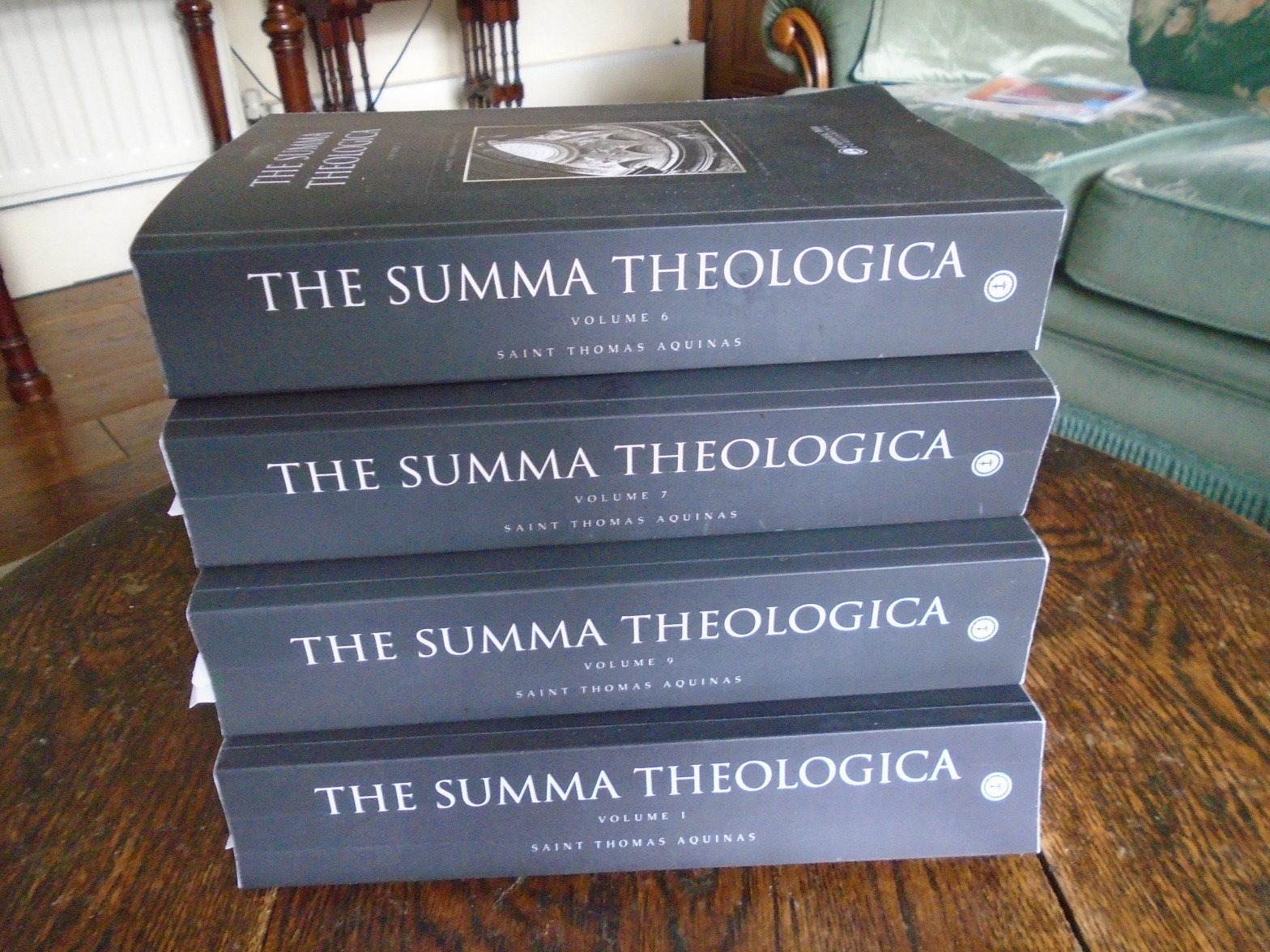
In Summa Theologica volumes 1 and 2 Aquinas discusses why certain phrases were employed by Moses in writing Genesis and what they actually signify. I, personally have derived great benefit from his insights as a basis to further reflection. However, this further reflection must be done in the light of modern science, not according to the science of the Middle Ages.
Thomas Aquinas believed that none of the Biblical authors erred in composing the Scriptures; if we have the wisdom to understand it, the truth becomes evident. The whole of his theology is based on the Bible and the actual words used. The works of Aquinas read as evangelical as any Protestant Evangelical writings, but he was writing nearly 300 years before the Reformation.
 Merry and True