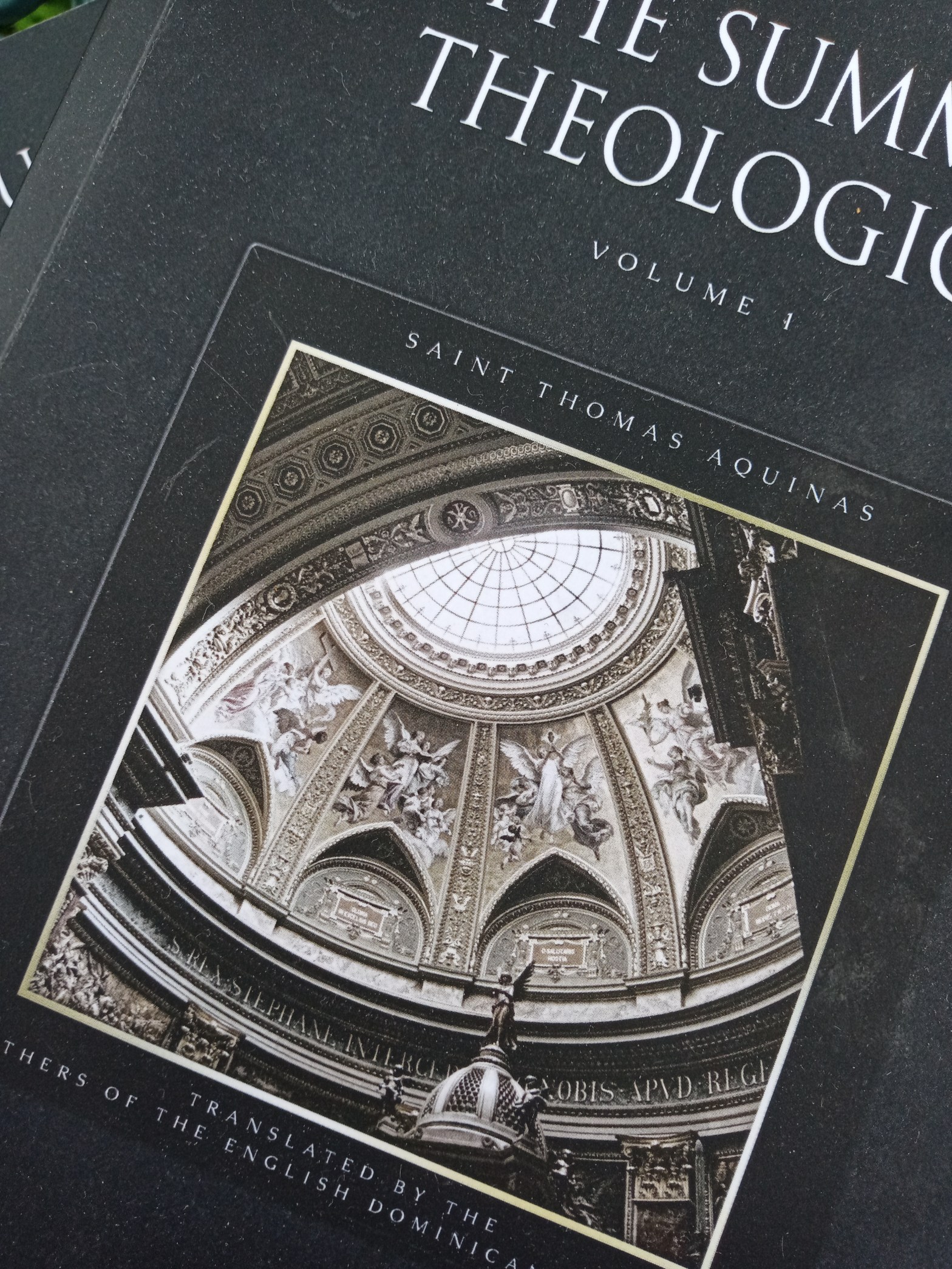
When William Shakespeare put this in his play Hamlet he was, of course, quoting Thomas Aquinas Summa Theologica Volume 2. Hamlet asks the skull of a man who has ceased to be whether it is better to live or die?
In the original reference Aquinas states that every contingent thing has in it something necessary. Contingency arises from matter. Things made of matter have in them the potentiality to be or not to be. [Page 219]
Shakespeare was quoting the following reference: Summa Theologica Volume 2: Treatise on man: What our intellect knows in material things: Whether our intellect can know contingent things?
Realism
The principle of identity – in the order of being (ontology) Aquinas states that everything is identical with itself. This signifies the unity of things. Ontologically something must either be or not be; it cannot both be and not be at the same time and in the same sense.
Most people find ontology difficult to follow, but they get the bit with the dialogue with the skull. They get that life is a difficult and painful business.
What is knowledge?
Thomas Aquinas’ thoughts culminate in the analysis of what thought is in itself. He reflects upon human thought and then upon God’s thoughts.
Human understanding is based on what can be perceived by the senses and captured in the imagination. The proper object of the human intellect is the ‘whatness’ or quiddity of the material thing. Aquinas is down-to-earth in being concerned about thoughts based on things that can be perceived.
The judgment of things is, however, based on innate first principles – principles infused into the human soul by God. We judge things through uncreated truth.
God is the efficient cause of all things. God is really related to creatures as their Creator, and their relationship with God is one of dependence. God knows his own essence and every creature as participating in his essence. Every creature has its own proper form in which it is like God. God knows the form or idea of every creature. In this way God both made the creature and knows the creature.
As human beings, we only know ourselves and are ourselves through God.
God thinks on a totally different level to us
God knows all things eternally at once. God knows things other than himself through himself. He knows them simultaneously and intuitively. God is omniscient.
 Merry and True
very true
LikeLike